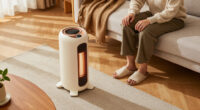
Use this guide to place, operate, and put away a portable space heater safely. It is for adults who have a residential electric heater and want to warm one room without creating a fire or electrical hazard. Setup takes about 10-15 minutes; warming the room takes longer and depends on its size and insulation.

Get home appliances delivered free with Prime
- Fast, free delivery on millions of items
- Prime Video, Amazon Music and more included
- Member-only deals all year

DREO Portable 1500W PTC Ceramic Space Heater with Thermostat
- ✔ Heating element: PTC ceramic
- ✔ Maximum heat output: 1500 W
- ✔ Stated coverage: 200 sq. ft.

WINHL 1500W Portable Ceramic Space Heater with 70° Oscillation
- ✔ Heating element: PTC ceramic
- ✔ Maximum power: 1500 W
- ✔ Oscillation: 70°

Amazon Basics Portable Ceramic Space Heater, 1500W, Black
- ✔ Heating element: Ceramic
- ✔ Power settings: High 1500 W; low 900 W; fan only
- ✔ Voltage and amperage: 120 V; 12.5 A
Difficulty: Beginner | Time: 10-15 minutes to set up; allow additional time for heating
What You’ll Need
Tools & Materials:
- Portable electric space heater with its manual and intact power cord
- Clear, level floor space near a suitable wall outlet
- Working smoke alarm in the area
Knowledge:
- Basic ability to inspect a cord and operate the heater’s controls
- Ability to identify the heater’s safety labels and manufacturer instructions
Use an electric heater designed for indoor residential use. Follow the instructions and safety labels for your model; they take precedence over general guidance. This guide does not cover fuel-burning heaters, which can produce carbon monoxide and require model-specific ventilation and safety procedures.
DREO Portable 1500W PTC Ceramic Space Heater with Thermostat
The DREO is the most adaptable pick in this group for someone who wants a compact heater to fit into a daily routine. Its 41°F–95°F thermostat range gives more precise target-setting than the two-speed heat controls on Amazon Basics, while its 34 dB listed noise level is lower than both the Amazon model’s 43 dB figure and the absence of a supplied noise figure for WINHL. Those details make DREO the clearest choice for a workspace or bedroom where both temperature adjustment and sound matter.Portability is part of its appeal: the heater weighs 3 pounds, measures 6.02 × 6.02 × 10 inches, and includes a carry handle. A remote, 12-hour timer, child lock, mute function, and memory function give it more convenience features than the simpler Amazon Basics unit. It also lists tip-over and overheat protection, flame-retardant materials, and a safety plug. The tradeoff is that more settings can be unnecessary if we only need a basic on/off heat source, and its stated coverage of 200 square feet should not be mistaken for a promise of even warmth in every layout. It is an indoor, corded appliance, and the supplied warranty information says “12” without specifying a unit. Compared with WINHL, DREO prioritizes quiet control and portability over oscillation.
Pros:
- Broad 41°F–95°F thermostat range and multiple operating modes
- Listed noise level of 34 dB and remote control
- Three-pound body with a carry handle
- Tip-over and overheat protection, plus child lock
Cons:
- Indoor use only and dependent on a suitable outlet
- Warranty information lists 12 without giving a unit
- No oscillation is specified, unlike WINHL
Best for: People who want adjustable supplemental warmth and a quiet, lightweight heater with a remote for an indoor workspace or bedroom.
Not ideal for: Buyers who need outdoor heating, a whole-home solution, or a clearly documented warranty duration.
Bottom line: We rank DREO first for combining quiet operation, fine thermostat control, and easy carrying in one compact supplemental heater.
“We rank DREO first for combining quiet operation, fine thermostat control, and easy carrying in one compact supplemental heater.”
WINHL 1500W Portable Ceramic Space Heater with 70° Oscillation
WINHL has the most distinct heat-distribution feature in this lineup: 70° oscillation. That makes it a better fit than the fixed-direction Amazon Basics heater when we want warmth to sweep across a desk-side area or other small space rather than stay aimed in one direction. Its 1500W PTC ceramic element, thermostat, ECO mode, five speeds, remote, and 12-hour timer also give it a useful set of adjustments. The remote needs two AAA batteries, which are not included.This is a tabletop supplemental heater, not a room-wide or whole-house answer. At 5.91 × 5.91 × 9.85 inches, it has a compact footprint, though its listed weight of 1.47 kg is heavier than the Amazon Basics model’s 2.8 pounds. DREO is the stronger choice when quietness and a wide thermostat range are priorities; WINHL instead gives us oscillation and a top temperature setting of 95°F. It lists overheat protection and tip-over shutoff and is described as ETL listed. The product information also says it must be plugged directly into a suitable wall outlet, so its convenience depends on outlet placement and a clear, appropriate location.
Pros:
- 70° oscillation helps move warmth across a small area
- Remote, thermostat, ECO mode, and 12-hour timer
- Five listed speeds and a 1500W PTC ceramic element
- Tip-over shutoff and overheat protection are listed
Cons:
- Designed for personal supplemental heat rather than whole-house use
- Remote requires two AAA batteries sold separately
- Must connect directly to a suitable wall outlet
Best for: Someone seeking a compact tabletop heater that can oscillate warmth across a small personal area and be adjusted by remote.
Not ideal for: People looking to heat a large room or whole home, or those who want a heater with included remote batteries.
Bottom line: We recommend WINHL when oscillation matters more than DREO’s quieter listed operation or Amazon Basics’ simpler controls.
“We recommend WINHL when oscillation matters more than DREO’s quieter listed operation or Amazon Basics’ simpler controls.”
Amazon Basics Portable Ceramic Space Heater, 1500W, Black
Amazon Basics is the most straightforward heater here. We get three useful choices—high at 1500W, low at 900W, and fan only—plus an adjustable thermostat. That makes its controls easier to scan than DREO’s more feature-rich interface and may suit someone who wants a compact source of supplemental warmth without a remote, timer, or multiple operating modes. At 2.8 pounds, it is the lightest listed option, slightly under DREO’s 3 pounds and lighter than WINHL’s 1.47 kg.The simpler setup comes with clear compromises. It does not oscillate, so unlike WINHL it directs heat from a fixed position. Its listed noise level is 43 dB, higher than DREO’s stated 34 dB. The product information also says it is not intended for bathrooms or other humid environments, which narrows where we should place it. Tip-over and overheat protection are included, but the supplied details do not identify a timer or remote. For someone who values direct settings and low weight, that restraint can be a benefit; buyers who want more exact thermostat control, quieter stated operation, or moving airflow should compare it with DREO or WINHL.
Pros:
- Three simple settings: high, low, and fan only
- Lightweight 2.8-pound design
- Adjustable thermostat
- Tip-over and overheat protection
Cons:
- Fixed direction with no oscillation
- Listed noise level is 43 dB, above DREO’s 34 dB
- Not intended for bathrooms or other humid environments
Best for: Buyers who want a lightweight indoor heater with basic high, low, and fan-only settings and an adjustable thermostat.
Not ideal for: Anyone who needs oscillation, a remote or timer, quieter listed operation, or heating in a humid environment.
Bottom line: We choose Amazon Basics for basic controls and low weight, while DREO and WINHL suit buyers who want more comfort features.
“We choose Amazon Basics for basic controls and low weight, while DREO and WINHL suit buyers who want more comfort features.”
As an Amazon Associate we earn from qualifying purchases.
Before You Start
Read the manual before plugging in the heater. Check that the smoke alarm works, and keep children and pets away from the setup area. Do not use a heater with a damaged cord, loose plug, cracked housing, missing parts, or signs of overheating. If the heater or outlet has been wet, do not use it until a qualified person has checked it.
Plan to supervise the heater while it runs. Do not use it while sleeping or leave it running unattended unless the manufacturer specifically permits that use and local fire-safety guidance allows it. Never use it to dry clothing or warm bedding.
Step-by-Step Instructions
Step 1: Choose a clear, level location
Place the heater upright on a firm, level, nonflammable floor where it cannot be knocked over. Keep it at least 3 feet (about 1 metre) from curtains, bedding, furniture, paper, clothing, and other combustible items, or farther if the manual requires it. Keep it out of doorways and walkways, and do not place it in a bathroom or other wet area unless the model is specifically rated for that location.
Tip:Do not set the heater on furniture, a rug that blocks its air openings, or a surface that can become hot or unstable. Keep its air intake and outlet unobstructed.
Check: The heater stands securely, has open space around it, and cannot be hit by a door or tripped over.
Step 2: Inspect the heater and outlet
Examine the casing, plug, and full length of the cord for cracks, fraying, bent prongs, scorch marks, or other damage. Check the outlet for looseness, discoloration, or heat damage. Stop and do not use the heater or suspect outlet if you find any of these signs; do not try to repair the heater with tape.
Tip:Stop using the heater if its plug becomes unusually hot, smells burnt, or sparks during normal connection. Disconnect power if you can do so safely.
Check: The heater, cord, plug, and outlet appear intact, with no burning smell or visible damage.
Step 3: Connect it directly to a wall outlet
Plug the heater directly into a suitable wall outlet, following the manual’s electrical requirements. Do not use an extension cord, power strip, timer, or multi-outlet adapter unless the manufacturer explicitly approves that exact setup. Route the cord away from foot traffic and heat, and do not put it under a rug.
Tip:Space heaters draw substantial power. Avoid sharing the outlet or circuit with other high-power appliances when possible, and follow any circuit limits in the manual.
Check: The plug is fully seated, the cord lies clear of traffic and heat, and no adapter or extension cord is in use.
Step 4: Set the controls before heating
Turn on the heater using the controls described in its manual. Select a low or moderate heat setting first, then adjust the thermostat gradually to a comfortable temperature. Use fan-only mode only as directed. Do not cover the heater or reach across its hot air outlet to adjust it.
Tip:Keep children from touching the controls or grille. The front and nearby surfaces can become hot even when the heater is operating normally.
Check: The heater starts without unusual noise, smoke, sparks, or smell, and warm air flows from the outlet.
Step 5: Monitor the room while it runs
Stay in the room or check the heater frequently while it is operating. Keep the area around it clear, and turn it off if the room becomes too warm or anyone feels unwell. Keep the heater away from flammable liquids and aerosol sprays. Do not use it near oxygen equipment; follow the equipment provider’s instructions where oxygen is present.
Tip:If the heater has a tip-over or overheat shutoff, treat that as a backup feature, not a substitute for safe placement and supervision.
Check: The heater remains upright and unobstructed, the cord and plug show no heat damage, and the room warms without alarms or unusual odors.
Step 6: Turn it off and let it cool
Switch off the heater using its control, then unplug it by gripping the plug rather than pulling the cord. If the manual specifies a cool-down period or fan cycle, follow it before unplugging. Leave the heater in its clear location until the grille and casing have cooled.
Tip:Do not move or store a hot heater. Keep hands, clothing, and combustible materials away from the grille until it is cool.
Check: The heater is switched off, disconnected as directed, and cool before anyone moves it.
Step 7: Store it in a dry, safe place
Wait until the heater is fully cool, then inspect it once more. Coil the cord loosely without sharp bends and store the unit in a dry spot where it cannot be crushed or knocked down. Keep it away from water, flammable materials, and children’s play areas. Repeat the placement, cord, and outlet checks before its next use.
Tip:Keep the manual with the heater so its electrical and clearance requirements are easy to find.
Check: The heater is cool, dry, unplugged, and stored without pressure on its cord or casing.
Common Mistakes to Avoid
- Placing the heater too close to curtains, furniture, or bedding. — Maintain at least 3 feet (about 1 metre) of clearance on all sides, or use the larger distance specified in the manual.
- Plugging the heater into an extension cord or power strip. — Connect it directly to a suitable wall outlet unless the manufacturer explicitly approves another arrangement.
- Leaving the heater running while asleep or away from home. — Turn it off when you leave the room or go to sleep, unless the manual and local fire-safety guidance explicitly allow supervised or scheduled operation.
- Using the heater to dry clothes or warm bedding. — Keep fabric and all other combustible items away from the heater and its airflow.
Troubleshooting
Problem: The heater does not turn on.
Solution: Switch it off and check that the plug is fully seated and the outlet works with a low-power device. Check the manual for a reset or tip-over shutoff procedure. If the outlet is warm, damaged, or still does not work, stop and contact a qualified electrician or the manufacturer.
Problem: The heater shuts itself off.
Solution: Turn it off and unplug it. Let it cool, then check that it is upright and its intake and outlet are clear. Follow the manual’s reset instructions. If it shuts off again, smells burnt, or makes unusual sounds, discontinue use and seek service.
Problem: The plug or outlet becomes hot, or you notice a burning smell.
Solution: Turn the heater off and unplug it if you can do so safely. Do not use that heater or outlet again until the cause has been checked by a qualified electrician or service provider. If you see smoke or fire, leave the area and call emergency services.
Problem: The room stays cold even though the heater runs.
Solution: Confirm that the heater is set to heat rather than fan-only mode and that its airflow is unobstructed. Close doors and windows if practical, while keeping the heater’s clearance area open. Use a heater rated for the room size; do not cover it or move it closer to combustible items.
What Success Looks Like
The heater is positioned upright on a stable floor with its required clearance, connected directly to an appropriate wall outlet, and operating without damage, unusual smells, smoke, or overheating. You remain able to monitor it. At the end of use, it is switched off, unplugged as directed, cool, and stored dry.
Next Steps
Repeat the cord, plug, outlet, and clearance checks each time you set up the heater. Clean dust from the unit only as the manual directs and only while it is unplugged and cool. Replace or service a damaged unit through the manufacturer or a qualified repair provider. If you need heat in several rooms, choose equipment designed and rated for that use rather than adding heaters to overloaded outlets.
Frequently Asked Questions
Can I leave a portable space heater on overnight?
Follow the heater’s manual and local fire-safety guidance. If either advises against overnight use, turn it off before sleeping. Keep the unit clear of bedding and curtains, and do not rely on automatic shutoff features as a replacement for safe use.
Can I use an extension cord with a space heater?
Use a direct wall connection unless the manufacturer specifically approves an extension cord for your model and states its required rating. Power strips and multi-outlet adapters are not suitable unless the instructions expressly say otherwise.
How far should a space heater be from furniture?
Keep at least 3 feet (about 1 metre) between the heater and combustible materials, including furniture, curtains, clothing, and bedding. Follow a greater clearance if the manual specifies one.
Why does my heater turn off after a short time?
It may have tipped, overheated, or reached its thermostat setting. Turn it off, unplug it, let it cool, and check that it is upright with clear airflow. Use the manual’s reset steps. Stop using it if the problem returns or you notice damage, smoke, or a burning odor.