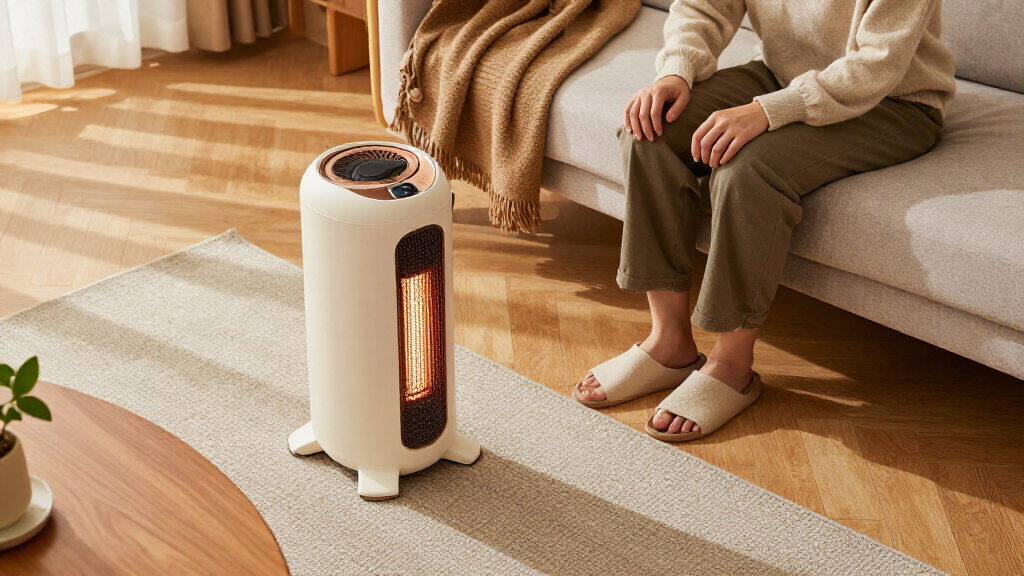

When comparing portable space heaters, the key choice is usually between a ceramic heater that delivers quick heat nearby and an oil-filled radiator that warms a room more gradually. Both types use electricity, and neither should be treated as a replacement for a properly sized heating system. The difference is how they deliver warmth: ceramic models suit short sessions at a desk or in a small chilly area, while oil-filled models are better for extended use where quiet, even heat matters. Choose based on how long you will run the heater, how often you need to move it, and whether fast heat or steady comfort matters more.

Get home appliances delivered free with Prime
- Fast, free delivery on millions of items
- Prime Video, Amazon Music and more included
- Member-only deals all year

DREO Portable 1500W PTC Ceramic Space Heater with Thermostat
- ✔ Heating element: PTC ceramic
- ✔ Heat output: 1500W
- ✔ Coverage listed: 200 sq. ft.

Amazon Basics Portable Ceramic Space Heater, 1500W, Black
- ✔ Heating element: Ceramic
- ✔ Power settings: High 1500W, low 900W, fan only
- ✔ Voltage and amperage: 120V; 12.5A

WINHL 1500W Portable Ceramic Space Heater with 70° Oscillation
- ✔ Heating element: PTC ceramic
- ✔ Power: 1500W
- ✔ Oscillation: 70°
At a Glance
| Criteria | Ceramic space heaters | Oil-filled radiator heaters | Winner |
|---|---|---|---|
| Heat-up speed | Usually warms the immediate area quickly | Takes longer to warm up and respond to adjustments | A |
| Long-session comfort | Direct warmth is useful nearby, but airflow may feel uneven | Provides gradual, steady warmth without a fan | B |
| Noise | Fan noise is common | Typically very quiet | B |
| Portability | Often compact and easy to carry | Bulky and heavy, often with wheels | A |
| Controls and features | Many models offer fan modes, thermostats, timers, or oscillation | Commonly includes a thermostat and basic controls; feature sets vary | A |
| Safety considerations | Look for tip-over shutoff, overheat protection, and cool-touch housing where available | Surface can become hot; tip-over and overheat protection vary by model | Depends |
| Value | Often a lower-cost choice for occasional spot heating | Can be worthwhile for quiet, extended room heating | Depends |
DREO Portable 1500W PTC Ceramic Space Heater with Thermostat
The DREO stands out as the most complete portable option in this comparison. Its 34 dB stated noise level is lower than the 43 dB listed for the Amazon Basics unit, which can matter when the heater sits beside a desk or reading chair. A carry handle and 3-pound weight also make it easy to shift between nearby indoor spots.Its controls give us more room to fine-tune comfort than the Amazon Basics model’s high, low and fan-only choices: DREO specifies a 41°F–95°F thermostat range, ECO mode, four speeds, a 12-hour timer and a remote. The child lock, mute and memory functions add convenience for households that want settings to persist. Compared with WINHL, it lacks the listed 70-degree oscillation, so warmth stays more directional. Its compact 6.02-inch square footprint helps with placement, but 1500W still makes it supplemental heat rather than a replacement for central heating.Safety provisions include tip-over and overheat protection, flame-retardant materials and a safety plug. The supplied warranty detail says “12” without a unit, leaving its duration unclear from the information provided. We would favor this model when quiet, adjustable personal heating matters more than oscillating airflow.
Pros:
- Listed 34 dB noise level is the quietest of these three
- Wide thermostat range with ECO, fan-only and multiple speed options
- Lightweight 3-pound design with carry handle and remote
- Tip-over, overheat and additional listed safety features
Cons:
- Does not list oscillation, unlike the WINHL model
- Warranty information gives “12” without specifying the unit
- Indoor supplemental heating only
Best for: People who want a quiet, lightweight heater with a remote and precise thermostat controls for a desk, bedroom or other indoor personal space.
Not ideal for: Buyers who need oscillating heat distribution, outdoor use or a clearly specified warranty term.
Bottom line: We recommend the DREO as the best balanced pick when quiet operation and adjustable controls outweigh the need for oscillation.
“We recommend the DREO as the best balanced pick when quiet operation and adjustable controls outweigh the need for oscillation.”
Amazon Basics Portable Ceramic Space Heater, 1500W, Black
Amazon Basics is the uncomplicated choice in this lineup. Its high, low and fan-only settings make the operating choices easy to understand, and at 2.8 pounds it is the lightest of the first two models by a small margin. For someone who wants basic spot warmth without a remote-centered control system, that simplicity can be a benefit.The tradeoff shows up when we compare it with DREO and WINHL. It has an adjustable thermostat, but the listed details do not give a precise thermostat range or timer, while DREO and WINHL specify broader control packages. It also has a fixed direction: unlike WINHL’s 70-degree oscillation, it will not sweep warmth across a wider personal area. Its listed 43 dB noise level is higher than DREO’s stated figure, so it is a less compelling fit for quiet work or sleep-adjacent use.The model includes tip-over and overheat protection and measures 7.52 × 6.34 × 9.45 inches. It is explicitly not intended for bathrooms or other humid environments. We would pick it for a small indoor spot where basic settings matter more than a timer, remote, oscillation or extensive temperature control.
Pros:
- Three clear settings: high, low and fan only
- Compact and lightweight at 2.8 pounds
- Adjustable thermostat
- Tip-over and overheat protection are listed
Cons:
- Non-oscillating design keeps heat directed in one area
- Listed 43 dB noise level is above DREO’s stated 34 dB
- Not intended for bathrooms or other high-moisture environments
Best for: Buyers seeking a lightweight indoor heater with straightforward high, low and fan-only settings for occasional spot warmth.
Not ideal for: People who want oscillation, a remote, a stated timer, especially quiet operation or a heater suitable for humid rooms.
Bottom line: We’d choose Amazon Basics for uncomplicated spot heating, provided fixed airflow and limited listed controls fit the use case.
“We’d choose Amazon Basics for uncomplicated spot heating, provided fixed airflow and limited listed controls fit the use case.”
WINHL 1500W Portable Ceramic Space Heater with 70° Oscillation
WINHL’s defining advantage is 70-degree oscillation. If we want warmth to move across a small desk area or between nearby seats, its sweeping airflow offers a clear distinction from the fixed-direction Amazon Basics heater and the non-oscillating DREO. The 1500W PTC ceramic element, thermostat, ECO mode and five speeds provide several ways to adjust operation, and a remote plus 12-hour timer make it convenient to manage from across the room.This is still a tabletop supplemental heater, not a whole-house solution. The product description frames it for small rooms and personal spaces, so buyers should keep expectations centered on nearby comfort. Its 1.47 kg weight is above the DREO’s 3 pounds, and the listed maximum temperature setting is 95°F. The remote requires two AAA batteries that are not included, a small setup detail absent from the DREO’s supplied remote information.WINHL lists overheat protection, tip-over shutoff and ETL listing, while also specifying that the heater must plug directly into a suitable wall outlet. Compared with DREO, it trades the lower stated noise level and lighter carry weight for moving airflow. We see it as the better fit where distribution across a personal area matters more than minimum weight or quietness.
Pros:
- 70-degree oscillation spreads airflow across a wider area
- Remote, thermostat, ECO mode and 12-hour timer
- Five speeds offer more airflow choices than the Amazon Basics model
- Overheat protection, tip-over shutoff and ETL listing
Cons:
- Designed for supplemental personal heating, not whole-house use
- Remote requires two AAA batteries, sold separately
- Must plug directly into a suitable wall outlet
Best for: People who want oscillating airflow, remote control and a timer while warming a small personal or tabletop area.
Not ideal for: Buyers expecting whole-room or whole-house heating, those prioritizing the lightest carry option, or anyone who needs included remote batteries.
Bottom line: We’d choose WINHL when oscillation is the priority and a tabletop supplemental heater suits the space.
“We’d choose WINHL when oscillation is the priority and a tabletop supplemental heater suits the space.”
As an Amazon Associate we earn from qualifying purchases.
Key Differences
The practical distinction is quick, directed heat versus slower, sustained warmth. A ceramic heater’s fan pushes heated air into the nearby space, so a person at a desk may feel warmer soon after switching it on. That speed is useful when the room is only briefly occupied. The fan also means some noise and airflow, and the warmth may be less even across a larger room.
An oil-filled radiator takes time to heat, but it does not rely on a fan to distribute warmth. That makes it a better fit for quiet rooms and longer sessions, especially when a gradual rise in temperature is acceptable. It remains warm for a time after being turned off, though that does not make it more energy efficient by itself. Both types convert electricity to heat, and running cost depends mainly on power draw, runtime, thermostat cycling, and local electricity rates.
Neither style is automatically safer or cheaper to operate. Features and build quality vary between models. Keep either heater away from bedding, curtains, furniture, and walkways; plug it directly into a wall outlet; and follow its manual. The best choice is the one that suits the room and usage pattern, with safety features and suitable placement treated as part of the purchase.
Detailed Comparison
Heat-up speed (Ceramic space heaters wins — moderate)
Ceramic heaters generally win for immediate warmth: the fan starts moving heated air into the nearby area quickly. Oil-filled radiators warm more slowly and take time to respond when you change the setting. This is a moderate, noticeable gap for brief visits to a cold room; for an all-evening session, the wait matters less.
Long-session comfort (Oil-filled radiator heaters wins — moderate)
Oil-filled radiators usually provide the steadier-feeling warmth of the two, without a fan blowing air around. Ceramic models can be effective when aimed at a nearby person, but their warmth is more dependent on airflow and position. The advantage is moderate for an occupied bedroom or living area, but smaller when you only need to warm your hands or feet briefly.
Noise (Oil-filled radiator heaters wins — major)
Oil-filled radiators win clearly because they operate without a heating fan. Ceramic heaters commonly make audible fan noise, though the level depends on the model and setting. This is a major practical difference for light sleepers, quiet work, or calls; for a busy room, it may be minor.
Portability (Ceramic space heaters wins — moderate)
Ceramic heaters are generally lighter and easier to carry between rooms. Oil-filled models are usually larger and heavier, though wheels on some units help move them across a floor. This is a moderate advantage for people who put the heater away after each use or need to move it often. Neither should be carried while hot.
Controls and features (Ceramic space heaters wins — minor)
Ceramic heaters often offer more variety, such as oscillation, fan-only modes, timers, and multiple heat settings. Oil-filled models tend to focus on thermostat control and straightforward operation. The gap is minor if you only need an on/off control and a temperature setting; check the individual model, since features are not guaranteed by heater type.
Safety considerations (minor difference)
There is no blanket winner. Ceramic models can have hot outlets or heated surfaces, while oil-filled radiators have a large surface that can become hot and a heavier body that can tip. Either type may include tip-over shutoff and overheat protection, but availability and implementation vary. Compare the specific unit’s safety features and follow clearance and outlet instructions. The difference is minor between categories and more meaningful between individual models.
Value (moderate difference)
Ceramic heaters often cost less upfront and deliver better value when used for short, occasional spot heating. Paying more for an oil-filled model can make sense when quiet operation and sustained warmth are priorities. Neither type guarantees lower electricity bills: operating cost is driven chiefly by wattage, runtime, thermostat behavior, and electricity prices. The winner depends on how you will use it.
Ceramic space heaters: Pros and Cons
Pros:
- Quick warmth for a nearby person or small area
- Usually compact and easy to move
- Often has a lower purchase price
- Frequently offers several operating modes
Cons:
- Fan noise may disturb sleep or quiet work
- Warmth can feel directed or uneven
- Air movement may be unwelcome to some users
- Features and safety protections vary by model
Oil-filled radiator heaters: Pros and Cons
Pros:
- Quiet operation suits bedrooms and focused work
- Steady warmth can be comfortable during longer sessions
- No fan pushing air around
- Some models have wheels for moving on level floors
Cons:
- Slow to heat up and respond to adjustments
- Often heavier and harder to store
- Hot surfaces require careful placement
- Can cost more upfront without lowering electricity use automatically
Who Should Choose What
Choose Ceramic space heaters if:
- You need quick warmth at a desk or in a small area for short periods.
- You expect to carry the heater between rooms or store it between uses.
- You want a lower upfront cost and can tolerate fan noise.
Choose Oil-filled radiator heaters if:
- You want quiet heat for a bedroom, study, or other calm space.
- You expect longer sessions and prefer gradual, steady warmth.
- You are willing to pay more or accept a heavier unit for fan-free operation.
Skip both if: You need to heat a large, open, or poorly insulated home as your main heating source; use an appropriately sized fixed heating system or seek qualified advice.
Value for Money
Ceramic heaters are usually the better value when the job is occasional, localized heat: they warm the nearby area quickly, are easier to move, and often cost less to buy. An oil-filled radiator earns its higher price when quieter operation and steady warmth matter during long stretches of use. That premium buys a different comfort profile, not guaranteed energy savings. Since both rely on electricity, compare wattage and expected runtime, and use a thermostat sensibly. A costly model is poor value if its quiet operation or longer-session comfort will rarely matter to you.
Final Verdict
For most people seeking quick, occasional warmth in one spot, choose a ceramic heater: it is faster, lighter, and usually less expensive. Choose an oil-filled radiator when quiet, sustained warmth is worth waiting for and the unit can stay in one place. The biggest deciding factor is your typical session: short and mobile favors ceramic; long and quiet favors oil-filled. Pay more for the radiator only if that quieter comfort will improve how you use the room.
Frequently Asked Questions
Which portable heater warms a room faster?
A ceramic heater generally provides heat sooner because its fan moves warmed air into the area. An oil-filled radiator needs more time to warm up, so it is less suited to quick, short visits.
Which type is quieter for a bedroom?
An oil-filled radiator is usually quieter because it does not use a fan. Check the specific model for indicator lights or control sounds if those could disturb sleep.
Does an oil-filled heater cost less to run?
Not automatically. Both use electricity, and cost depends on wattage, runtime, thermostat cycling, and your electricity rate. Compare the power ratings and how long you expect to run each heater.
Which heater is easier to move?
Ceramic heaters are usually lighter and more compact. Oil-filled radiators can be heavy, though some have wheels. Switch off and let either heater cool before moving it.
What safety features should I check?
Look for tip-over shutoff and overheat protection, then follow the manufacturer’s instructions for clearance and outlet use. Keep the heater away from fabric and furniture, and never cover it.