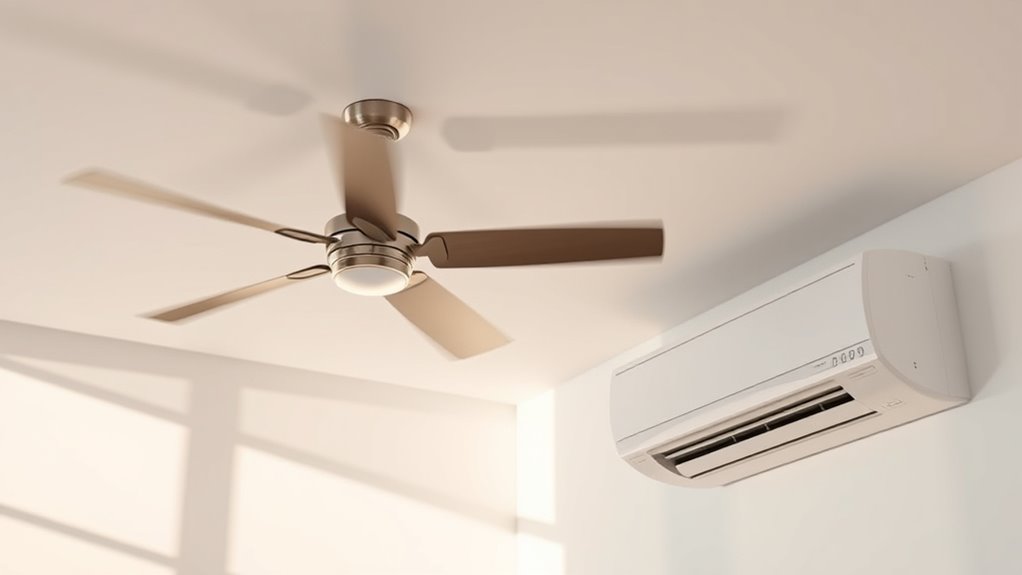

To maximize efficiency, run ceiling fans counterclockwise at high speed during cooling, which enhances the cooling effect and allows you to raise your thermostat setting on the air conditioner by about 4°F. Always turn off fans when the AC isn’t running to prevent circulating warm air. Proper placement, regular maintenance, and synchronized operation—using timers or switches—ensure both devices work together effectively. Continuing with advanced strategies can further optimize comfort and energy savings.
Open a free Amazon Business account
Business pricing, bulk buying and tax-exempt orders.
As an affiliate, we earn on qualifying purchases.
Key Takeaways
- Coordinate ceiling fan and AC operation by running fans only when the AC is on to save energy.
- Set ceiling fans to rotate counterclockwise at high speed to enhance cooling efficiency and comfort.
- Use fans to increase perceived coolness, allowing higher thermostat settings on the AC, reducing energy consumption.
- Regularly maintain and clean fans and filters to ensure optimal airflow and heat exchange efficiency.
- Position ceiling fans properly, ideally centrally with appropriate downrod length, to maximize air circulation and cooling effectiveness.
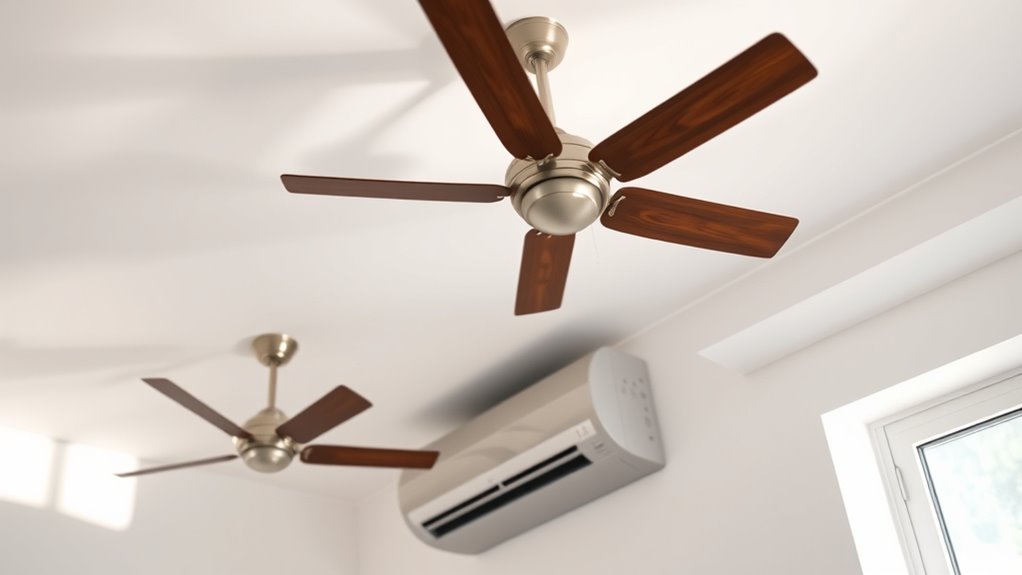
Ceiling fans and air conditioners are essential tools for maintaining comfortable indoor temperatures, especially during hot weather. To maximize their efficiency when used together, understanding their complementary functions and ideal operation strategies is critical. Ceiling fans do not lower room temperature but create a breeze that enhances the body’s cooling process via evaporation, which can make a room feel cooler without reducing the actual air temperature. Conversely, air conditioners actively lower the ambient temperature by removing heat and humidity from the air. When used in tandem, these devices can achieve energy savings and improved comfort levels if properly coordinated.
Ceiling fans create a cooling breeze, while air conditioners lower indoor temperatures—using both efficiently enhances comfort and saves energy.
The key to maximizing efficiency is understanding the airflow dynamics and control mechanisms. During the cooling season, set the ceiling fan to rotate counterclockwise at high speed, directing airflow downward to create a wind-chill effect. This circulation increases the perceived coolness, allowing you to raise the thermostat setting on the air conditioner by approximately 4°F without sacrificing comfort. This adjustment reduces the load on the AC unit, decreasing energy consumption and operational costs. In warmer months, ensure that the ceiling fan is turned off when the air conditioner is not operating, as circulating warm air does not contribute to cooling and can increase the cooling load when the AC is turned on.
Another critical aspect involves the timing and synchronization of device operation. Use programmable thermostats and fan switches to automate the process, ensuring that the fan runs only when the air conditioner is active. This prevents unnecessary energy expenditure and reduces wear on both devices. Additionally, proper maintenance—such as cleaning fan blades and replacing filters—ensures ideal airflow and heat exchange efficiency. Dirty filters or dusty blades impair performance, forcing the AC to work harder and consume more energy.
Proper placement of ceiling fans is also essential. Fans should be installed centrally in the room for uniform airflow distribution. In rooms with high ceilings, use longer downrods to position the fan blades at an ideal height, typically 8 to 9 feet above the floor, to maximize air circulation. When cooling, avoid reversing the fan direction to clockwise, as this circulates warm air near the ceiling, reducing overall effectiveness.
Finally, consider the thermal environment and external factors such as sunlight exposure and insulation. Using window treatments and sealing leaks can reduce heat gain, lessening the workload on both ceiling fans and air conditioners. Additionally, using energy-efficient cooling appliances can further enhance savings and performance. By integrating these technical considerations, you can optimize the combined use of ceiling fans and air conditioners, achieving significant energy savings while maintaining a consistent, comfortable indoor climate.
As an affiliate, we earn on qualifying purchases.
Frequently Asked Questions
Can Ceiling Fans Help Reduce Air Conditioner Energy Costs?
Yes, ceiling fans help reduce air conditioner energy costs by circulating cooled air more efficiently. By creating a wind-chill effect, fans allow you to set the thermostat higher without sacrificing comfort. This decreases the workload on your AC unit, lowering energy consumption. Properly positioned fans can enhance overall cooling efficiency, especially in well-insulated spaces. Using fans in conjunction with your air conditioner optimizes energy use and minimizes operational costs.
What Is the Ideal Ceiling Fan Speed for Cooling Efficiency?
You should set your ceiling fan to around 3 to 4 speed for ideal cooling efficiency. While higher speeds circulate air faster, they can create discomfort and unnecessary energy consumption. Lower speeds may not provide enough airflow, reducing cooling benefits. The ideal balance uses medium speed, which maximizes air movement without excess noise or energy use, helping you stay comfortable while saving on energy costs.
Do Ceiling Fans Work Effectively in Large or Open Spaces?
Ceiling fans can work effectively in large or open spaces when you select a model with high airflow capacity (CFM) and appropriate blade size. Make certain the fan’s motor is powerful enough to circulate air evenly across the area. Proper placement is essential; install the fan centrally and at an ideal height. Using a fan with adjustable speeds allows you to maximize airflow based on room size and cooling needs, maximizing efficiency.
How Should I Position Ceiling Fans With Air Conditioners for Optimal Comfort?
Position your ceiling fan directly opposite your air conditioner’s vents to promote proper circulation. Make certain your fan’s blades are angled to create a consistent breeze that complements the AC’s cooling. Keep the fan on a medium speed to avoid drafts, and set it to rotate counterclockwise in summer for ideal airflow. Proper positioning prevents temperature stratification, maximizes cooling efficiency, and maintains a comfortable climate with minimal energy expenditure.
Are There Specific Ceiling Fan Features That Enhance Air Conditioning Performance?
Choose ceiling fans with reversible motors to switch blade direction seasonally, enhancing airflow efficiency. Select fans with high CFM (cubic feet per minute) ratings to maximize air circulation, reducing the workload on your air conditioner. Features like adjustable speed settings, quiet operation, and energy-efficient motors also improve performance. Properly sized fans tailored to room dimensions guarantee ideal airflow, helping your air conditioning system work more effectively and reducing energy costs.
Conclusion
By pairing ceiling fans with air conditioners, you optimize overall efficiency, reduce energy consumption, and enhance comfort. This synergy smoothly sustains a cooler climate, saving costs and conserving power. When used wisely, fans and ACs collaboratively create a controlled, consistent comfort zone, curbing unnecessary cooling and cutting costs. Maximizing their mutual efficiency transforms your space into a smart, sustainable sanctuary, proving that strategic synergy markedly boosts comfort while balancing budget and environmental impact.
Fall Picks
fall essentials
As an affiliate, we earn on qualifying purchases.