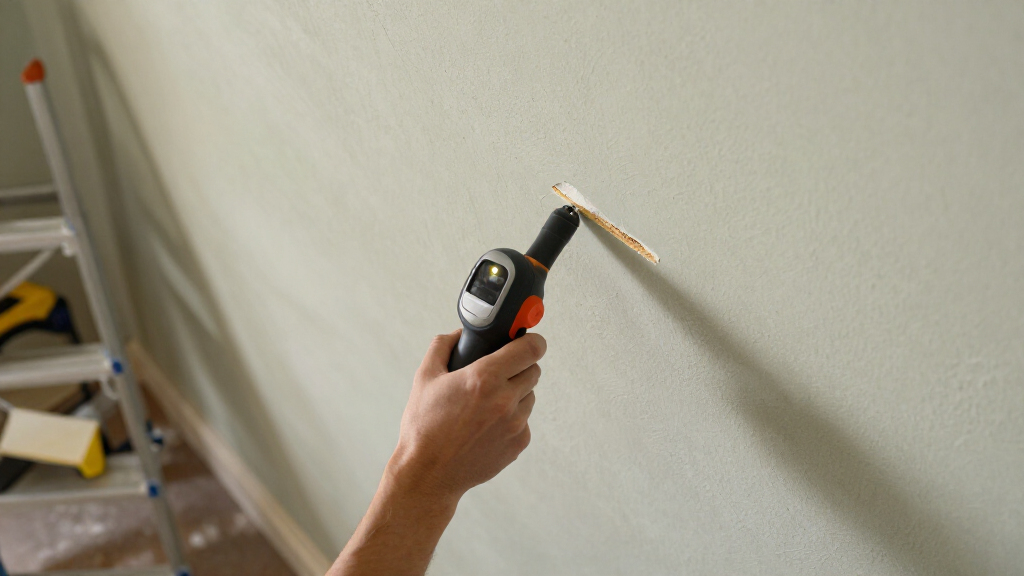

TL;DR
Pro Tool Reviews tested six stud finders on a mock-up that included lath-and-plaster construction. The Franklin ProSensor M210/X2100 detected the center of every tested stud and detected live AC, while the M70/X700 avoided missed and false stud readings but did not locate centers as often. The results come from one test setup, and the leading model also produced false stud indications.
Pro Tool Reviews tested six stud finders on a mock-up containing lath and plaster and found that the Franklin ProSensor M210/X2100 detected the center of every stud in its test, while the Franklin M70/X700 offered a less expensive alternative with no missed or false stud readings. The results show that tools can perform differently on plaster than on common drywall, but even the top-rated model returned false stud indications, so the report recommends taking repeated readings.

Get home appliances delivered free with Prime
- Fast, free delivery on millions of items
- Prime Video, Amazon Music and more included
- Member-only deals all year
For the plaster section, the M210/X2100 recorded 100% on-center detection, with no missed studs and no readings that marked a stud edge as its center. It also recorded 100% AC detection in the tests. However, the tester reported a 33% false-stud detection rate, meaning the tool sometimes indicated another object as a stud. The report listed a price of $59.99.
The Franklin M70/X700 recorded 67% on-center detection and 33% off-center detection, with no missed studs or false stud detections in the test. It does not have AC detection, according to the report, and was listed at $21.99. Pro Tool Reviews described it as its editor’s choice, citing its lower price and absence of missed or false stud readings despite its lower center-detection result.
Two other models in the supplied results were the Zircon HD70 and JAXWQ 139-FYELLOW. Zircon recorded 67% on-center detection, 7% missed studs and 47% false stud detection; JAXWQ recorded 60% on-center detection, 7% missed studs and 33% false stud detection. Both recorded 50% AC detection. The report says it tested six models, but the source material provided here does not include the remaining two models’ results.
Choosing a Finder for Plaster
The results matter to people mounting shelves, cabinets or televisions in older homes, where lath-and-plaster walls can be thicker and harder for electronic sensors to read than drywall. A mistaken location can lead to a failed fastener or an unnecessary hole; when drilling or cutting, an incorrect reading can also mean encountering wiring or plumbing. The test suggests that a higher on-center score does not remove the need to check readings against the wall and the intended work.
The comparison also makes the trade-off between the two recommended Franklin models clearer. The M210/X2100 had the stronger center-location result and detected live AC in this test, but it also produced false stud indications. The M70/X700 cost less and had no false stud indications in the test, but it does not detect AC and marked the center less often. These are results from the report’s test setup, not a guarantee of performance in every home or wall.
Products Worth Considering

Ring Battery Doorbell (2nd Gen) and Floodlight Cam Plus Wired Bundle, Speckled Gray and White

Roborock Q7 M5+ Robot Vacuum and Mop

Dyson V15 Detect Cordless Vacuum
As an affiliate, we earn on qualifying purchases.
How the Plaster Test Worked
Pro Tool Reviews says Tom Gaige built a mock-up with sections of single-layer drywall, double-layer drywall and lath and plaster, leaving gaps so testers could see what was behind each surface. The targets included standard studs, studs with live AC, metal studs, electrical conduit with live AC, PVC pipe and water-filled copper pipe. The supplied results focus on performance in the plaster section.
The tester used repeated passes from different sides, allowing the devices to reset or recalibrate, then compared readings. The report defines on-center detection as the share of times a tool correctly identified a stud’s center; it separately records off-center readings, missed studs, false stud detections and AC detection. The author notes that older framing may vary and that stud spacing in lath-and-plaster walls can be inconsistent, so measuring from one assumed stud location may not be dependable.
“Only one nailed the center of every stud.”
— Pro Tool Reviews report
Limits of the Test Results
The supplied report material does not give the total number of attempts behind each percentage, the publication date, or full results for all six tested models. It also does not establish whether the mock-up represents the range of plaster thicknesses, lath materials, repairs and framing found in occupied homes. The prices are those listed in the report and may not reflect current retail prices.
The percentages should not be read as a prediction that a finder will perform the same way on every wall. The M210/X2100’s 33% false-stud rate is reported without a breakdown here of which objects triggered those readings. The test also does not establish that a stud finder’s AC alert can identify every wire or make drilling safe. Users should treat readings as indications, not proof of what is inside a wall.
Verify Before Drilling
The report’s practical next step is to repeat readings from both directions and compare the marks rather than relying on one scan. If readings disagree, or a supposed stud behaves differently from neighboring ones, the tester advises checking further; the report notes that pipes and other objects can produce false stud indications. Readers comparing models should also check current specifications and prices, particularly whether AC detection is included.
Anyone planning to drill, cut or undertake electrical work should take appropriate safety precautions and follow applicable code and permit requirements. A stud finder reading alone cannot verify that an area is free of wiring, plumbing or other hazards; seek a qualified professional when the work or wall contents are uncertain. The source material gives no further testing schedule or announced follow-up, so whether Pro Tool Reviews will publish the omitted models’ results or additional testing remains unknown.
Key Questions
Which model performed best at locating stud centers in the test?
The Franklin ProSensor M210/X2100 recorded 100% on-center detection in Pro Tool Reviews’ lath-and-plaster test. It also had a 33% false-stud detection rate, so the report advises taking repeated readings.
Was the less expensive Franklin M70/X700 accurate?
It recorded 67% on-center detection, with no missed studs or false stud detections in this test. The report listed it at $21.99 and notes that it does not detect AC.
Can a stud finder reading confirm that a wall is safe to drill?
No. The test reports how often tools detected studs and live AC in a mock-up; it does not establish that a particular wall is free of wires, pipes or other hazards. Treat readings as indications and seek qualified help if the contents are uncertain.
Why did the report recommend taking multiple readings?
Plaster construction can be difficult for sensors, and the top-performing model still produced false stud indications. The tester recommends scanning from opposite sides and comparing marks to improve confidence in the location.
Source: rss