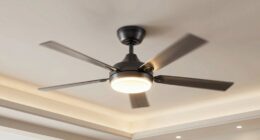
Ceiling fans are more environmentally friendly than air conditioners because they consume markedly less energy, leading to lower greenhouse gas emissions. They promote energy conservation by reducing reliance on power-hungry cooling systems and have simpler manufacturing processes with fewer refrigerants, which contribute to global warming. While effective in moderate climates, their environmental benefits become even clearer when used thoughtfully. To explore how these factors impact sustainability further, consider the details behind their efficiency and lifecycle advantages.
Key Takeaways
- Ceiling fans consume significantly less energy than air conditioners, reducing greenhouse gas emissions.
- They have simpler designs and fewer refrigerants, leading to lower lifecycle environmental impacts.
- Using ceiling fans allows higher thermostat settings, decreasing overall electricity demand.
- Air conditioners rely on energy-intensive compressors and potent refrigerants that contribute to global warming.
- Ceiling fans promote sustainable cooling, especially in moderate climates, by supporting energy conservation efforts.

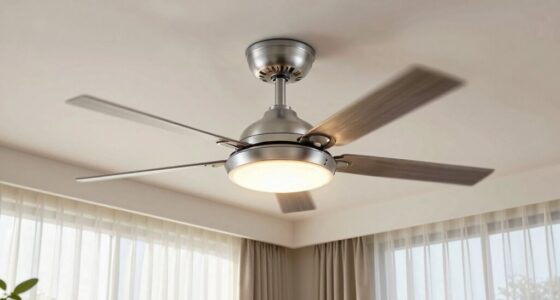
When evaluating the environmental impacts of cooling systems, ceiling fans emerge as a more sustainable alternative to air conditioners due to their lower energy consumption and reduced greenhouse gas emissions. Unlike air conditioning units, which rely on refrigeration cycles driven by electrically powered compressors, ceiling fans operate through simple mechanical motion, circulating air to create a cooling sensation without markedly altering indoor temperatures. This fundamental difference means that ceiling fans typically consume between 15 and 75 watts, whereas air conditioners often draw 1,000 to 2,500 watts or more during operation. Consequently, the energy footprint of ceiling fans is considerably smaller, translating into lower carbon emissions associated with electricity production.
Ceiling fans use significantly less energy than air conditioners, reducing carbon emissions and environmental impact.
From an environmental perspective, the impact of manufacturing and disposing of these devices also favors ceiling fans. Ceiling fans generally have fewer complex components, such as compressors, refrigerants, and electronic controls, which reduces resource extraction and manufacturing emissions. Additionally, refrigerants used in air conditioners, particularly hydrofluorocarbons (HFCs), are potent greenhouse gases with high global warming potential. Although modern units may use more environmentally friendly refrigerants, leaks and end-of-life disposal still pose substantial risks for atmospheric greenhouse gas release, exacerbating climate change. Ceiling fans, by contrast, do not depend on refrigerants, making their lifecycle emissions inherently lower and less environmentally risky.
Furthermore, ceiling fans support energy conservation strategies by enabling households to maintain comfortable indoor conditions with minimal energy input. During moderate weather, they can effectively promote air circulation, reducing reliance on air conditioning and allowing for higher thermostat settings. This synergy not only diminishes electricity demand but also extends the lifespan of more energy-intensive cooling systems. When integrated into an energy-conscious design, ceiling fans contribute to a holistic approach for reducing carbon footprints.
However, it’s important to recognize that ceiling fans are most effective in specific climates and conditions. In extremely hot or humid environments, they may only provide a perceived cooling effect, leading users to revert to air conditioning for comfort. From an environmental standpoint, this underscores the need for contextual application of cooling solutions. Nonetheless, in temperate climates or during milder seasons, their low energy requirements make ceiling fans a pragmatic choice for reducing overall energy consumption.
energy-efficient ceiling fans
As an affiliate, we earn on qualifying purchases.
As an affiliate, we earn on qualifying purchases.
Frequently Asked Questions
How Do Ceiling Fans Impact Indoor Air Quality?
Ceiling fans improve indoor air quality by promoting air circulation, which helps disperse indoor pollutants and reduce stagnant air. Unlike air conditioners that recirculate the same air, fans facilitate the exchange of indoor and outdoor air when windows are open, diluting indoor contaminants. This continuous movement minimizes mold growth and dust accumulation, creating a healthier environment. By reducing reliance on energy-intensive cooling systems, ceiling fans also lower overall environmental impact.
Are Ceiling Fans Suitable for Large or Open Spaces?
Sure, ceiling fans are great, but when it comes to large or open spaces, they’re like trying to tame a tornado with a feather. You’ll need multiple fans or larger industrial models, which can increase energy consumption and reduce their eco-friendly appeal. For truly expansive areas, consider integrating ventilation systems or energy-efficient HVAC options to maintain sustainable indoor climates without the fanfare of overwork.
How Do Ceiling Fans Compare in Initial Setup Costs?
Ceiling fans generally have lower initial setup costs compared to air conditioners. You’ll spend less on purchasing and installing a fan, as it requires minimal wiring and hardware. In contrast, air conditioners involve complex installation, refrigerant handling, and electrical work, increasing upfront expenses. Opting for ceiling fans reduces your carbon footprint by consuming less energy initially, making them a more sustainable choice for eco-conscious setups and long-term savings.
Can Ceiling Fans Be Used Outdoors Effectively?
Like a sturdy lighthouse guiding ships safely, your outdoor ceiling fan can effectively improve comfort. Designed for outdoor use, it withstands moisture and temperature fluctuations, ensuring energy-efficient cooling without excessive power consumption. Its strategic placement reduces reliance on air conditioning, lowering energy use and emissions. By choosing an outdoor-rated ceiling fan, you promote sustainable living, leveraging renewable energy benefits and reducing your carbon footprint while enjoying a reliable, eco-conscious cooling solution in open-air spaces.
Do Ceiling Fans Consume Less Electricity Than Portable Fans?
Yes, ceiling fans generally consume less electricity than portable fans. Ceiling fans operate at lower wattages, typically between 60-75 watts, and distribute airflow efficiently across a wider area, reducing energy use. Portable fans often require higher wattages (around 90-120 watts) for similar cooling. Choosing ceiling fans over portable fans minimizes energy consumption, lowering your carbon footprint, and promotes environmentally sustainable cooling practices by reducing overall electricity demand.

Conciseer Modern 42 Inch Ceiling Fans with Lights and Remote, Bedroom Living Room Office, Flush Mount, 18W 3CCT Dimmable, Dual Color 3 Blades 6 Speed Reversible Quiet DC Motor, Black/Wood Grain
Stylish & Energy-Saving Design: This 42-inch Conciseer fan blends retro charm with modern simplicity. Its dual-color blades (Black/Wood…
As an affiliate, we earn on qualifying purchases.
As an affiliate, we earn on qualifying purchases.
Conclusion
Choosing ceiling fans over air conditioners markedly reduces energy consumption and greenhouse gas emissions, making them a greener option for cooling. Ceiling fans use far less electricity, acting as the lightweight champion in your sustainability arsenal, whereas air conditioners are the heavyweight contenders. By opting for ceiling fans, you’re not just saving on energy bills but also helping to diminish your carbon footprint, contributing to a healthier planet—because every small action is like a drop in the ocean of environmental impact.

SHLUCE 19" Farmhouse Flush Mount Caged Ceiling Fans with Lights, Fandelier Rustic Low Profile Ceiling Fan with Light and Remote, Small Bladeless Ceiling Fans with Lights for Kitchen, Bedroom – ETL
⏲️【Remote Control and 4-Lights Socket】The flush mount ceiling fan with 4 E26 light socket (bulbs not included) and…
As an affiliate, we earn on qualifying purchases.
As an affiliate, we earn on qualifying purchases.

Amico Ceiling Fans with Lights, 42 inch Low Profile Ceiling fan with Light and Remote Control, Flush Mount, Reversible, 3CCT, Dimmable, Noiseless, Black Ceiling Fan for Bedroom, Indoor/Outdoor Use
Ceiling Fan with Light: Decorate your home with Amico ceiling fan! While bringing you coolness and comfort, it…
As an affiliate, we earn on qualifying purchases.
As an affiliate, we earn on qualifying purchases.