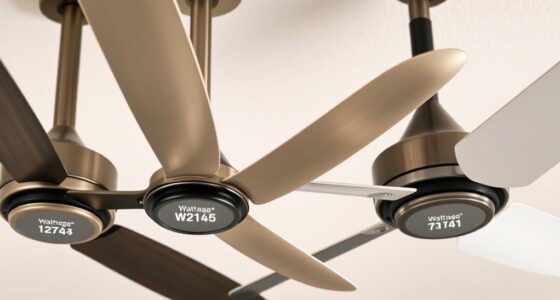
CFM per watt measures your HVAC system’s airflow efficiency relative to its energy use, indicating how much airflow you get per unit of power consumed. Higher values mean better efficiency, as your system moves more air while using less energy. Factors like static pressure and operating conditions affect this metric, making it vital to analyze performance across different scenarios. To optimize system performance and energy savings, understanding the nuances of CFM per watt is essential; exploring further will reveal how to enhance efficiency effectively.
Key Takeaways
- CFM per Watt measures how effectively a device moves air relative to its energy consumption.
- Higher CFM per Watt indicates better energy efficiency in airflow systems.
- It is calculated by dividing airflow (CFM) by power consumption (Watts).
- Factors like static pressure and operating conditions influence this metric’s accuracy.
- Using CFM per Watt helps compare and optimize HVAC and ventilation system performance.

How do we accurately evaluate a system’s energy performance? To determine this, you must analyze how efficiently a system converts electrical energy into useful work, often through quantifiable metrics that provide a clear comparison across different devices or configurations. One such metric is CFM per watt, which offers a precise measure of airflow efficiency relative to power consumption. This ratio enables you to assess how effectively a system moves air in relation to the energy it consumes, serving as a vital indicator for optimizing HVAC performance, ventilation systems, and other airflow-dependent applications.
CFM, or cubic feet per minute, quantifies the volumetric airflow delivered by a system, while watts measure the electrical power input required to sustain that airflow. By calculating the CFM per watt ratio, you essentially normalize airflow output to energy input, allowing for direct comparisons between equipment regardless of size or capacity. A higher CFM per watt value signifies a more efficient system—one that delivers greater airflow for less energy—whereas a lower value indicates inefficiency and potential energy wastage. Precise measurement of both parameters requires calibrated instruments: an anemometer or flow meter for airflow and a power meter for electrical consumption, ensuring data accuracy for meaningful analysis.
It’s essential to consider the operational context when interpreting CFM per watt. Different systems may operate under varying load conditions, environmental factors, or pressure differentials, which can influence airflow and energy use. Standardized testing protocols help maintain consistency, but real-world performance may vary. Furthermore, you should account for static pressure, as excessive resistance in ductwork or filters can reduce airflow efficiency without a proportional increase in energy consumption, skewing the CFM per watt metric. Therefore, a comprehensive evaluation involves analyzing the system’s performance across different operating points to identify optimal conditions and potential improvements. Additionally, understanding the principles of energy efficiency can help in designing systems that maximize airflow while minimizing power consumption.

BTMETER BT-100 Handheld Anemometer, Digital Wind Speed CFM Meter Gauge Air Flow Velocity Tester for HVAC Shooting Drone, Wind Chill, 14℉-113℉ Wind Temperature
【Multifunction Pro Anemometer】Wind Speed, Wind Temperature, Wind Chill, Low battery indicator on bright backlit LCD screen. BT-100 is…
As an affiliate, we earn on qualifying purchases.
As an affiliate, we earn on qualifying purchases.
Frequently Asked Questions
How Does CFM per Watt Compare to Other Energy Efficiency Metrics?
CFM per watt measures how efficiently a fan moves air relative to its power consumption, offering a direct comparison of airflow to energy use. Unlike metrics like SEER or EER, which focus on cooling efficiency, CFM per watt emphasizes airflow efficiency. You can use it alongside other metrics to evaluate ventilation system performance, identify energy savings opportunities, and optimize system design for specific airflow requirements while minimizing power consumption.
Can CFM per Watt Be Used for All Types of Ventilation Systems?
CFM per watt can be applied to most ventilation systems, but its usefulness varies. For example, it works well for continuous or variable-volume systems like fans or ERVs, where airflow efficiency is critical. However, for systems with complex controls or heat exchanges, other metrics like total energy consumption or cooling capacity might provide a more thorough evaluation of efficiency. Always consider the system type when using CFM per watt as a metric.
What Factors Influence the CFM per Watt Performance?
Like a modern-day alchemist, you must consider multiple factors influencing CFM per watt performance. These include fan motor efficiency, system design, ductwork layout, air filter resistance, and operational conditions such as static pressure. Variations in these elements impact energy consumption and airflow output, making precise calibration essential. To optimize performance, you’ll analyze component specifications, maintain system components, and account for environmental factors that could affect airflow efficiency.
How Can CFM per Watt Improvements Reduce Operational Costs?
Improving CFM per watt reduces operational costs by increasing airflow efficiency, lowering energy consumption, and decreasing utility bills. When you optimize fan performance, you require less power to achieve the same airflow, which results in significant savings over time. Additionally, enhanced efficiency minimizes wear and tear, reducing maintenance costs. These improvements lead to a more cost-effective operation, maximizing your equipment’s lifespan and ensuring consistent indoor air quality at lower energy expenses.
Are There Industry Standards for Acceptable CFM per Watt Values?
Yes, industry standards for acceptable CFM per watt values differ depending on equipment and application, but generally, HVAC systems aim for higher efficiency metrics—typically above 1.5 CFM per watt for ventilation fans. These benchmarks are established by organizations like ASHRAE and ENERGY STAR. You should compare your equipment’s performance against these standards to guarantee compliance and optimize energy efficiency, reducing operational costs and environmental impact.

Gopper 12" Ultra Quiet Bathroom Exhaust Fan with 6500K LED Light, 1.0 Sone 120 CFM, 10×10 Mount, 1500 LM Ceiling Ventilation Fan, Energy Efficient (6500K LED-W)
12-inch Classic LED Light: Only bright cool white (6500K), non-adjustable color temperature.
As an affiliate, we earn on qualifying purchases.
As an affiliate, we earn on qualifying purchases.
Conclusion
Understanding CFM per watt is like tuning a finely crafted engine—each component must work in harmony to maximize efficiency. By analyzing this metric, you gain a clear roadmap to optimize airflow and power consumption, reducing waste and enhancing performance. Think of it as balancing a delicate scale; each increment in airflow costs energy, so precision guarantees you’re not just moving air, but doing so with minimal effort. Mastering this metric empowers you to engineer smarter, more sustainable systems.
BTMETER BT-100 Handheld Anemometer, Digital Wind Speed CFM Meter Gauge Air Flow Velocity Tester for HVAC Shooting Drone, Wind Chill, 14℉-113℉ Wind Temperature
【Multifunction Pro Anemometer】Wind Speed, Wind Temperature, Wind Chill, Low battery indicator on bright backlit LCD screen. BT-100 is…
As an affiliate, we earn on qualifying purchases.
As an affiliate, we earn on qualifying purchases.

Manometer, Professional Air Pressure Meter, Dual-Port HVAC Digital Manometer Gas Pressure Tester,12 Selectable Units Differential Pressure Gauge, (Included Battery)
Digital Manometer can the air pressure of the single pipe or differential pressure of two pipes measure handheld…
As an affiliate, we earn on qualifying purchases.
As an affiliate, we earn on qualifying purchases.