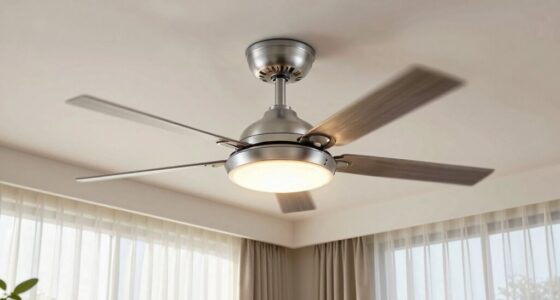
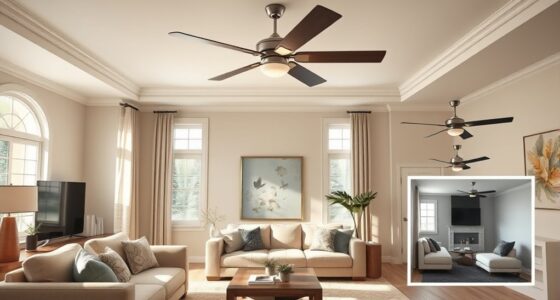
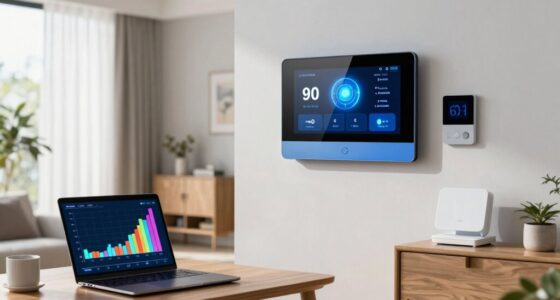
When comparing ceiling fans, focus on their wattage ratings at different speeds. DC motor fans typically consume 20-30W, while traditional AC motors range from 60-75W, indicating greater efficiency for the former. Wattage varies across speed levels, with the lowest at low speeds and peaks at high speeds. Higher-performance models may have surge wattages that impact electrical safety. To maximize efficiency and savings, examine airflow (CFM) relative to wattage—continuing your exploration reveals more on selecting ideal models.
Key Takeaways
- Compare rated wattage at various speeds to assess energy efficiency across models.
- DC motor fans typically consume 20-30W, while AC motors range from 60-75W at high speed.
- Lower wattage at comparable airflow (CFM) indicates higher efficiency in a fan model.
- Wattage variation across speeds is minimal in energy-efficient fans, reducing energy consumption during operation.
- Consider surge wattage and motor technology to understand electrical demands and long-term savings.

Understanding the wattage of ceiling fans is essential for evaluating their energy efficiency and operational costs. Wattage directly correlates with power consumption, influencing both energy bills and environmental impact. When comparing models, it’s crucial to analyze their rated wattage at various speeds, as this determines how much electricity they draw during operation. Typically, ceiling fans range from 50 to 75 watts at high speed, with some energy-efficient models consuming even less. These figures serve as a baseline for assessing overall efficiency, but they must be contextualized within performance metrics such as airflow and noise levels to ensure you’re obtaining optimal value.
Analyzing wattage at various speeds helps assess ceiling fan efficiency and operational costs.
Different fan models utilize varying motor technologies and blade designs, which significantly impact wattage. For instance, DC motor fans tend to operate at lower wattages—sometimes as low as 20-30 watts—while delivering comparable airflow to traditional AC motor fans that may require 60-75 watts. This discrepancy arises because DC motors are inherently more efficient, converting electrical energy into mechanical motion with less heat loss. When you compare models, look beyond just the wattage ratings and examine their airflow capacity (measured in CFM). A fan with lower wattage but high airflow indicates superior efficiency, translating to less energy consumed for the same cooling effect.
Furthermore, the wattage of a ceiling fan varies with speed settings. Most fans consume the least power at their lowest setting and the most at high speed. However, the incremental increase is often minimal, especially in energy-efficient models. Some newer designs incorporate smart controls that optimize energy use based on room conditions or user preferences, reducing unnecessary power draw. As you analyze different models, consider how their wattage scales across speed levels and whether their features justify any additional energy costs.
It is also important to account for the startup or surge wattage, which can briefly spike above the rated operational wattage. While typically a small percentage of overall consumption, this factor affects the sizing of electrical circuits and the longevity of your wiring. In high-performance models, these surges may be more pronounced, so understanding these nuances helps in making informed decisions. Additionally, reviewing energy-efficient features can help identify models that provide better performance with less power consumption. Overall, comparing wattage across models isn’t solely about selecting the lowest power draw; it involves evaluating how efficiently each fan converts electrical energy into effective airflow, considering operational costs and long-term savings. By adopting a precise, data-driven approach, you can select a ceiling fan that balances performance with energy efficiency, minimizing both environmental impact and your utility expenses.

LEDIARY 20" Caged Ceiling Fan with Light and Remote, Low Profile Flush Mount Fandelier, Black Gold Bladeless Enclosed Small Fan Lights Ceiling Fixtures, Rustic Farmhouse Style for Bedroom, Outdoor
【Industrial Chic & True-Tone Colors】 This caged ceiling fan with light blends rustic farmhouse charm and modern industrial...
As an affiliate, we earn on qualifying purchases.
Frequently Asked Questions
How Does Fan Size Affect Wattage Consumption?
Larger fan sizes generally consume more wattage because they have bigger blades and motors, requiring more power to operate efficiently. As you increase fan diameter, expect wattage to rise proportionally, especially at higher speeds. However, energy-efficient models use advanced motor technology to minimize power use, so size alone isn’t the sole determinant. You should consider both blade size and motor efficiency for accurate wattage expectations in your analysis.
Do Energy-Efficient Fans Consume Less Power?
Energy-efficient fans do consume less power; they typically use 20-30% less wattage than standard models. An interesting statistic shows that a high-efficiency ceiling fan can operate on as low as 50 watts, compared to traditional fans requiring 75-100 watts. This reduction in energy use translates to lower electricity bills and decreased environmental impact. You should consider ENERGY STAR-rated fans for maximum efficiency and cost savings over time.
What Is the Typical Wattage Range for Ceiling Fans?
You’ll find that typical ceiling fan wattage ranges from 50 to 75 watts at high speed, with most models consuming around 60 watts during operation. At lower speeds, wattage drops markedly, often between 20 and 30 watts. Energy-efficient models are designed to operate within the lower end of this spectrum, reducing power consumption without sacrificing airflow. Understanding these ranges helps you select fans that balance performance and energy savings effectively.
How Can I Reduce Ceiling Fan Energy Costs?
You can reduce your ceiling fan energy costs by optimizing its use through smart controls like timers and dimmers, which limit unnecessary operation. Switching to energy-efficient models with lower wattage ratings directly cuts power consumption. Regular maintenance, such as cleaning blades and ensuring proper motor lubrication, enhances efficiency. Additionally, setting the fan to appropriate speeds based on room temperature prevents excess energy use, ensuring cost-effective cooling without sacrificing comfort.
Are Higher Wattage Fans More Effective?
Higher wattage fans generally produce greater airflow, making them more effective at cooling larger spaces. However, efficiency depends on their design; some models deliver high airflow with lower wattage, optimizing energy use. When choosing a fan, consider airflow (CFM) relative to wattage to guarantee effective cooling without unnecessary energy consumption. Ultimately, higher wattage can be more effective, but only if it balances performance with energy efficiency.

addlon Ceiling Fans with Lights, 42 Inch Low Profile Ceiling Fan with Light and Remote Control, Flush Mount, Reversible, 3CCT, Dimmable, Quiet, Black Small Ceiling Fan for Bedroom Indoor/Outdoor Use
Ceiling Fan with Light: Bring more than just wind and light, but comfort! addlon modern ceiling fan, with...
As an affiliate, we earn on qualifying purchases.
Conclusion
While selecting a ceiling fan, you might think bigger wattage equals better airflow, but the truth is, efficiency often trumps power. Ironically, many high-wattage models consume more energy without noticeably outperforming their lower-watt counterparts. By analyzing wattage data, you’ll see that ideal models deliver comfort with minimal energy use. So, next time you’re tempted by wattage numbers, remember: sometimes, less truly means more—more efficiency, that is.

Amico Ceiling Fans with Lights, 42 inch Low Profile Ceiling fan with Light and Remote Control, Flush Mount, Reversible, 3CCT, Dimmable, Noiseless, Black Ceiling Fan for Bedroom, Indoor/Outdoor Use
Ceiling Fan with Light: Decorate your home with Amico ceiling fan! While bringing you coolness and comfort, it...
As an affiliate, we earn on qualifying purchases.

ZMISHIBO 52 Inch Ceiling Fan with Light, App&Remote Control, Flush Mount Low Profile, Dimmable 20W LED Light, Quiet Reversible Motor for Bedroom, Living Room, Apartment, Black
Perfect Size for Rooms: This 52-inch ceiling fan is ideal for cooling and illuminating spacious areas like living...
As an affiliate, we earn on qualifying purchases.