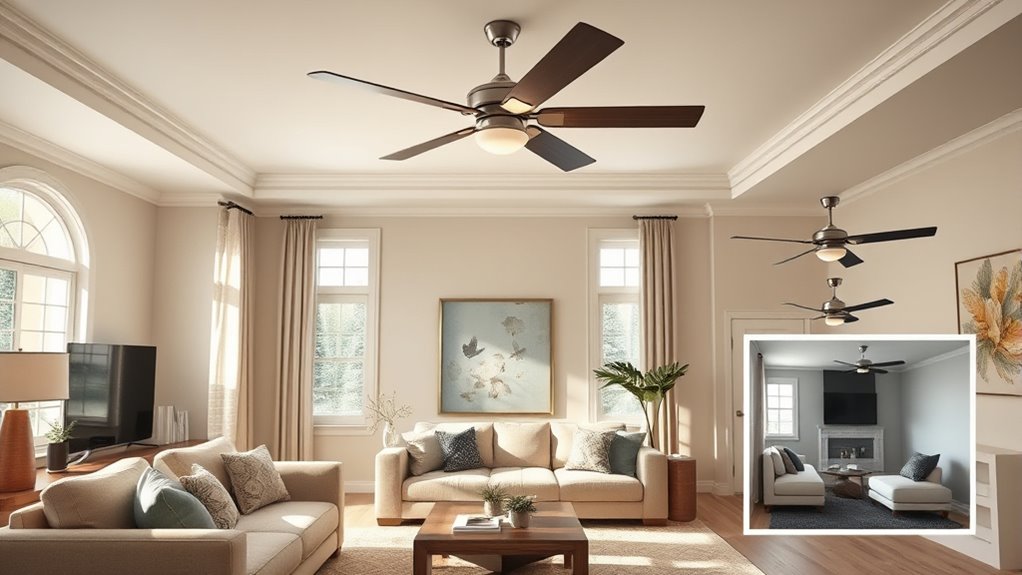

When choosing ceiling fans, consider room size to optimize efficiency and airflow. Larger rooms benefit from fans with blade spans of 52 inches or more, providing broad coverage and consistent temperature control, but may consume more energy due to larger motors. Small rooms require fans with shorter blades, operating efficiently at higher speeds with less power. Matching fan size to room volume prevents overcirculation and saves energy, and understanding blade pitch and performance factors can help you make smarter choices — explore further to learn more.
Key Takeaways
- Larger rooms require fans with 52-inch+ blade spans to ensure effective airflow and energy efficiency.
- Small rooms are best served by fans 36 inches or less to prevent overcirculation and reduce energy waste.
- High CFM ratings in large fans provide broad coverage, while small fans operate efficiently at higher speeds with less power.
- Blade pitch and motor design influence airflow; steeper pitches increase efficiency in large fans, while modest pitches suit small fans.
- Incorporating variable speed controls enhances efficiency by allowing precise airflow adjustments for room size.
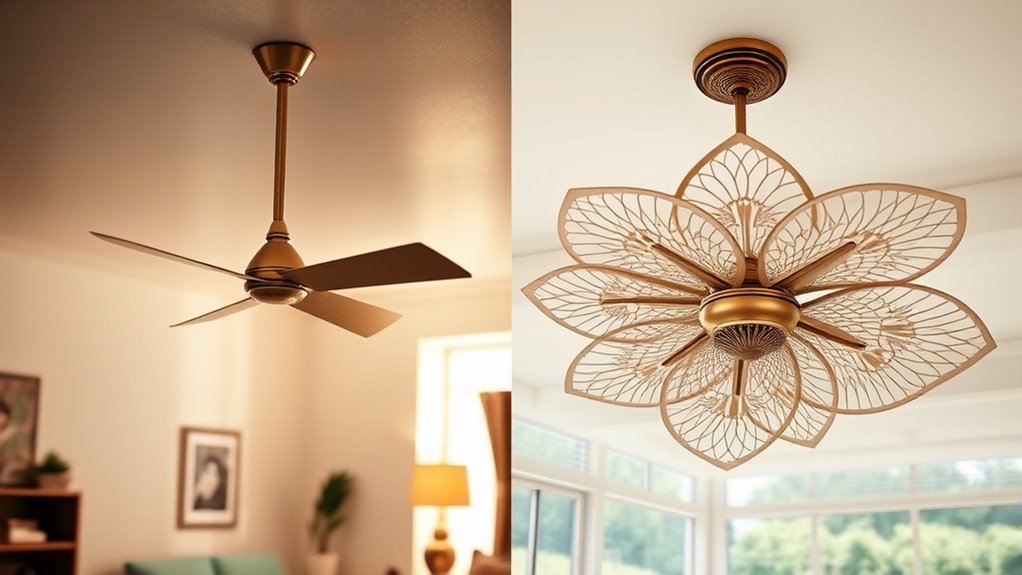
Have you ever wondered why choosing a ceiling fan depends on room size? The answer lies in the fundamental principles of airflow dynamics and energy efficiency. When selecting a fan, understanding how size influences air movement and power consumption is essential for ideal performance. Larger rooms require fans with greater blade spans and higher airflow capacities, typically measured in cubic feet per minute (CFM). Conversely, small rooms benefit from more compact fans that provide sufficient circulation without overpowering the space or wasting energy. The key is matching the fan’s airflow capacity to the room’s volume to ensure effective cooling or air redistribution.
Choosing the right ceiling fan depends on room size for optimal airflow and efficiency.
In large rooms, the challenge lies in achieving uniform airflow across a broad area. Fans with blades spanning 52 inches or more are designed to generate higher CFM ratings, which enable them to circulate air effectively over wide distances. These fans often incorporate multiple blades or larger blade surface areas to generate the necessary airflow. However, larger fans tend to consume more power due to their increased motor size and blade mass. Consequently, efficiency hinges on selecting a model with the highest CFM per watt ratio, ensuring that you maximize airflow without unnecessary energy expenditure. Additionally, larger fans may need to operate at lower speeds to reduce noise and vibration, which can influence their overall efficiency.
In small rooms, the focus shifts to preventing overcirculation and energy waste. A fan with a smaller blade span, such as 36 inches or less, typically suffices to produce adequate airflow. These fans operate efficiently at higher speeds and lower power levels, often delivering a high CFM per watt ratio suitable for confined spaces. Using an oversized fan in a small room can lead to excessive airflow, causing discomfort and increased energy consumption. Conversely, undersized fans might struggle to circulate air effectively, leading to uneven temperature distribution and higher energy costs as the HVAC system compensates.
Efficiency considerations also extend to blade pitch and motor design. Larger fans often feature blades with a steeper pitch, which increases airflow at the expense of higher motor load. In small rooms, a more modest blade pitch ensures energy-efficient operation while still providing sufficient air movement. Modern fans incorporate variable speed controls, allowing you to fine-tune airflow according to room size, further enhancing efficiency. Ultimately, the choice hinges on balancing airflow needs with power consumption to enhance both comfort and energy use, emphasizing that room size is a critical factor in achieving these goals.
Moreover, considering energy-efficient designs can significantly impact long-term electricity savings and environmental footprint.

Ohniyou Ceiling Fans with Lights, 52'' Low Profile Ceiling Fan with Light and Remote/APP Control, Modern Flush Mount Ceiling Fan for Indoor Bedroom Living Room, Dimmable, Qiuet DC Motor, Black
Smart Ceiling Fans with APP & Remote Control: This modern ceiling fan with lights has all functions controllable…
As an affiliate, we earn on qualifying purchases.
As an affiliate, we earn on qualifying purchases.
Frequently Asked Questions
How Do Ceiling Fan Blade Pitch Differences Affect Efficiency?
You’ll notice that blade pitch directly impacts efficiency by altering airflow and power consumption. A steeper pitch increases air movement but requires more energy, potentially reducing efficiency. Conversely, a shallower pitch moves less air but consumes less power, maximizing energy use. To maximize efficiency, choose a blade pitch that balances airflow needs with energy consumption, considering your room size and ventilation requirements for ideal performance.
What Are the Noise Level Considerations for Large Room Ceiling Fans?
In large rooms, noise levels can considerably impact comfort. For instance, a ceiling fan with high-quality, balanced blades and a powerful motor minimizes noise by reducing vibration and wobble. You should look for fans with quiet operation features, such as brushless motors or sound-dampening mounts. Regular maintenance, like tightening components and cleaning blades, also helps keep noise low, ensuring efficient airflow without disruptive sound, especially in expansive spaces.
Can a Small Room Ceiling Fan Cool a Large Space Effectively?
A small room ceiling fan typically struggles to cool a large space effectively due to limited airflow capacity and lower CFM ratings. You may notice insufficient air circulation, leading to uneven cooling. For ideal efficiency, choose a fan with a higher CFM rating designed for large areas. If you use a small fan, supplement with additional cooling methods like portable fans or air conditioning to achieve desired comfort levels.
How Does Ceiling Height Impact Fan Performance in Different Room Sizes?
You’ll find that ceiling height substantially impacts fan performance—studies show that fans installed at ideal heights improve air circulation by up to 30%. When your ceiling is higher than 8 feet, you need a downrod to guarantee proper airflow. In large rooms, high ceilings can cause air stratification, making it harder for fans to distribute cool or warm air evenly. Proper height adjustment maximizes efficiency and comfort.
Are Energy-Saving Features More Important in Large or Small Room Fans?
Energy-saving features are more vital in large room fans because they consume more power due to higher airflow demands. You should prioritize models with efficient motors, variable speed settings, and smart controls to optimize energy use. In small rooms, these features are less essential since fans operate at lower capacity and consumption. Focusing on energy efficiency in larger fans ensures cost savings and reduces environmental impact over time.

GJeg Ceiling Fans with Lights,36" Low Profile Ceiling Fan with Light and Remote Control,Flush Mount, Reversible, Dimmable, Noiseless, White Ceiling Fan for Bedroom
✅【Ceiling Fans with Lights】: We provide very detailed instructions and installation videos to help you complete the installation….
As an affiliate, we earn on qualifying purchases.
As an affiliate, we earn on qualifying purchases.
Conclusion
Choosing the right ceiling fan hinges on understanding your room’s size and airflow needs. While larger fans optimize circulation in expansive spaces, smaller units excel in confined areas, reducing energy consumption. But what if your room falls somewhere in between? The decision becomes more nuanced, requiring careful analysis of airflow patterns, efficiency metrics, and energy costs. Ultimately, selecting the ideal fan isn’t just about size—it’s about revealing the perfect balance of performance and savings, leaving you to wonder what your choice could unveil.

JSAITEE 52 inch Ceiling Fan with Light, 6 Speeds Reversible Low Profile Ceiling Fan with Light and Remote/APP Control, 3 Color Temp+Dimmable RGB, 8 Blades, Flush Mount Quiet Ceiling Fans, Black
【6 – Speed and Reversible】: Our ceiling fan offers 6 speed settings with a maximum air volume of…
As an affiliate, we earn on qualifying purchases.
As an affiliate, we earn on qualifying purchases.

addlon Ceiling Fans with Lights, 42 Inch Low Profile Ceiling Fan with Light and Remote Control, Flush Mount, Reversible, 3CCT, Dimmable, Quiet, Black Small Ceiling Fan for Bedroom Indoor/Outdoor Use
Ceiling Fan with Light: Bring more than just wind and light, but comfort! addlon modern ceiling fan, with…
As an affiliate, we earn on qualifying purchases.
As an affiliate, we earn on qualifying purchases.