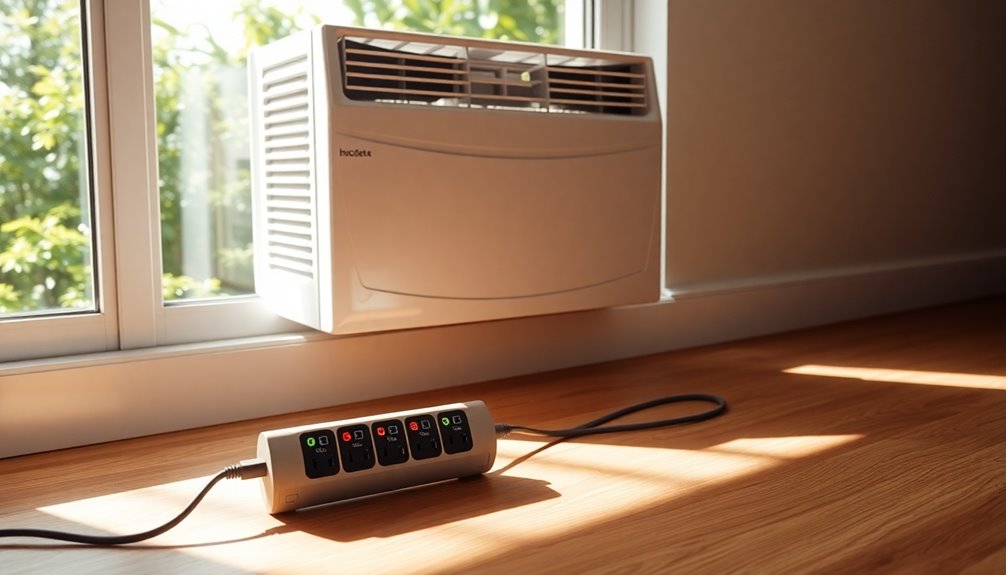
For a surge protector for a window air conditioner, my best overall pick is the Heavy-Duty 20A 4400W model, whose higher stated capacity makes it the strongest match for buyers prioritizing an appliance-focused design. The BSEED 20A, 2400W single-outlet protector is a more compact alternative, while the BXST 140J model with LED display adds visible status information in a single-outlet format. The main tradeoffs are matching the protector’s electrical rating to the AC’s requirements, choosing a wall-mounted single outlet or a multi-outlet unit, and deciding whether added indicators or extra outlets are useful. A surge protector does not replace the correct branch circuit, grounded receptacle, or manufacturer-approved electrical setup. Read on for the full comparison and practical selection guidance.

Get home appliances delivered free with Prime
- Fast, free delivery on millions of items
- Prime Video, Amazon Music and more included
- Member-only deals all year
Complete the kit


Key Takeaways
- Higher stated capacity separates the leading options: the Heavy-Duty 20A 4400W model has the largest listed capacity in this lineup, while several 15A models list 1800W or 1875W.
- Single-outlet designs fit an AC-focused setup better: the BSEED 20A 2400W and several BXST options dedicate the connection to one appliance, unlike three-outlet BSEED models.
- Two-packs and four-packs solve coverage, not compatibility: BXST offers two single-outlet options in two-packs, and BSEED lists a four-pack, but each protector still needs to match the connected appliance and outlet.
- Display and indicator features vary: the BXST 140J model lists an LED display, while other products emphasize outlet count, stated capacity, or a ground-protected light indicator.
- Product names alone do not settle AC suitability: buyers need to verify the air conditioner’s nameplate, plug type, receptacle, and manufacturer guidance rather than relying only on appliance labels or wattage claims.


| surge protector for window air conditioner | Maximum current | Plug type | Dimensions | Voltage |
|---|---|---|---|---|
| Heavy-Duty 20A 4400W Surge Pro | 20 A | Type B, 3-pin North American | 4.5 × 3 inches | — |
| BSEED Voltage Protector | 15 A | Type B | 4.49 × 3.11 inches | 120 volts in specifications; 125V in title |
| BSEED Surge Protector Power St | 15A | Type B, 3-pin North American | 4.49 × 3.11 inches | 120V |
| BXST Single Outlet Surge Prote | 15 A | Type B, 3-pin North American | 1.57 × 1.18 inches | 120 volts |
| BSEED Surge Protector for Refr | 20 A | Type B, 3-pin North American | — | 120 VAC |
| BSEED Surge Protector for Home | 15A | Type B, 3-pin North American | 4.49 × 3.11 inches | 120V |
| Appliance Surge Protector Volt | 15A | Type B, 3-pin North American | 3.14 × 2.36 inches | 125V |
| BXST Single Outlet Surge Prote | 20A | Type B, 3-pin | 1.78 × 1.3 inches | 220V |
| BXST 140J Surge Protector with | 15A | Type B, 3-pin North American | 2.1 × 1.5 inches | 120V |
| BSEED Surge Protector for Home | 10A | Type B, 3-pin North American | 2.56 × 3.94 inches | 125V |
More Details on Our Top Picks
Heavy-Duty 20A 4400W Surge Protector for Appliances with Overload & Voltage Protection
For a window air conditioner that needs a higher-current protector, this model stands apart from the 15A BSEED and BXST options with a stated 20A maximum current and 4400W capacity. Its three-minute delay is intended to give the compressor time before power resumes after an interruption, while surge and voltage protection address more than brief spikes alone. The fire-resistant, UL94-compliant materials and stated five-year warranty add reassurance for a permanently plugged-in appliance. The major catch is a serious mismatch in the supplied information: the description says it supports 220V, but the specs list 120V. I would verify the actual outlet and product rating with the seller before buying; neither rating should be assumed. It also provides just one outlet.
Pros:- Three-minute restart delay is designed to help protect an AC compressor after power interruptions.
- 20A maximum current and stated 4400W capacity exceed the listed ratings of the 15A alternatives.
- UL94-compliant fire-resistant materials are specified.
- Description states a five-year warranty and equipment coverage.
Cons:- Product information conflicts: the description says 220V while the specifications say 120V.
- Single outlet does not provide connections for other devices.
- Requires careful verification against the AC nameplate and outlet before purchase.
Best for: Owners of a window AC whose manufacturer specifies a compatible 20A protector, after confirming the unit’s voltage and outlet requirements with the seller.
Not ideal for: Buyers with a standard 120V setup who need a clearly verified rating, or anyone looking to protect several devices from one wall unit.
- Number of outlets:1
- Voltage listed in specs:120 volts
- Voltage stated in description:220V
- Maximum current:20 A
- Stated power capacity:4400W
- Dimensions:4.5 × 3 inches
- Weight:4.8 ounces
- Plug type:Type B, 3-pin North American
- Delay:3 minutes
Our verdict“Choose this only if its voltage and current rating are confirmed to match your window AC, since the conflicting 120V and 220V details make fit verification essential.”
BSEED Voltage Protector, 3 Outlet Surge Protector for Home Appliances, Wall Mount Power Suppressor, 125V, 1875W
The BSEED Voltage Protector suits a wall setup where an air conditioner is not the only appliance needing a protected connection: it offers three outlets, unlike the single-outlet BXST unit. Its listed 120V and 15A limits, however, are the figures to check against the AC’s label; the product title says 125V, and the stated 1875W ceiling may make it a poor match for some window units. LED status indicators make operating status easier to check, while the three-minute delay is intended to reduce rapid compressor restarts after power events. Compared with the similarly rated BSEED power strip, this model specifically describes wall mounting and a flame-retardant shell. Its multi-outlet design is useful, but it should not invite plugging in additional loads beyond the AC’s allowed circuit capacity.
Pros:- Three outlets accommodate more than the one device supported by single-outlet models.
- LED indicators show voltage status at a glance.
- Three-minute delay is designed to limit rapid compressor cycling after a power event.
- Flame-retardant shell and stated three-year warranty.
Cons:- 15A and 1875W limits may not suit every window air conditioner.
- Title and specification voltage differ, listing 125V and 120V respectively.
- Delay before power resumes may be inconvenient when immediate restart is expected.
Best for: Buyers with a compatible 120V window AC and nearby low-load devices who want several wall-mounted protected outlets and visible status indicators.
Not ideal for: Owners of ACs whose nameplate demands more than 15A or whose running/startup requirements exceed the stated 1875W limit, and anyone needing a single appliance-only plug.
- Number of outlets:3
- Voltage:120 volts in specifications; 125V in title
- Maximum current:15 A
- Power capacity:1875W
- Plug type:Type B
- Dimensions:4.49 × 3.11 inches
- Enclosure material:Plastic
- Warranty:3 years
- Delay:3 minutes
Our verdict“Pick this for a compatible 15A-or-lower AC when extra wall outlets and status lights matter more than a dedicated single-appliance connection.”
BSEED Surge Protector Power Strip for Home Appliances, 3 Outlets, 120V, 15A, 1875W
This BSEED power strip is a straightforward pick for buyers who want three protected outlets and clear status feedback in one compact appliance-focused unit. Its listed 120V, 15A and 1875W ratings provide a more explicit match point than the BSEED Voltage Protector’s title, which says 125V while its specs say 120V. That does not make this the right choice for every AC: the window unit’s label and startup needs still have to fall within its rating. LED indicators and a delay function help distinguish it from the BXST two-pack, which instead emphasizes compact single-outlet plugs and a stated 540J rating. The tradeoff is that a strip format with only three outlets offers limited expansion, and the product provides no USB ports. Its three-year warranty is a useful support detail, not a substitute for checking electrical compatibility.
Pros:- Three outlets allow several compatible appliances to connect.
- LED indicators provide visible operating information.
- Delay function is included for appliance protection.
- Three-year warranty and stated customer support.
Cons:- 15A and 1875W ratings rule it out for ACs that exceed either limit.
- Only three outlets, with no USB connections.
- 120V rating is not suitable for appliances requiring a different voltage.
Best for: Window-AC owners with a 120V, 15A-compatible unit who want LED status feedback and a few protected connections in one appliance-oriented power strip.
Not ideal for: Buyers whose AC exceeds 15A or 1875W, or who want a compact single-outlet protector with a stated joule rating.
- Number of outlets:3
- Voltage:120V
- Maximum current:15A
- Power capacity:1875W
- Plug type:Type B, 3-pin North American
- Dimensions:4.49 × 3.11 inches
- Weight:0.16 kg
- Enclosure material:Polycarbonate
- Warranty:3 years
Our verdict“Choose this BSEED strip when your AC fits its 120V and 15A limits and you value status indicators alongside a small number of extra outlets.”
BXST Single Outlet Surge Protector, Refrigerator Surge Protector Wall Socket, Ground Protected Light Indicator for TV, Air Conditioner, Washing Machine, and Home Appliances, 15A 1800W, 2 Pack
When wall space is tight or you want to protect two separate appliances, the BXST two-pack offers two compact single-outlet units rather than one three-outlet BSEED device. Each plug is listed at 15A and 1800W, close to the BSEED strips’ 15A and 1875W limits, so the AC’s own electrical label remains the deciding check. The ground-protected indicator gives a quick visual cue, and the plug-and-play format avoids a larger wall-mounted body. The stated 540J surge rating is useful context, though it is lower than buyers may want for locations with frequent or severe surges. Unlike the BSEED models described with a three-minute delay, this listing does not specify a delay feature. Its small size and two-unit bundle suit separate outlets, not a setup that needs multiple connections beside one AC.
Pros:- Two separate units can protect appliances in different locations.
- Compact dimensions are less likely to block neighboring wall space.
- Ground-protected indicator provides visible status information.
- Plug-and-play installation requires no complicated setup.
Cons:- Each unit has only one outlet.
- Stated 540J rating may be limiting for areas exposed to stronger surges.
- No delay feature is specified, unlike the BSEED options.
Best for: People protecting a compatible 15A window AC and one other appliance at separate outlets, especially where a bulky multi-outlet unit would obstruct nearby plugs.
Not ideal for: Buyers who need multiple outlets at the AC location, a specified compressor delay, or a higher stated joule rating.
- Units included:2
- Outlets per unit:1
- Voltage:120 volts
- Maximum current:15 A
- Power capacity:1800W
- Dimensions:1.57 × 1.18 inches
- Enclosure material:Polypropylene
- Plug type:Type B, 3-pin North American
Our verdict“Choose the BXST two-pack for compact, separate appliance connections when its 15A limit suits your AC and a stated compressor delay is not a requirement.”
BSEED Surge Protector for Refrigerator, 120VAC, 20Amp, 2400 Watts, 1 Pack
For buyers seeking a dedicated appliance plug with a clearly stated 120VAC, 20A and 2400W rating, this BSEED model avoids the voltage conflict in the Heavy-Duty 20A 4400W protector’s supplied details. It provides one outlet and a three-minute activation delay, making it a more focused choice than the three-outlet BSEED models when the goal is to connect just one compatible AC. The delay means power is not immediate after plugging in or after an interruption, which may frustrate someone expecting an instant restart. Its 2400W ceiling is also lower than the Heavy-Duty model’s stated 4400W, so buyers should compare the AC nameplate rather than assume that 20A alone establishes fit. The listing describes protection against surges, spikes and voltage fluctuations, but does not provide a joule rating.
Pros:- Clearly stated 120VAC rating avoids the voltage ambiguity in the Heavy-Duty 20A 4400W listing.
- 20A maximum current is higher than the 15A BSEED and BXST options.
- Three-minute activation delay is designed for appliance protection.
- Polycarbonate enclosure and stated three-year warranty.
Cons:- Single outlet cannot serve additional devices.
- 2400W capacity is below the Heavy-Duty model’s stated 4400W.
- No joule rating is supplied for comparison with the BXST 540J unit.
Best for: Owners of a single 120V window AC whose electrical requirements fit the stated 20A and 2400W limits and who prefer a dedicated outlet with a restart delay.
Not ideal for: Buyers needing several outlets, a higher stated wattage ceiling, or a specified joule rating for direct surge-strength comparison.
- Voltage:120 VAC
- Amperage:20 A
- Maximum current:20 A
- Power capacity:2400W
- Number of outlets:1
- Plug type:Type B, 3-pin North American
- Operating frequency:50–60 Hz
- Enclosure material:Polycarbonate
- Delay:3 minutes
Our verdict“Pick this dedicated BSEED unit if your 120V AC fits its 20A and 2400W limits and you want a delay feature without the Heavy-Duty model’s voltage ambiguity.”
BSEED Surge Protector for Home Appliances, 3 Outlets, 125V, 1875W, 4 Pack
For a window air conditioner and other appliances spread around the home, this four-pack offers more placement flexibility than buying a single-outlet protector for each device. Each unit has three outlets, LED status indicators, and a 3-minute delay intended to reduce risk from power disturbances. Its listed 15A capacity and 1875W rating are relevant for appliance use, but I would check the AC’s nameplate and startup requirements before connecting it; outlet count alone does not confirm a suitable load match. Compared with the BSEED Single Outlet Surge Protector, this set can serve more devices per plug, though the single-outlet model lists a delay function and a three-year warranty. The tradeoff is a larger wall-mounted footprint and no stated voltage-adjustment controls.
Pros:- Four units allow protection at multiple appliance locations.
- Three outlets per unit offer more connection points than single-outlet models.
- LED indicators make voltage status easier to check.
- A 3-minute delay is specified, and the product includes a three-year warranty.
Cons:- The 15A and 1875W limits may not suit every window AC; buyers need to verify the appliance label and requirements.
- Three outlets can encourage connecting additional loads, so total load needs attention.
- No adjustable voltage thresholds or remote controls are specified.
Best for: Households that want to protect several compatible appliances in different rooms and value a multi-unit set with status lights.
Not ideal for: Owners of higher-draw window ACs who need a clearly stated higher-capacity unit or adjustable voltage thresholds.
- Outlets per unit:3
- Pack quantity:4
- Voltage:120V
- Maximum current:15A
- Maximum power:1875W
- Plug type:Type B, 3-pin North American
- Dimensions:4.49 × 3.11 inches
- Additional features:LED indicator; 3-minute delay
- Warranty:3 years
Our verdict“Choose this four-pack if you need several wall-mounted protectors for compatible appliances, but verify each AC’s electrical requirements before use.”
Appliance Surge Protector Voltage Stabilizer Fireproof UL94V-1 Wall Mount Surge Protectors Outlet for Refrigerator, TV & Heavy Appliances
This single-outlet model is the most control-oriented choice in this group: it combines surge protection with adjustable high- and low-voltage thresholds, delay settings, and a real-time LED voltage display. Those settings can help buyers tailor protection to an appliance, rather than relying only on the fixed delay described for the BSEED 3-Outlet 4-Pack. For a window AC, the appeal is monitoring voltage conditions at the wall; its one-outlet format also keeps other devices from sharing that protected connection. The tradeoff is setup: a buyer must understand the adjustments and confirm they suit the air conditioner. Product data lists 125V and 15A but gives no wattage rating or surge-energy figure, so I would not infer capacity beyond those stated limits.
Pros:- Adjustable voltage thresholds and delay settings allow configuration for an appliance.
- LED display provides real-time voltage information.
- Single outlet keeps the protected connection dedicated to one device.
- Fire-resistant construction is specified.
Cons:- Manual setup adds work and the wrong settings may not suit the connected appliance.
- Only one outlet is available.
- No wattage or joule rating is provided in the supplied product data.
Best for: AC owners who want visible voltage monitoring and adjustable thresholds and are comfortable configuring a dedicated appliance protector.
Not ideal for: Buyers seeking a simple plug-in with multiple outlets, or anyone whose AC requirements exceed the stated 15A limit.
- Outlets:1
- Voltage:125V
- Maximum current:15A
- Plug type:Type B, 3-pin North American
- Dimensions:3.14 × 2.36 inches
- Supported devices:Air conditioners, refrigerators, TVs, freezers
- Display:LED voltage display
- Adjustments:Voltage thresholds and delay times
Our verdict“Pick this model when adjustable voltage protection and a live display matter more than extra outlets or a simple setup.”
BXST Single Outlet Surge Protector for Refrigerator, Air Conditioner, Smart TV – 2 Pack
The strongest reason to choose this BXST pair is its 220V rating, not a feature advantage for a typical North American window AC. Its listing names air conditioners among compatible devices and gives a 20A maximum current, but buyers must confirm that both the appliance and the wall supply use the required voltage and plug arrangement. It also specifies 140 joules of surge absorption and a compact body, while the BXST 140J 120V LED Display model is the clearer fit for standard 120V North American outlets and includes adjustable voltage settings. Two units are useful when more than one compatible appliance needs protection, but each still serves only one outlet. I would skip this for a 110–120V AC; the stated voltage mismatch is decisive.
Pros:- Two protectors are included for separate appliance locations.
- Lists 140 joules of surge absorption.
- Compact dimensions suit tight wall-outlet spaces.
- 20A maximum current is specified.
Cons:- The 220V rating makes it unsuitable for standard 110–120V outlets.
- Each unit provides only one outlet.
- The 12-month warranty is shorter than the three-year coverage listed for the BSEED models.
Best for: Buyers with compatible 220V appliance circuits who want two compact single-outlet protectors and a stated 140J rating.
Not ideal for: Most North American window-AC owners using standard 110–120V outlets, because this model is listed for 220V.
- Outlets per unit:1
- Pack quantity:2
- Voltage:220V
- Maximum current:20A
- Surge absorption:140 joules
- Plug type:Type B, 3-pin
- Dimensions:1.78 × 1.3 inches
- Enclosure material:Polycarbonate
- Warranty:12 months
Our verdict“Choose this pair only if your AC and supply are confirmed compatible with 220V; standard North American window-AC users should choose a 120–125V model instead.”
BXST 140J Surge Protector with LED Display, 120V, 15A, 1800W, One Outlet
For a standard North American outlet, this BXST is a more directly relevant choice than the 220V BXST two-pack: it is listed at 120V, 15A, and 1800W, with a single dedicated outlet for an appliance. Its LED display and adjustable high- and low-voltage settings give buyers more visibility and control than the fixed-indicator approach of the BSEED 3-Outlet 4-Pack. The compact dimensions may help where a bulky plug-in device would interfere with nearby outlets. The compromise is that the 140J rating is modest as listed, and manual threshold setup takes care. I would match the AC’s running and startup requirements against its label before buying; the 1800W figure should not be treated as proof that every window unit is suitable.
Pros:- 120V, 15A, and 1800W ratings suit many standard appliance circuits, subject to AC requirements.
- LED display shows voltage information.
- Adjustable high- and low-voltage settings provide more control than basic indicator-only models.
- Compact dimensions suit crowded outlet areas.
Cons:- One outlet protects only one connected appliance.
- The listed surge rating is 140J.
- Voltage thresholds require manual setup.
Best for: Window-AC owners with a 120V supply who want a compact, one-appliance protector with a voltage display and adjustable limits.
Not ideal for: Buyers who need several outlets, a higher stated surge-energy rating, or a setup that requires no manual adjustment.
- Outlets:1
- Voltage:120V
- Maximum current:15A
- Maximum power:1800W
- Plug type:Type B, 3-pin North American
- Dimensions:2.1 × 1.5 inches
- Enclosure material:Polycarbonate
- Warranty:1 year
Our verdict“Choose this compact BXST for a compatible 120V AC if voltage monitoring matters more than multiple outlets or a larger surge-energy rating.”
BSEED Surge Protector for Home Appliances, Single Outlet, 125V, 1440 Watts
This BSEED single-outlet protector suits buyers who want a straightforward appliance-focused design with LED status indicators, automatic protection, and a delay function. Its three-year warranty is longer than the one-year coverage listed for the BXST 140J 120V model, but the BSEED is rated at only 10A and 1440W. That lower capacity makes checking the window AC’s nameplate especially important; many buyers may need a different model if the unit’s electrical requirements exceed those limits. The single outlet avoids sharing the connection with other devices, while the delay can temporarily interrupt power during voltage problems. Unlike the adjustable BXST, this listing does not specify user-set voltage thresholds or a joule rating, so it offers less detail for buyers comparing surge capacity.
Pros:- LED indicators show voltage conditions.
- Automatic protection and a delay function are specified.
- Three-year warranty is longer than the one-year coverage listed for the BXST 120V model.
- Single outlet keeps the protected appliance connection dedicated.
Cons:- The 10A and 1440W limits may rule it out for many window ACs.
- Only one outlet is provided.
- No joule rating or adjustable voltage thresholds are listed.
Best for: Owners of lower-draw appliances who want a single-outlet protector with status indicators, a delay function, and a longer stated warranty.
Not ideal for: Window-AC owners whose unit requires more than 10A or 1440W, or buyers who want an explicit joule rating and adjustable thresholds.
- Outlets:1
- Voltage:125V
- Maximum current:10A
- Maximum power:1440W
- Plug type:Type B, 3-pin North American
- Dimensions:2.56 × 3.94 inches
- Enclosure material:Polycarbonate
- Compatible devices:Refrigerators, freezers, ice makers, washing machines
- Warranty:3 years
Our verdict“Buy this BSEED only when your appliance’s label fits its 10A and 1440W limits and you value a delay function and three-year warranty.”

How We Picked
I compared these ten models by the details that matter when the connected appliance is a window AC: stated amperage and wattage, single- versus multi-outlet layout, protective features named in the listing, and whether the design gives useful status information. I gave more weight to clearly stated electrical capacity and a straightforward appliance-focused setup than to outlet quantity alone. Multi-packs ranked for their coverage and convenience, but they did not receive an automatic advantage for a single-air-conditioner installation.
The ranking reflects fit and clarity, not a claim that every model is suitable for every window AC. The Heavy-Duty 20A 4400W model leads on its listed capacity; the BSEED 20A 2400W model stands out among compact single-outlet choices; and the BXST 140J adds a visible display. Lower-ranked options can still suit buyers who need multiple outlets, a multipack, or a simple single-outlet device, but their listed ratings and features offer fewer standout advantages for this specific use. Product specifications should be checked against the AC manual and the protector’s full documentation before purchase.
| surge protector for window air conditioner | Plug type | Enclosure material |
|---|---|---|
| Heavy-Duty 20A 4400W Surge Pro | Type B, 3-pin North American | — |
| BSEED Voltage Protector | Type B | Plastic |
| BSEED Surge Protector Power St | Type B, 3-pin North American | Polycarbonate |
| BXST Single Outlet Surge Prote | Type B, 3-pin North American | Polypropylene |
| BSEED Surge Protector for Refr | Type B, 3-pin North American | Polycarbonate |
| BSEED Surge Protector for Home | Type B, 3-pin North American | — |
| Appliance Surge Protector Volt | Type B, 3-pin North American | — |
| BXST Single Outlet Surge Prote | Type B, 3-pin | Polycarbonate |
| BXST 140J Surge Protector with | Type B, 3-pin North American | Polycarbonate |
| BSEED Surge Protector for Home | Type B, 3-pin North American | Polycarbonate |
Factors to Consider When Choosing Surge Protector For Window Air Conditioner
Choosing a protector for an air conditioner takes more than matching a product label to the words “AC” or “appliance.” I would start with the unit’s electrical requirements and the outlet setup, then decide whether features such as a display or multiple sockets are worth the added complexity.
Match Ratings to the AC Nameplate
Check the air conditioner’s manual and nameplate for voltage, amperage, and any stated minimum circuit requirements before choosing a protector. A device listing 20A or a high wattage does not make an incompatible receptacle or circuit safe to use. Compare the protector’s ratings with the AC’s requirements, and do not assume that a higher number automatically means better protection. The product’s full documentation should also identify what conditions it protects against and how it handles overload or voltage faults. If the ratings or compatibility remain unclear, ask a qualified electrician or the manufacturer rather than guessing.
Check the Plug, Receptacle, and Ground
Window ACs can have different plug shapes and electrical needs, so confirm that the protector accepts the exact plug without adapters. Verify that the wall receptacle is properly grounded when the protector’s instructions call for grounding. A grounded-light indicator can help communicate connection status, but it does not repair faulty wiring or certify the circuit. Avoid forcing a plug, using a loose-fitting outlet, or adding an extension cord unless the AC manufacturer explicitly permits that setup. A correct fit and sound receptacle matter more than extra sockets.
Choose Single Outlet or Multi-Outlet Deliberately
A single-outlet protector keeps the setup focused on the AC and reduces temptation to add other loads to the same device. Three-outlet designs can be useful where you also need to protect low-power equipment, but outlet count does not increase the capacity of the wall circuit. Do not use spare sockets for another high-draw appliance without checking the combined load and product instructions. Multi-packs make sense when several compatible appliances or rooms need protection, not because one AC needs several protectors. For a dedicated air-conditioner connection, a simple single-outlet layout is often easier to assess.
Understand What Surge Protection Does—and Does Not Do
Surge protection is meant to help limit certain voltage spikes; it does not guarantee that equipment will be protected from every electrical event. It is not a substitute for a correctly sized circuit, proper wiring, or protection required by local electrical rules. Some listings also mention overload or voltage protection, but buyers should check the manual for the exact function, limits, and response behavior rather than treating those phrases as interchangeable. Do not assume a protector stabilizes voltage unless the manufacturer clearly describes that capability. If the AC repeatedly trips a breaker or shows electrical problems, stop using the setup and investigate the underlying cause.
Decide Whether an Indicator or Display Helps
A light or display can make the device’s status easier to see, especially when the receptacle is behind furniture or near a window. That convenience is useful only if the indicator’s meaning is explained in the product manual. A light should not be treated as proof that the AC circuit is correctly wired or that the protector can handle every fault. An LED display may offer more visible information, but it also adds a feature to interpret and does not replace checking ratings. If you prefer a simple setup, prioritize clear specifications and fit over extra status features.
Know When to Pay for More Capacity or Features
Paying for a higher stated rating can make sense only when that rating matches the AC and the outlet arrangement; it cannot compensate for an undersized circuit. A higher-capacity model may appeal to buyers seeking a more appliance-focused protector, while a basic single-outlet unit may be enough when its documented limits match the appliance. Multi-packs offer coverage for more locations, but unused units add no benefit to a single-AC setup. Consider the plug orientation, wall clearance, and whether the unit could block a neighboring receptacle. When documentation is vague, a modest feature list with clear compatibility information is preferable to impressive-sounding claims.
Frequently Asked Questions
Can I plug a window air conditioner into any surge protector?
No. Check the AC manual and nameplate, then compare its electrical requirements and plug with the protector’s ratings and instructions. The wall receptacle and circuit must also be appropriate for that unit; a protector cannot correct a mismatched circuit or faulty wiring. Avoid adapters and extension cords unless the manufacturer specifically allows them. If compatibility is uncertain, confirm it with the AC maker or a qualified electrician before connecting the unit.
Is a 20A surge protector automatically better for my window AC than a 15A model?
Not automatically. The AC, protector, receptacle, and branch circuit must all be compatible, and the highest rating printed on one component does not raise the rating of the others. In this roundup, the Heavy-Duty model lists 20A and 4400W, while several other products list 15A and lower wattage, but those figures alone do not prove suitability for a particular air conditioner. Use the appliance documentation and protector manual to verify the match. Ask an electrician if the circuit rating or receptacle type is unclear.
Should I choose a single-outlet protector or a three-outlet model?
For an AC-only connection, a single-outlet model keeps the arrangement simple and discourages adding other loads. A three-outlet protector can suit buyers who have a legitimate need for additional compatible devices, but it does not increase the wall circuit’s capacity. Avoid plugging another high-draw appliance into the same protector unless its instructions and the circuit allow the combined load. The BSEED three-outlet products offer more connection points, while the single-outlet options in this lineup are more focused on one appliance. Choose based on the actual setup, not outlet count alone.
Do the indicator light or LED display prove that my AC is protected?
No indicator can prove that the complete electrical setup is safe or that every surge will be stopped. The BXST 140J lists an LED display, and the BXST two-pack listing mentions a ground-protected light indicator, but buyers should consult each manual to understand exactly what those signals mean. An indicator may communicate a device status or grounding condition; it does not repair a wiring fault or confirm the AC circuit’s capacity. If an indicator shows a problem, follow the product instructions and have the outlet checked when needed. Treat visual feedback as a helpful feature, not a substitute for compatibility checks.
Can I use one protector from a multipack for my AC and save the others for different rooms?
Possibly, but each installation needs its own compatibility check. Confirm that every appliance’s requirements match the protector and that each wall outlet and circuit is suitable; a multipack does not make the devices interchangeable for every load. The BXST single-outlet products are listed as two-packs, and one BSEED three-outlet model is listed as a four-pack, so extra units may help cover additional locations. Store unused protectors according to their instructions and inspect them before use. Do not use a spare unit to solve an undersized circuit or a missing outlet type.
Conclusion
For the broadest stated capacity in this lineup, my best overall choice is the Heavy-Duty 20A 4400W model, subject to confirming compatibility with the AC and circuit. The best value for a focused setup is the BSEED 20A 2400W single-outlet model for buyers who want a higher listed rating without extra sockets; the four-pack BSEED option suits people protecting several compatible locations. My best premium-style pick is the BXST 140J with LED display, since visible status information is its clearest differentiator, while my best for beginners is a straightforward single-outlet option with clearly verified ratings and instructions. For buyers who need multiple outlets or several devices, compare the BSEED three-outlet models; for a two-location single-outlet setup, consider the BXST two-packs. Before choosing any of them, match the product documentation to the AC’s nameplate, plug, receptacle, and circuit.