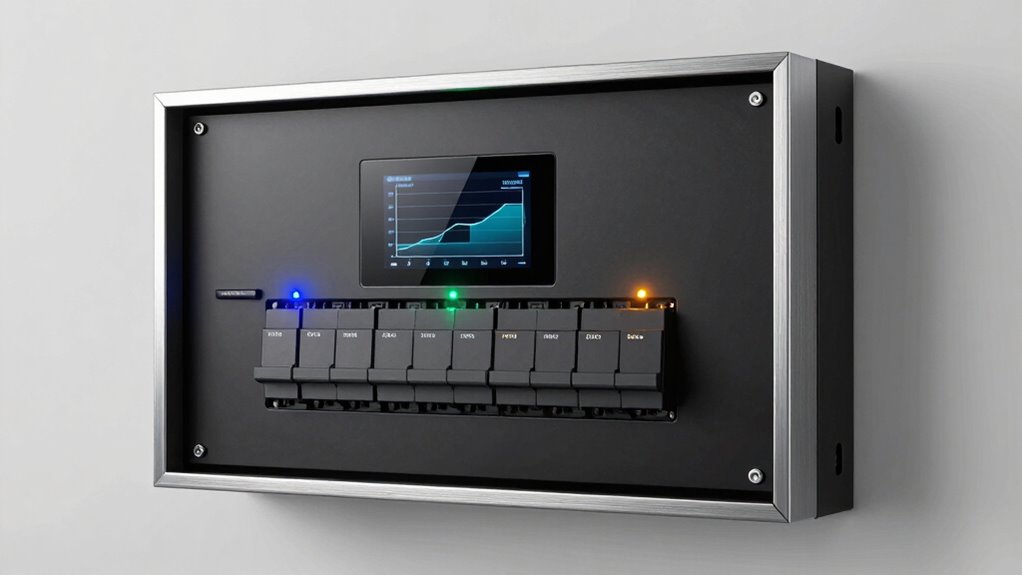

If you’re looking for a smart breaker panel monitor, you’re probably aiming to gain better control and insight into your home’s energy consumption. The best overall pick, the Emporia Vue 3, offers comprehensive real-time data and easy integration. The Meross Smart Energy Monitor stands out for its compatibility with popular smart home systems, while other options focus on circuit-level detail or local data storage. Each choice involves tradeoffs between cost, complexity, and features. Keep reading for a detailed comparison to help you find the best fit for your home and budget.
Complete the kit


Key Takeaways
- Top monitors vary significantly in the level of circuit detail and data accessibility.
- Compatibility with smart home platforms like Home Assistant influences ongoing usability.
- Higher-end models tend to offer more circuit sensors and real-time tracking at a premium price.
- Ease of installation and user interface are often overlooked but critical for non-technical users.
- Most monitors strike a balance between local data storage and cloud-based insights, affecting privacy and reliability.
| Emporia Vue 3 Home Energy Monitor – Real-Time Electricity Usage and Power Consumption Meter |  | Best Overall for Comprehensive Home Energy Management | Certification: UL Listed | Supported Systems: Single phase, Single-split phase, 2-wire, 3-wire, 3-phase, 4-wire Wye | Connectivity: 2.4 GHz Wi-Fi | VIEW ON AMAZON | See Our Full Breakdown |
| Meross Smart Energy Consumption Monitor with Circuit Monitoring and Home Assistant Support |  | Best for Smart Home Integration and Privacy-Conscious Users | Certification: ETL, UL 61010 | Compatible Systems: Single-phase 2-wire, single-split phase 3-wire, 3-phase 4-wire Wye | Maximum Current: 200A for main, 60A for branch | VIEW ON AMAZON | See Our Full Breakdown |
| SIEMENS Inhab Smart Home Energy Monitor with Circuit Level Sensors |  | Best for Direct Panel Monitoring in North America | Circuit Sensors: 16-50 Amp | Main Sensors: 2-200 Amp | Compatibility: USA and Canada | VIEW ON AMAZON | See Our Full Breakdown |
| Refoss Smart Home Energy Monitor with Circuit Sensors and Local Data Storage |  | Best for Privacy-Conscious, Tech-Savvy Users with Multiple Circuits | Circuit Sensors: 16x60A | Supported Systems: Single-phase, Split-phase, 3-phase 4-wire Wye | Main Sensors: 2 (up to 200A) | VIEW ON AMAZON | See Our Full Breakdown |
| WiFi Home Energy Monitor with 3 80A CT Clamps, Circuit-Level Monitoring, and App Control |  | Best for Basic Circuit Monitoring with App Control and Temperature Alerts | Input Voltage: 100–240V AC | Number of CT Clamps: 3 | Clamp Current: 80A each | VIEW ON AMAZON | See Our Full Breakdown |
| Smart Home Energy Monitor with 16 50A Circuit Sensors, Real-Time Power & Cost Tracking, Compatible with Home Assistant |  | Best for Detailed Local Monitoring and Privacy-Conscious Users | Sensor Count: 16 | Sensor Current: 50A | Supported Voltages: 120/240VAC, 415Y/240VAC (no Delta) | VIEW ON AMAZON | See Our Full Breakdown |
| smart breaker panel monitor | Warranty | Connectivity |
|---|---|---|
| Emporia Vue 3 Home Energy Moni | 1 year | 2.4 GHz Wi-Fi |
| Meross Smart Energy Consumptio | 2 years | — |
| SIEMENS Inhab Smart Home Energ | — | — |
| Refoss Smart Home Energy Monit | 2 years | — |
| WiFi Home Energy Monitor with | — | WiFi 2.4GHz |
| Smart Home Energy Monitor with | 1 year | WiFi 2.4GHz, MQTT, LAN |
More Details on Our Top Picks
Emporia Vue 3 Home Energy Monitor – Real-Time Electricity Usage and Power Consumption Meter
The Emporia Vue 3 stands out as the most balanced choice for those seeking a comprehensive home energy monitor with real-time data, especially because of its UL certification and support for solar integration. Compared with the SIEMENS Inhab, it offers broader system compatibility and remote management, though it requires Wi-Fi for full functionality and has limited data retention for granular intervals. Its support for multiple system types makes it versatile, but the need for an additional sensor for some 3-phase setups adds complexity. This model is ideal for homeowners who want detailed insights and remote control without sacrificing safety.
Pros:- UL-certified for safety and reliability
- Provides detailed real-time energy data and supports solar/net metering
- Remote management via a user-friendly mobile app
Cons:- Requires Wi-Fi for full functionality, limiting offline use
- Additional sensor needed for some 3-phase systems, adding installation complexity
Best for: Homeowners with single-phase or multi-phase systems wanting detailed, reliable energy data and solar support
Not ideal for: Users with limited Wi-Fi or those seeking a simple plug-and-play device without network dependency
- Certification:UL Listed
- Supported Systems:Single phase, Single-split phase, 2-wire, 3-wire, 3-phase, 4-wire Wye
- Connectivity:2.4 GHz Wi-Fi
- Data Retention:7 days for 1-minute data, indefinite for 1-hour data
- Warranty:1 year
Our verdict“This pick suits tech-savvy homeowners who need detailed, reliable energy insights with remote management capabilities.”
Meross Smart Energy Consumption Monitor with Circuit Monitoring and Home Assistant Support
The Meross Monitor excels at providing detailed circuit-level energy insights, making it ideal for users who want to integrate their energy data directly into home automation systems like Home Assistant. Compared to the Refoss model, it offers a straightforward user interface and robust local data storage, but installation may require some technical skill, and it’s limited to US electrical standards. Its support for automation platforms and no cloud dependency make it a strong choice for privacy-focused households. This product makes the most sense for tech-savvy users who want granular control and automation integration without ongoing subscription fees.
Pros:- Accurate real-time monitoring with detailed analysis
- Supports circuit-level insights for precise energy management
- Integrates seamlessly with Home Assistant and offers local data storage
Cons:- Installation can be complex for non-technical users
- Limited to US electrical systems, reducing global applicability
Best for: Home automation enthusiasts seeking detailed circuit data with local control and privacy
Not ideal for: Less tech-inclined users or those outside the US due to compatibility issues
- Certification:ETL, UL 61010
- Compatible Systems:Single-phase 2-wire, single-split phase 3-wire, 3-phase 4-wire Wye
- Maximum Current:200A for main, 60A for branch
- Data Storage:Up to 5 years
- Warranty:2 years
Our verdict“This monitor suits users who prioritize automation, privacy, and detailed energy analytics in a smart home setup.”
SIEMENS Inhab Smart Home Energy Monitor with Circuit Level Sensors
The SIEMENS Inhab is designed for homeowners who want direct, real-time energy data from their panel, with the benefit of supporting higher current sensors up to 200 amps. Its installation at the panel level allows for precise, circuit-by-circuit tracking, similar to the Refoss but with a focus on North American standards and safety. However, it’s limited geographically to the US and Canada and lacks detailed app features or data history. Its direct measurement approach makes it a reliable choice for users comfortable with panel installation. This model makes sense for those seeking detailed local energy data in North America with a straightforward app interface.
Pros:- Real-time energy data via mobile app
- Supports high current sensors at the panel level
- UL and CE certified for safety and standards compliance
Cons:- Installation requires panel access and technical skills
- Limited app features and no extensive data history
Best for: US and Canadian homeowners looking for direct, panel-level energy monitoring with advanced safety standards
Not ideal for: International users outside North America or those preferring cloud-based monitoring without the need for panel access
- Circuit Sensors:16-50 Amp
- Main Sensors:2-200 Amp
- Compatibility:USA and Canada
- Standards:CE marked, UL Listed
Our verdict“This monitor fits homeowners in North America who need direct, reliable energy readings at the panel and circuits.”
Refoss Smart Home Energy Monitor with Circuit Sensors and Local Data Storage
The Refoss Energy Monitor offers detailed circuit-level data, making it suitable for households aiming to identify inefficiencies across multiple circuits. Its local data storage and open API provide privacy advantages over cloud-dependent solutions like the WiFi Home Energy Monitor. While setup can be complex, its support for automation platforms and high-gain external antenna make it flexible. Some users report connectivity issues, and the price may be high relative to basic monitors. Still, for those wanting extensive circuit data without sacrificing privacy, it’s a strong candidate. This device appeals to advanced users who want detailed insights without cloud reliance.
Pros:- Detailed real-time monitoring for multiple circuits
- Local data storage ensures privacy and no subscription fees
- Supports automation and solar optimization with open API
Cons:- Complex installation requiring technical knowledge
- Some connectivity issues reported by users
Best for: Homeowners with technical skills seeking detailed, privacy-focused energy data for multiple circuits
Not ideal for: Casual users or those seeking simple plug-and-play solutions due to installation complexity
- Circuit Sensors:16x60A
- Supported Systems:Single-phase, Split-phase, 3-phase 4-wire Wye
- Main Sensors:2 (up to 200A)
- Branch Sensors:16 (up to 60A each)
- Data Storage:5 years
- Warranty:2 years
Our verdict“This monitor suits tech-savvy households prioritizing privacy and detailed circuit insights in their energy management.”
WiFi Home Energy Monitor with 3 80A CT Clamps, Circuit-Level Monitoring, and App Control
The WiFi Home Energy Monitor is tailored for users seeking straightforward circuit-level monitoring with immediate app access, supporting up to three circuits with 80A clamps. It includes temperature alerts and remote control, making it suitable for basic household energy oversight. Compared to more advanced models like Emporia Vue 3, it offers less system integration and detail but excels in simplicity and quick setup. Installation requires some electrical work, and its fixed temperature threshold limits customization. This product works well for those who want quick, circuit-by-circuit energy data with basic temperature monitoring.
Pros:- Supports monitoring multiple circuits simultaneously
- Real-time energy data via smartphone app
- Includes temperature monitoring with alerts and remote circuit control
Cons:- Installation may require a qualified electrician
- Limited to AC 100–240V circuits and fixed temperature threshold
Best for: Homeowners wanting easy-to-use, circuit-level monitoring with remote control features
Not ideal for: Users needing in-depth data analysis, integration, or extensive circuit coverage
- Input Voltage:100–240V AC
- Number of CT Clamps:3
- Clamp Current:80A each
- Connectivity:WiFi 2.4GHz
- App Compatibility:Smart Life/Tuya
- Temperature Alert Threshold:50°C
Our verdict“This device suits homeowners who want a simple, circuit-specific energy monitor with basic temperature alerts and remote control capabilities.”
Smart Home Energy Monitor with 16 50A Circuit Sensors, Real-Time Power & Cost Tracking, Compatible with Home Assistant
This energy monitor stands out by offering detailed, real-time power data directly from your circuit panel, making it ideal for users who prioritize local control and privacy. Unlike the Emporia Vue 3, which uses cloud-based analytics, this model allows operation without internet if privacy is key, thanks to its local data storage and privacy mode. Its clamp-on sensors are straightforward to install in most panels, but the setup can be limited by voltage and phase constraints, making it less flexible than models supporting three-phase systems or higher voltages. The detailed data is a plus for rental property owners or shared housing, but some advanced features, like integration with MQTT or Home Assistant, require additional setup and familiarity. Overall, this pick is perfect for those who want detailed local insights without sacrificing privacy, but less suitable for users seeking plug-and-play simplicity or broader voltage support.
Pros:- Easy clamp-on installation with minimal panel disruption
- Provides detailed real-time energy and cost data
- Supports multiple phases and appliances, ideal for shared or rental homes
- Privacy mode allows operation without internet or cloud reliance
Cons:- Requires WiFi and app setup for full features, which may be complex for some users
- Limited to specific voltage and phase configurations, reducing flexibility
Best for: Homeowners or renters who want detailed, local energy data with privacy controls and have some technical skills for setup.
Not ideal for: Users seeking a plug-and-play solution or with panels supporting three-phase or higher voltages, as this model’s compatibility is limited.
- Sensor Count:16
- Sensor Current:50A
- Supported Voltages:120/240VAC, 415Y/240VAC (no Delta)
- Connectivity:WiFi 2.4GHz, MQTT, LAN
- Warranty:1 year
- Dimensions:3.1 x 1.2 x 4.18 inches
- Weight:4.09 pounds
Our verdict“This monitor suits users who value local control, privacy, and detailed energy insights, but it’s less suited for those seeking broad compatibility or simple setup.”
How We Picked
To evaluate these smart breaker panel monitors, I focused on performance, ease of installation, data accuracy, and integration capabilities. Price-to-value ratio was also a key factor, ensuring the options are accessible but feature-rich. I compared each model’s ability to provide real-time insights, support for smart home platforms, and user-friendly interfaces. The ranking reflects a balance of these factors, prioritizing products that deliver comprehensive monitoring with practical usability for a broad range of homeowners.Factors to Consider When Choosing Smart Breaker Panel Monitor
Choosing the right smart breaker panel monitor requires understanding several key factors that impact performance, usability, and value. Beyond just features, it’s important to consider how well the monitor integrates with your existing smart home setup and whether its data presentation meets your needs. The following considerations will help you identify the best model for your specific situation, avoiding common pitfalls like overpaying for unnecessary sensors or choosing a system that’s incompatible with your smart ecosystem.Compatibility with Smart Home Ecosystems
Ensuring your chosen monitor works seamlessly with platforms like Home Assistant, SmartThings, or Alexa can greatly enhance its usefulness. Some models offer native integrations, while others require third-party hubs or custom setups. Compatibility affects not only ease of use but also long-term expandability as your smart home evolves. Consider your existing ecosystem before making a purchase to avoid future integration headaches.
Number of Circuits Monitored
The quantity of circuits that a monitor can track varies widely, from a handful to full panel coverage. More sensors mean detailed insights into specific areas or appliances, but they also increase the cost. For most households, a balance of 8-16 circuits provides sufficient detail without overspending. Overly granular monitoring might be unnecessary unless you’re managing a complex or multi-family building.
Data Storage and Privacy
Some monitors store data locally, offering greater privacy and independence from cloud services, while others rely on cloud storage, enabling remote access and updates. Consider your comfort level with data privacy and your internet reliability when choosing. Local storage options often cost more and require more setup effort but provide peace of mind in case of connectivity issues.
Ease of Installation and Use
Installation complexity varies, with some monitors designed for DIY installation and others requiring professional wiring. User interface and app design also impact daily usability. If you’re not comfortable with electrical work, prioritize models with clear instructions, good mobile apps, and excellent customer support. Remember, a complicated setup can diminish the benefits of real-time monitoring.
Cost and Value
While premium monitors offer extensive features and higher precision, they come at a higher price. Budget models may cover basic circuit monitoring but lack advanced analytics or integrations. Consider what level of detail and control you need, and whether paying more aligns with your energy management goals. Sometimes, a mid-range model provides the best balance of features and affordability.
Frequently Asked Questions
Can I install a smart breaker panel monitor myself?
Many models are designed for DIY installation and come with detailed instructions. However, installing a breaker panel monitor involves working with high-voltage components, which can be dangerous if you’re inexperienced. For safety and compliance reasons, hiring a licensed electrician is recommended if you’re unsure about electrical work. Proper installation ensures accurate data and long-term reliability.
Will a smart breaker panel monitor work with my existing smart home system?
Most monitors support popular platforms like Alexa, Google Home, or Home Assistant, but compatibility varies. It’s important to verify that the model you choose explicitly lists your system as supported. If integration is a priority, opting for a device with native compatibility reduces setup complexity and improves reliability. Be prepared for some apps to require additional configuration or third-party integrations.
How accurate are these monitors for detecting energy usage?
These monitors generally provide accurate real-time data at the circuit level, which helps identify energy hogs and inefficiencies. However, their precision depends on sensor quality and installation correctness. Some models may have slight discrepancies, especially when measuring very low loads or in complex wiring setups. For most homeowners, they offer enough accuracy to make meaningful energy management decisions.
Do I need professional help to upgrade to a smart breaker panel monitor?
While some models allow for straightforward installation, working inside a breaker panel often involves high-voltage components, making professional help advisable. An electrician can ensure that the system is correctly wired, compliant with electrical codes, and safely commissioned. Investing in professional installation can prevent costly mistakes and provide peace of mind about safety and data accuracy.
Are these monitors worth the investment for average homeowners?
For homeowners interested in monitoring and reducing energy costs, these monitors can be a valuable tool. They provide insights that help identify inefficiencies and potential issues early. However, for those with minimal electrical loads or simple setups, the cost might outweigh the benefits. If you enjoy smart home tech and are eager to optimize energy use, a smart breaker panel monitor can be a worthwhile addition.
Conclusion
The best overall choice, the Emporia Vue 3, suits homeowners seeking comprehensive, easy-to-use monitoring with broad compatibility. The Meross Smart Energy Monitor offers excellent smart home integration at a competitive price, making it ideal for tech-savvy users. For those prioritizing privacy and local data control, models with local storage like the Refoss stand out. Beginners or DIY enthusiasts should consider simpler, user-friendly options, while large households or energy-conscious users might need the extensive sensor arrays of higher-end systems. Your ideal pick depends on your technical comfort, budget, and specific energy management goals.