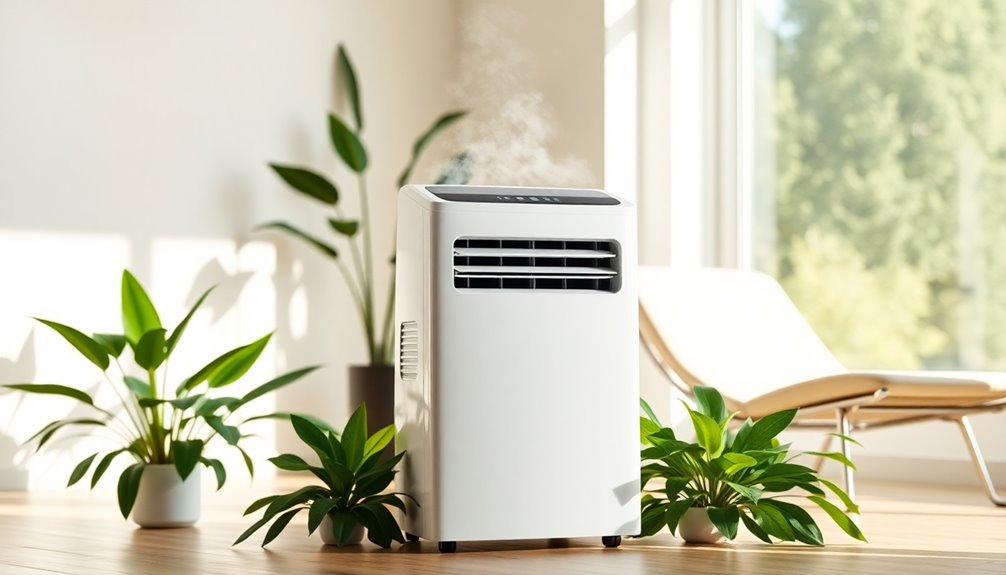
A portable air conditioner without exhaust hose is usually an evaporative cooler, so it lowers perceived temperature through moving air and water rather than removing heat from the room. My best overall pick is the Portable Windowless Air Conditioner with 1800 CFM, a 3-gallon tank, and 120° oscillation because it offers the strongest balance of airflow, runtime, and coverage among the true hoseless models. The 2-gallon, 20-hour Windowless Portable Air Conditioner Fan is my best value choice, while the 45.1-inch model stands out for bedrooms where a slim footprint matters. Buyers must choose between convenient, low-energy evaporative cooling and the stronger temperature reduction of a compressor AC, which still needs somewhere to discharge heat. Continue reading for my full breakdown of which designs suit dry climates, personal cooling, overnight use, and buyers willing to accept a vent hose.

Get home appliances delivered free — and shop member deals
- Fast, free delivery on millions of items
- Access to Prime Big Deal Days deals on October 6–7
- Prime Video, Amazon Music and more included
Complete the kit


Key Takeaways
- The 1800 CFM, 3-gallon model leads the hoseless group because its high airflow, larger reservoir, and 120° oscillation make it better suited to shared spaces than the smaller 2-gallon alternatives.
- Several listings are functionally duplicates: products 1 and 2 share the same headline specifications, while products 7 and 13 appear identical, making seller support, return terms, and price the deciding factors.
- The 45.1-inch tower model favors bedroom placement over raw airflow, trading the wider 120° sweep of the leading models for a slim body, 60° swing, and included ice packs.
- The 400W R-290 spot cooler is not a direct substitute for central room cooling; without a path for rejected heat, it makes more sense for close-range cooling or dehumidification than lowering the temperature of an enclosed room.
- The BTU-rated DREO, ZAFRO, Hykolity, Coolblus, and 8000-BTU models provide stronger cooling, but they belong to the vented compressor category and rank below the evaporative models for strict no-hose buyers.
| Portable Windowless Air Conditioner with 1800 CFM |  | Best Overall Evaporative Cooler | Airflow: 1800 CFM | Claimed coverage: Up to 600 sq. ft. | Water tank: 3 gallons | VIEW ON AMAZON | See Our Full Breakdown |
| Portable Windowless Air Conditioner 1800 CFM with 360° Wheels |  | Best for Room-to-Room Mobility | Airflow: 1800 CFM | Claimed coverage: Up to 600 sq. ft. | Water tank: 3 gallons | VIEW ON AMAZON | See Our Full Breakdown |
| Hoseless Portable Air Conditioner 3-in-1 Spot Cooler and Dehumidifier | 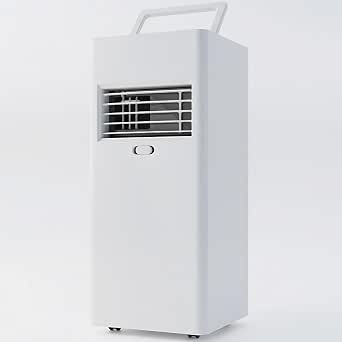 | Best Refrigerant Spot Cooler | Cooling capacity: 4000 BTU | Claimed coverage: Up to 150 sq. ft. | Power: 400W | VIEW ON AMAZON | See Our Full Breakdown |
| Windowless Air Conditioner Swamp Cooler with 2-Gallon Tank |  | Best Bedroom Pick | Claimed coverage: Up to 300 sq. ft. | Water tank: 2 gallons | Power consumption: 65W | VIEW ON AMAZON | See Our Full Breakdown |
| Windowless Portable Air Conditioner with Upgraded Motor | 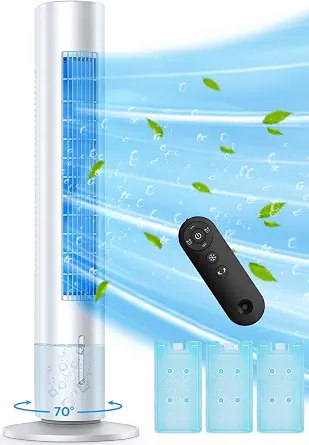 | Best for Small Home Offices | Claimed coverage: Up to 300 sq. ft. | Tank capacity: 2 gallons | Timer: 15 hours | VIEW ON AMAZON | See Our Full Breakdown |
| Windowless Portable Air Conditioner, 45.1-Inch Evaporative Air Cooler |  | Best Slim Tower Cooler | Water tank capacity: 1.06 gallons | Ice packs: 4 included | Oscillation: 60° | VIEW ON AMAZON | See Our Full Breakdown |
| Windowless Portable Air Conditioner Fan with 2-Gallon Tank |  | Best for Long Personal Cooling | Mounting type: Freestanding | Reservoir capacity: 2 gallons | Claimed runtime: Up to 20 hours | VIEW ON AMAZON | See Our Full Breakdown |
| Windowless Portable Air Conditioner with Dual Tanks |  | Best Wide-Angle Evaporative Cooler | Listed cooling area: 600 sq. ft. | Water tank capacity: 2 gallons | Ice packs: 6 reusable leak-proof packs | VIEW ON AMAZON | See Our Full Breakdown |
| Quiet Portable Air Conditioner 8000 BTU |  | Best True AC If Venting Is Acceptable | Cooling power: 8,000 BTU | Room size: Up to 350 sq. ft. | Noise level: 50 dB | VIEW ON AMAZON | See Our Full Breakdown |
| ZAFRO 16000 BTU Smart Inverter Portable Air Conditioner |  | Best Premium Power If Dual Hoses Are Allowed | Cooling capacity: 16,000 BTU ASHRAE / 12,000 BTU SACC | Cooling system: Inverter compressor with dual hoses | Noise level: 42 dB | VIEW ON AMAZON | See Our Full Breakdown |
| Portable Air Conditioner Fan with 3-in-1 Cooling, 6 Speeds, 12H Timer, 20H Cooling Tank, Remote Control, No Hose Needed |  | Best Overall Hoseless Pick | Cooling technology: Upgraded evaporative cooling | Water tank capacity: 3 gallons | Cooling duration: Up to 20 hours | VIEW ON AMAZON | See Our Full Breakdown |
| Windowless Portable Air Conditioner Fan, Evaporative Cooler with 3 Modes & 3 Speeds, 2-Gallon Tank, 20H Cooling, 12H Timer, Remote Control, No Hose Needed |  | Best Compact Hoseless Pick | Cooling type: Evaporative air cooler | Reservoir capacity: 2 gallons | Rated floor area: 150 sq. ft. | VIEW ON AMAZON | See Our Full Breakdown |
| DREO Portable Air Conditioner 515S, 12000 BTU ASHRAE Smart AC Unit |  | Best Premium Vented Alternative | Cooling capacity: 12,000 BTU ASHRAE / 8,000 BTU DOE | Coverage: Up to 16 ft | Noise level: 45 dB | VIEW ON AMAZON | See Our Full Breakdown |
| Hykolity WiFi Enabled Portable Air Conditioner 10,000 BTU |  | Best Quiet WiFi Alternative | Cooling capacity: 10,000 BTU | Room coverage: Up to 450 sq. ft. | Noise level: 45 dB | VIEW ON AMAZON | See Our Full Breakdown |
| Coolblus Portable Air Conditioner, 8500 BTU, 3-in-1 Cooling, Dehumidifier, Fan |  | Best Simple Compressor Alternative | Cooling capacity: 8,500 BTU | Room coverage: Up to 360 sq. ft. | Noise level: 52 dB | VIEW ON AMAZON | See Our Full Breakdown |
| portable air conditioner without exhaust hose | Noise level |
|---|---|
| Portable Windowless Air Condit | — |
| Portable Windowless Air Condit | — |
| Hoseless Portable Air Conditio | 40 dB |
| Windowless Air Conditioner Swa | 45 dB |
| Windowless Portable Air Condit | Below 45 dB |
| Windowless Portable Air Condit | 36.9 dB |
| Windowless Portable Air Condit | 45 dB |
| Windowless Portable Air Condit | Less than 25 dB |
| Quiet Portable Air Conditioner | 50 dB |
| ZAFRO 16000 BTU Smart Inverter | 42 dB |
| Portable Air Conditioner Fan w | 38 dB |
| Windowless Portable Air Condit | 45 dB |
| DREO Portable Air Conditioner | 45 dB |
| Hykolity WiFi Enabled Portable | 45 dB |
| Coolblus Portable Air Conditio | 52 dB |
More Details on Our Top Picks
Portable Windowless Air Conditioner with 1800 CFM
I rank the Portable Windowless Air Conditioner with 1800 CFM first because its high airflow, 3-gallon tank, and claimed 600-square-foot reach form the strongest package for large, dry spaces. Compared with the Windowless Air Conditioner, Swamp Cooler, it doubles the stated coverage and adds a larger tank, making it better suited to garages and open living areas. The 65W draw also keeps energy use far below a compressor air conditioner. Still, this is an evaporative cooler rather than true AC: it adds moisture and cannot provide a thermostat-controlled room temperature. The four ice packs may make the airflow feel cooler, but they require refreezing. I would choose it for broad air movement in an arid climate, while treating the 600-square-foot figure as a best-case claim rather than guaranteed whole-room cooling.
Pros:- 1800 CFM airflow is the strongest stated output in this five-product group
- 3-gallon tank supports longer sessions between refills
- 120-degree horizontal oscillation distributes air across wide spaces
- 65W power draw is economical for extended operation
Cons:- Cooling performance falls as humidity rises
- Cannot remove room heat like a vented compressor air conditioner
- Dimensions and weight are not supplied, making fit and portability hard to judge
Best for: People in dry climates who need strong airflow across a large living room, workshop, or garage without installing a hose
Not ideal for: Residents of humid regions or buyers expecting compressor-style temperature control across 600 square feet
- Airflow:1800 CFM
- Claimed coverage:Up to 600 sq. ft.
- Water tank:3 gallons
- Power consumption:65W
- Timer:15 hours
- Modes:Normal, Nature, Sleep, Cooling
- Oscillation:120° horizontal, 20° vertical
- Ice packs:4 reusable leak-proof packs
Our verdict“This is my first choice for high-volume airflow in a large, dry room, provided the buyer wants evaporative relief rather than true refrigerated cooling.”
Portable Windowless Air Conditioner 1800 CFM with 360° Wheels
The Portable Windowless Air Conditioner 1800 CFM with 360° Wheels shares nearly every major cooling specification with the top-ranked B0H3L1M5T8 model, so its clearest distinction is mobility. Its 360-degree silent wheels make more sense for buyers who plan to move one cooler between a home office, bedroom, and living area. The 1800 CFM output and 120-degree swing should spread air more broadly than the 2-gallon Windowless Portable Air Conditioner with 4 Modes & 3 Speeds. I place it second because the supplied data does not reveal a meaningful performance gain over the first pick. It also carries the same humidity-dependent cooling limitation: the unit circulates dampened air instead of extracting heat outdoors. A 3-gallon tank reduces refill frequency, although keeping the four ice packs cold adds another recurring chore.
Pros:- 360-degree silent wheels support frequent room-to-room movement
- 1800 CFM airflow is suited to broad air circulation
- 3-gallon reservoir can run longer than the 2-gallon alternatives
- Four modes and three speeds offer useful control over airflow
Cons:- Specifications are almost identical to the higher-ranked B0H3L1M5T8 model
- Water and frozen ice packs require repeated attention
- Evaporative operation can make a humid room feel clammy
Best for: Dry-climate households that want one high-airflow evaporative cooler to roll between several rooms
Not ideal for: Buyers who will leave the unit in one location or need dependable cooling during humid weather
- Airflow:1800 CFM
- Claimed coverage:Up to 600 sq. ft.
- Water tank:3 gallons
- Power:65W
- Timer:15 hours
- Fan speeds:3
- Noise in Sleep mode:Under 25 dB
- Oscillation:120° horizontal, 20° vertical
Our verdict“I favor this version for buyers who value easy rolling mobility more than a clearly differentiated cooling advantage.”
Hoseless Portable Air Conditioner 3-in-1 Spot Cooler and Dehumidifier
The Hoseless Portable Air Conditioner 3-in-1 Spot Cooler is the outlier here because it lists R-290 refrigerant, 4,000 BTU cooling, and dehumidification rather than relying on water-soaked media. That makes it more appealing than the Portable Windowless Air Conditioner with 1800 CFM in humid conditions, especially for close-range cooling in a tent or RV. I rank it below the evaporative leaders because a refrigerant unit must discharge captured heat somewhere. Without an exhaust hose, I would treat this as a personal spot cooler, not assume it can lower the temperature of a sealed 150-square-foot room; its warm side may offset the cold airflow. The 400W draw is modest beside many full-size portable ACs but much higher than the 65W evaporative models. Auto-evaporation reduces drainage work, while the 40 dB rating suits sleep-sensitive settings.
Pros:- R-290 refrigerant can deliver cooler spot airflow without adding moisture
- 400W demand is more manageable than many full-size compressor units
- Auto-evaporation reduces routine condensate handling
- Compact footprint and wheels suit tents, RVs, and small rooms
Cons:- Hoseless operation raises a major question about where condenser heat is discharged
- 150-square-foot claimed coverage is the smallest in this group
- 400W consumption is more than six times that of the listed evaporative models
Best for: Campers, RV owners, and desk-side users seeking targeted refrigerated airflow where humidity makes an evaporative cooler ineffective
Not ideal for: Anyone expecting hoseless whole-room refrigeration in a closed bedroom, since captured heat still needs somewhere to go
- Cooling capacity:4000 BTU
- Claimed coverage:Up to 150 sq. ft.
- Power:400W
- Voltage:115V
- Refrigerant:R-290
- Noise level:40 dB
- Dimensions:10.6 x 10.43 x 23.6 inches
- Controls:Remote and touch
Our verdict“This is my pick for targeted refrigerated airflow in humid or mobile settings, but I would not buy it as a substitute for a vented whole-room AC.”
Windowless Air Conditioner Swamp Cooler with 2-Gallon Tank
I see the Windowless Air Conditioner Swamp Cooler as the better bedroom choice because its 15-hour timer, Sleep mode, remote, and 45 dB rating support overnight control without leaving bed. Compared with the Portable Windowless Air Conditioner 1800 CFM, it has half the claimed coverage and a smaller 2-gallon tank, but that reduced capacity is less limiting in a bedroom under 300 square feet. Its stated 20-hour runtime can cover a full night, although actual duration will vary with speed and climate. The advertised 41–49°F cooling effect should not be read as a guaranteed drop in room temperature; evaporative cooling depends on dry air and often changes the temperature near the outlet more than across the entire room. I rank it below the refrigerant spot cooler because it cannot dehumidify or deliver consistent results in muggy conditions.
Pros:- 15-hour timer and remote are convenient for overnight use
- Four modes and three speeds allow quieter or stronger airflow
- 120-degree horizontal oscillation spreads air beyond one bedside position
- 65W consumption keeps overnight electricity use low
Cons:- Performance is strongly limited by indoor humidity
- 2-gallon tank is smaller than both 1800 CFM picks
- Claimed 41–49°F cooling effect may not represent the change in overall room temperature
Best for: Dry-climate sleepers who want remote operation, timed airflow, and a reservoir large enough to run overnight
Not ideal for: People with humid bedrooms, respiratory sensitivity to added moisture, or expectations of thermostat-controlled cooling
- Claimed coverage:Up to 300 sq. ft.
- Water tank:2 gallons
- Power consumption:65W
- Timer:15 hours
- Modes:Cooling, Sleep, Normal, Nature
- Fan speeds:3
- Noise level:45 dB
- Ice packs:4 reusable ice boxes
Our verdict“I recommend this for overnight evaporative cooling in a dry, modest-size bedroom where timer and remote access matter most.”
Windowless Portable Air Conditioner with Upgraded Motor
The Windowless Portable Air Conditioner with Upgraded Motor fits a small home office where adjustable airflow and low-distraction operation matter more than maximum capacity. Its 2-gallon tank, sub-45 dB claim, remote, and 15-hour timer closely resemble the Windowless Air Conditioner, Swamp Cooler, but the advertised upgraded motor gives this model a clearer emphasis on rapid airflow. I still place it fifth because no CFM figure or power rating is provided, making direct performance and running-cost comparisons difficult. The claim of a 41–49°F reduction in three seconds likely describes air near the outlet, not the temperature of a 300-square-foot room. Like the larger 1800 CFM picks, this is best in low humidity and requires water refills. Its 120-degree swing should reduce hot spots around a desk, though it cannot match true AC for sustained room cooling.
Pros:- Below-45 dB noise claim is suitable for calls and focused work
- 120-degree swing spreads airflow around a desk or small office
- Remote and 15-hour timer simplify adjustments during the workday
- Four modes and three speeds provide flexible airflow
Cons:- No CFM or wattage figure is supplied for meaningful performance comparison
- Rapid 41–49°F cooling claim does not establish a whole-room temperature drop
- Requires water and performs poorly as humidity increases
Best for: Remote workers in dry climates who want quiet, oscillating airflow for a home office of up to 300 square feet
Not ideal for: Spec-focused buyers who need verified airflow, power-consumption data, or dependable cooling in humid conditions
- Claimed coverage:Up to 300 sq. ft.
- Tank capacity:2 gallons
- Timer:15 hours
- Modes:Cooling, Sleep, Normal, Natural
- Fan speeds:3
- Horizontal swing:120°
- Noise level:Below 45 dB
- Claimed cooling effect:41–49°F reduction in 3 seconds
Our verdict“I would choose this for quiet desk-area relief in a dry home office, but not when measurable cooling output is the main priority.”
Windowless Portable Air Conditioner, 45.1-Inch Evaporative Air Cooler
I rank the 45.1-Inch Windowless Evaporative Air Cooler as the strongest space-saving tower choice in this group. Its 60° swing distributes air more broadly than a fixed personal fan, while the listed 36.9 dB noise level suits bedside use. Compared with the Windowless Portable Air Conditioner Fan with a 2-gallon tank, this model is quieter and slimmer, but its 1.06-gallon reservoir needs more frequent attention. The four ice packs can make the airflow feel cooler, though they do not provide compressor-style room cooling. I would treat the 250-square-foot rating as an airflow guideline, especially in humid weather. Its main tradeoff is limited endurance: buyers gain a tall, easy-to-place design but give up the larger tank and longer runtime offered by bulkier alternatives.
Pros:- Listed 36.9 dB operation is well suited to sleeping and focused work
- Tall, narrow design occupies little floor space
- Four included ice packs can produce cooler-feeling airflow
- Washable filter and remote control simplify routine use
Cons:- The 1.06-gallon tank requires more refilling than the 2-gallon models
- Evaporative cooling can add unwanted humidity
- Listed dimensions appear inconsistent with the tower-style product description
Best for: Bedroom or home-office users who want a quiet, narrow evaporative cooler with simple remote operation
Not ideal for: People in humid climates or anyone expecting a true air conditioner that lowers the temperature throughout a 250-square-foot room
- Water tank capacity:1.06 gallons
- Ice packs:4 included
- Oscillation:60°
- Timer:12 hours
- Noise level:36.9 dB
- Listed coverage:250 sq. ft.
- Power:65W
- Dimensions:8.86″D x 45.08″W x 8.66″H
- Weight:10.7 pounds
Our verdict“I recommend this model for quiet, space-conscious personal cooling, provided the buyer accepts regular refilling and evaporative rather than refrigerated cooling.”
Windowless Portable Air Conditioner Fan with 2-Gallon Tank
I place the Windowless Portable Air Conditioner Fan ahead of smaller-tank choices for buyers who dislike frequent refills. Its 2-gallon reservoir is rated for up to 20 hours, nearly doubling the capacity of the 45.1-Inch Windowless Evaporative Air Cooler. Built-in wheels also make this model easier to move, though its 150-square-foot rating positions it as a personal or small-room cooler rather than a whole-room AC. The supplied noise figures conflict—45 dB in the specifications and 38 dB in the product claims—so I would not choose it solely for silent operation. Three modes and three speeds offer useful control without app setup. The larger tank is the deciding advantage, while narrower coverage, added bulk, and evaporative performance in humid air keep it below wider-swing alternatives.
Pros:- Two-gallon tank supports a claimed runtime of up to 20 hours
- Swivel casters and a portable form factor aid room-to-room movement
- Three modes and three speeds provide straightforward airflow control
- Remote control allows adjustments from a bed or desk
Cons:- Coverage is limited to a listed 150 square feet
- Published noise figures conflict between the specifications and product claims
- No smart-home or app integration
Best for: Remote workers or sleepers cooling a small, dry room who want long runtime and easy movement between spaces
Not ideal for: Smart-home users, humid-climate households, or buyers who need cooling beyond a 150-square-foot personal zone
- Mounting type:Freestanding
- Reservoir capacity:2 gallons
- Claimed runtime:Up to 20 hours
- Listed coverage:150 sq. ft.
- Noise level:45 dB
- Fan speeds:3
- Power:65W
- Dimensions:12.6″D x 11.02″W x 22.6″H
- Weight:12.5 pounds
Our verdict“I would choose this for long-duration personal airflow in a small, dry room, not as a substitute for refrigerated air conditioning.”
Windowless Portable Air Conditioner with Dual Tanks
The Windowless Portable Air Conditioner with Dual Tanks earns its place through coverage flexibility rather than raw cooling power. Its 120° horizontal and 110° vertical swing reaches more directions than the 60° oscillation of the 45.1-Inch Windowless Evaporative Air Cooler, making it better suited to a shared bedroom or small living area. Six reusable ice packs and dual tanks reduce interruptions, while the listed sub-25 dB noise level is unusually low. I remain cautious about the 600-square-foot claim: at 65W, this is still an evaporative cooler, so that figure should not be confused with compressor AC coverage. Compared with the 2-Gallon Windowless Portable Air Conditioner Fan, it offers broader air distribution and more ice packs. Its weak point is climate dependence, since high humidity reduces evaporation and can make the room feel clammy.
Pros:- Wide horizontal and vertical swing distributes air across multiple positions
- Dual tanks support a claimed cooling duration of up to 24 hours
- Six reusable ice packs exceed the included pack count of smaller alternatives
- Listed noise below 25 dB favors bedrooms and shared workspaces
Cons:- The 600-square-foot coverage claim is ambitious for a 65W evaporative unit
- Cooling performance falls as indoor humidity rises
- Continuous use requires water refills and repeated ice-pack freezing
Best for: Couples, dorm residents, or RV users who want quiet, wide-swing airflow across more than one seating or sleeping position
Not ideal for: Buyers in humid regions or anyone relying on the 600-square-foot claim for compressor-like whole-room cooling
- Listed cooling area:600 sq. ft.
- Water tank capacity:2 gallons
- Ice packs:6 reusable leak-proof packs
- Claimed runtime:Up to 24 hours
- Power consumption:65W
- Noise level:Less than 25 dB
- Swing range:120° horizontal and 110° vertical
- Dimensions:11″ x 10″ x 22″
- Remote range:26 feet
Our verdict“I favor this model for broad, quiet airflow in dry spaces, while treating its large coverage claim as air-distribution reach rather than true AC capacity.”
Quiet Portable Air Conditioner 8000 BTU
I would only place the Quiet Portable Air Conditioner 8000 BTU on a hoseless shortlist as a comparison point for buyers willing to compromise on the title’s main promise. Unlike the Windowless Portable Air Conditioner with Dual Tanks, this compressor model can lower room temperature and remove moisture rather than merely sending water-cooled airflow into the room. Its 8,000 BTU rating covers up to 350 square feet, and sleep mode plus a 24-hour timer suit overnight schedules. The catch is decisive: it needs the included window kit and an exhaust connection, so it is not windowless or hoseless. At 47 pounds and 750W, it is also far heavier and more power-hungry than the 65W evaporative picks. I rank it for real medium-room cooling, but only where vent installation is possible.
Pros:- Compressor cooling can reduce room temperature rather than only cool the airflow
- Dehumidifier mode is useful in muggy conditions
- Twenty-four-hour timer and sleep mode support scheduled overnight use
- Caster wheels help offset the heavy cabinet
Cons:- Requires a window kit and exhaust hose, directly conflicting with a hoseless requirement
- At 47 pounds, it is much less portable than the evaporative models
- 750W power draw is far higher than the 65W windowless coolers
Best for: Apartment dwellers who can install a window exhaust kit and need genuine cooling plus dehumidification in a room up to 350 square feet
Not ideal for: Renters who cannot use a window kit or shoppers specifically requiring a hose-free appliance
- Cooling power:8,000 BTU
- Room size:Up to 350 sq. ft.
- Noise level:50 dB
- Refrigerant:R-32
- Power:750W
- Voltage:115V
- Dimensions:11.4″D x 12″W x 26.5″H
- Weight:47 pounds
- Installation:Tool-free window kit included
Our verdict“I recommend this only when actual 350-square-foot cooling matters more than avoiding a window kit and exhaust hose.”
ZAFRO 16000 BTU Smart Inverter Portable Air Conditioner
The ZAFRO 16000 BTU Smart Inverter Portable Air Conditioner is the most capable cooling machine here, but it is also the poorest literal match for a roundup centered on no exhaust hose. Its inverter compressor and dual-hose system deliver far stronger, steadier cooling than any of the evaporative models. Against the Quiet Portable Air Conditioner 8000 BTU, the ZAFRO offers higher 12,000 BTU SACC output, app control, a lower listed 42 dB noise level, and a strong 12.8 CEER efficiency rating. Those gains come with more involved installation, two hose connections, and a cabinet described as bulky. Self-evaporation can postpone drainage for up to 72 hours, but high humidity may still require a drain hose. I view this as the premium vented alternative for buyers whose real priority is powerful cooling rather than a genuinely windowless setup.
Pros:- Inverter compressor and dual-hose design support fast, even cooling
- 12,000 BTU SACC output exceeds the 8,000 BTU model
- App and remote controls provide flexible operation
- Listed 42 dB noise and 12.8 CEER combine quiet use with strong efficiency
Cons:- Dual exhaust hoses directly conflict with a no-hose buying requirement
- Setup is more involved than with evaporative coolers or single-hose units
- A drain hose may still be needed during humid conditions
Best for: Tech-focused buyers who can accommodate dual exhaust hoses and want powerful, quiet, app-controlled compressor cooling
Not ideal for: Anyone who needs a genuinely hoseless unit, has little floor space, or wants the simplest possible setup
- Cooling capacity:16,000 BTU ASHRAE / 12,000 BTU SACC
- Cooling system:Inverter compressor with dual hoses
- Noise level:42 dB
- Energy efficiency:12.8 CEER
- Controls:App and remote control
- Modes:Cool, Dry, Fan, Sleep, Extra, Eco
- Timer:24 hours
- Drainage:Up to 72 hours drainage-free; drain hose for high humidity
Our verdict“I would pick the ZAFRO for premium compressor performance and smart control only when dual-hose installation is fully acceptable.”
Portable Air Conditioner Fan with 3-in-1 Cooling, 6 Speeds, 12H Timer, 20H Cooling Tank, Remote Control, No Hose Needed
I rank the Portable Air Conditioner Fan B0GXDKX7FB first in this batch because it delivers the strongest balance of genuine hose-free operation, adjustment range, and low noise. Its three-gallon tank is larger than the two-gallon reservoir in the Windowless Portable Air Conditioner Fan B0GXD398BT, while six speeds provide finer airflow control than that model’s three. The claimed 38 dB output also makes this the better bedroom candidate. Up to 20 hours of operation reduces refill frequency, though actual runtime will depend on speed and room conditions. This is still an evaporative cooler rather than a refrigerated AC: it cools the airflow around a person and adds moisture, but cannot pull an entire humid room down to a set temperature. Buyers seeking compressor-level cooling should choose the DREO 515S and accept an exhaust setup.
Pros:- Completely hoseless operation with no window installation
- Three-gallon tank supports up to 20 hours of cooling
- Six speeds provide more airflow control than the other evaporative model
- Claimed 38 dB noise level suits sleep and focused work
Cons:- Evaporative cooling cannot match a compressor air conditioner
- Performance declines as indoor humidity rises
- The tank needs refilling and routine cleaning
Best for: I would choose this for bedroom or home-office users in dry climates who want quiet, adjustable personal cooling without a window hose.
Not ideal for: I would skip it for humid rooms or buyers expecting thermostat-controlled, whole-room temperature reduction.
- Cooling technology:Upgraded evaporative cooling
- Water tank capacity:3 gallons
- Cooling duration:Up to 20 hours
- Modes:Cooling, Natural, Sleep
- Speeds:6
- Maximum airflow:32 ft/s
- Timer:1–12 hours
- Noise level:38 dB
- Remote range:16 feet
Our verdict“This is my leading hoseless choice for quiet personal cooling, provided the room is dry enough for evaporation to work well.”
Windowless Portable Air Conditioner Fan, Evaporative Cooler with 3 Modes & 3 Speeds, 2-Gallon Tank, 20H Cooling, 12H Timer, Remote Control, No Hose Needed
The Windowless Portable Air Conditioner Fan B0GXD398BT earns the compact role because its 12.5-pound body is easier to reposition than a full compressor unit, and its stated 150-square-foot coverage keeps expectations grounded. Compared with the Portable Air Conditioner Fan B0GXDKX7FB, it has a smaller two-gallon tank, half as many speeds, and a higher 45 dB rating. In return, its narrower 11.02-inch width is friendly to cramped bedrooms, dorms, and deskside spaces. The three modes, oscillation, remote, and 12-hour timer cover everyday personal-cooling needs without window hardware. I would treat the advertised 20-hour runtime as a best-case figure rather than guaranteed performance. Like the other hoseless pick, this is an evaporative spot cooler, so it will not dehumidify or deliver the room-wide temperature drop of the vented Coolblus model.
Pros:- No exhaust hose, window adapter, or fixed installation
- 12.5-pound construction is easy to move
- Two-gallon tank supports long unattended sessions
- Oscillation, remote control, and timer add practical convenience
Cons:- Only intended for personal cooling across about 150 square feet
- Three speeds offer less control than the six-speed B0GXDKX7FB model
- Adds humidity and loses effectiveness in damp rooms
Best for: I would recommend this to renters, students, and home-office users who need a light, narrow cooler for a personal zone of roughly 150 square feet.
Not ideal for: I would skip it for large living rooms, humid climates, or anyone who needs active dehumidification.
- Cooling type:Evaporative air cooler
- Reservoir capacity:2 gallons
- Rated floor area:150 sq. ft.
- Speeds:3
- Noise level:45 dB
- Wattage:65 watts
- Weight:12.5 pounds
- Dimensions:12.6 x 11.02 x 22.05 inches
- Controls:Remote control
Our verdict“This is my compact hoseless pick for close-range cooling where low weight matters more than whole-room performance.”
DREO Portable Air Conditioner 515S, 12000 BTU ASHRAE Smart AC Unit
I place the DREO 515S above the other compressor models because its 12,000 BTU ASHRAE rating, 45 dB noise claim, and app, voice, and remote controls form the strongest premium package. Unlike the Portable Air Conditioner Fan B0GXDKX7FB, this model uses refrigeration and can lower indoor temperature while removing moisture. That makes it much more capable during humid heat. The tradeoff is central to this roundup: drainage-free does not mean exhaust-free. Self-evaporation addresses collected condensate, not the hot air produced by the cooling cycle, so I would not buy it as a truly hoseless machine. Its smart setup may also feel excessive for someone wanting simple buttons. Still, the 8,000 BTU DOE rating gives buyers a clearer real-world capacity reference than listings that state only one BTU figure.
Pros:- Refrigerated cooling is far stronger than evaporative alternatives
- 45 dB noise rating is suitable for many bedrooms
- App, Siri, Alexa, Google Home, and remote controls
- Self-evaporating design reduces routine condensate draining
Cons:- Drainage-free wording does not make the compressor system exhaust-free
- Smart setup may be complicated for buyers seeking simple controls
- Indoor-only design limits placement
Best for: I would choose this for tech-oriented bedroom users who prioritize strong refrigerated cooling, quiet operation, and voice control over hose-free placement.
Not ideal for: I would skip it for buyers who cannot vent hot air through a window or who want a basic cooler without app setup.
- Cooling capacity:12,000 BTU ASHRAE / 8,000 BTU DOE
- Coverage:Up to 16 ft
- Noise level:45 dB
- Temperature range:61°F–86°F
- Modes:Cool, Fan, Dry
- Connectivity:App and voice control
- Voice platforms:Siri, Alexa, Google Home
- Drainage:Self-evaporating system
Our verdict“I recommend the DREO 515S when real room cooling and smart controls outweigh the need for a genuinely hoseless design.”
Hykolity WiFi Enabled Portable Air Conditioner 10,000 BTU
The Hykolity 10,000 BTU Portable Air Conditioner makes the most sense for buyers who want quiet WiFi control without paying for the broader voice-platform support listed for the DREO 515S. Both claim 45 dB operation, but Hykolity states coverage up to 450 square feet and includes the exhaust hose and window adapter needed for installation. Those accessories also expose why it ranks below the two evaporative coolers for this particular roundup: it is not a hoseless product. In exchange for accepting a window connection, the buyer gets refrigerated cooling, dehumidification, a turbo mode, and steadier performance in humid weather. I would also be cautious when comparing its single 10,000 BTU figure with DREO’s separate ASHRAE and DOE ratings because the stated measurement standard is unclear. WiFi is optional for basic control, though it is required to receive the model’s main smart benefit.
Pros:- Refrigerated cooling and dehumidification handle humid weather
- 45 dB claimed noise level compares well with other compressor units
- WiFi, remote, and LED controls offer flexible operation
- Exhaust hose and window adapter are included
Cons:- Requires an exhaust hose and window installation
- BTU measurement standard is not identified in the supplied data
- Full smart functionality depends on WiFi
Best for: I would select this for connected-home users cooling a room up to 450 square feet who have a suitable window and value low stated noise.
Not ideal for: I would skip it for windowless rooms, WiFi-averse buyers, or anyone whose main requirement is zero exhaust hose.
- Cooling capacity:10,000 BTU
- Room coverage:Up to 450 sq. ft.
- Noise level:45 dB
- Modes:Turbo, Cool, Fan, Dehumidify, Sleep
- Controls:WiFi, remote, LED display
- Self-evaporation:Yes
- Included venting accessories:Exhaust hose and window adapter
Our verdict“This is my quiet WiFi alternative for buyers willing to trade hoseless placement for stronger room cooling.”
Coolblus Portable Air Conditioner, 8500 BTU, 3-in-1 Cooling, Dehumidifier, Fan
I assign the Coolblus 8,500 BTU Portable Air Conditioner the simple-compressor role because it covers the basics—cooling, drying, and air circulation—without making WiFi part of the proposition. Its stated 360-square-foot coverage suits a modest bedroom or office, but the Hykolity 10,000 BTU model reaches a claimed 450 square feet and runs at 45 dB versus Coolblus’s 52 dB. Coolblus is also the weaker long-session choice because it lacks inverter technology and lists only one power level. Most importantly, the supplied window kit means this is a vented AC, despite its portable format; buyers seeking no hose should move toward the B0GXDKX7FB evaporative cooler. The benefit of accepting that installation is true refrigerated cooling plus dehumidification. Casters, a remote, a washable mesh filter, sleep mode, and a 24-hour timer keep everyday operation manageable.
Pros:- Three operating functions cover cooling, dehumidifying, and circulation
- Rated for rooms up to 360 square feet
- Casters and remote control simplify daily use
- Washable mesh filter reduces replacement needs
Cons:- Window kit and venting conflict with a strict no-hose requirement
- 52 dB rating is louder than the Hykolity and DREO models
- No inverter and only one power level limit efficiency control
Best for: I would choose this for buyers cooling a medium-size bedroom or office who want basic refrigerated performance and remote operation without smart-home features.
Not ideal for: I would skip it for light sleepers, energy-focused long-term users, and rooms where an exhaust connection cannot be installed.
- Cooling capacity:8,500 BTU
- Room coverage:Up to 360 sq. ft.
- Noise level:52 dB
- Operating modes:Cooling, Dehumidifying, Air Circulation
- Wattage:840 watts
- Refrigerant:R-32
- Filter:Washable mesh filter
- Inverter:No
- Controls:Remote control
Our verdict“I recommend the Coolblus only when straightforward refrigerated cooling matters more than quiet operation, smart controls, or a hoseless setup.”

How We Picked
I ranked these products with category fit as the first filter. Models that genuinely operate without an exhaust connection received priority, while conventional BTU-rated units were retained as comparison points for buyers who value stronger cooling more than hose-free installation. Within the hoseless group, I compared airflow, tank capacity, oscillation, operating modes, timer length, controls, and footprint. I treated large coverage claims cautiously when a listing did not provide airflow data or explain the cooling method.
The highest positions went to models offering the best balance of air movement, practical runtime, and room distribution. I placed greater weight on a large reservoir and wide swing than on extra fan-speed increments, since those features have a bigger effect on daily usability. Bedroom-oriented models gained ground for quiet modes, timers, and slim dimensions, while duplicate listings received no automatic advantage for repeating the same specifications. My rankings also reflect maintenance demands and value, including refill frequency, cleaning access, ice-pack dependence, and whether paying more buys stronger cooling or merely more controls.
Factors to Consider When Choosing Portable Air Conditioner Without Exhaust Hose
The phrase hoseless portable air conditioner covers several different technologies, and choosing the wrong one can lead to disappointing room temperatures. I recommend starting with the cooling method, local humidity, and intended distance from the unit before comparing modes, timers, or remote controls.
Understand Where the Heat Goes
A true compressor air conditioner moves heat from one place to another, which means that heat needs an outlet. A single-hose or dual-hose unit sends it outdoors, while a ventless compressor device may release it back into the same room. An evaporative cooler avoids that problem because it uses water evaporation and airflow instead of a refrigeration cycle. The tradeoff is that it usually changes how cool you feel more than it changes the room’s measured temperature. I would choose a hoseless evaporative model for flexible spot cooling and a vented compressor model when maintaining a set temperature matters. Claims of high BTU output without any stated heat-discharge method deserve extra scrutiny.
Match Evaporative Cooling to Your Climate
Evaporative coolers perform best when the surrounding air is dry enough to absorb more moisture. In an arid climate, that evaporation can produce a useful temperature drop while adding welcome humidity. In a muggy climate, the water evaporates more slowly and the room may begin to feel clammy. I would check typical summer indoor relative humidity, not only the outdoor forecast, because kitchens, bathrooms, and basements often hold more moisture. Once indoor humidity regularly sits above roughly 60 percent, a fan or vented AC may be a better purchase. Leaving a door or window slightly open can support air exchange, even though the cooler itself needs no fitted exhaust hose.
Separate Airflow From Room-Cooling Capacity
High CFM describes how much air a unit moves, not how many degrees it can lower an enclosed room. Strong airflow matters in a living area because it carries the cooling sensation farther and works better across multiple seats. A lower-output tower can still suit a bedroom when it sits close to the bed and runs quietly. I would favor wide oscillation for shared rooms and focused airflow for a desk, sofa, or sleeping position. Room-size claims are more credible when supported by airflow or BTU data rather than marketing language alone. Buyers often get better results by treating a hoseless unit as a personal cooling zone instead of expecting whole-home climate control.
Account for Water, Cleaning, and Refill Work
A larger tank extends the gap between refills, but actual runtime changes with fan speed, humidity, and the cooling mode selected. A 3-gallon reservoir makes sense for long daytime sessions, while a 2-gallon tank can be easier to lift, empty, and clean. Ice packs may sharpen the initial cooling sensation, though they add freezer space and a repeated swapping routine. I would inspect whether the tank is removable or easy to drain, since inaccessible corners can collect scale and biofilm. Hard-water households may need filtered water or more frequent descaling to keep the cooling pad working well. The best tank size is the one that balances runtime with manageable maintenance, not simply the largest number on the listing.
Choose Controls That Match Daily Use
Extra modes add value only when they change how the unit fits a routine. A sleep setting, dimmed display, and long timer matter more in a bedroom than six closely spaced fan speeds. Remote control is useful when the cooler sits across a room, while app control mainly benefits buyers who want scheduling away from home. I would prioritize simple onboard controls if several household members will operate the unit. Published noise figures are more useful than labels such as quiet, though sound character can still vary between a steady fan and a cycling compressor. For overnight use, low-speed noise and display brightness deserve as much attention as maximum cooling output.
Know When Paying for a Vented AC Makes Sense
A hoseless evaporative cooler is usually the more economical choice for a dry room, a rental with installation limits, or close-range relief. Paying more for a compressor model makes sense when the goal is a stable thermostat setting, humidity removal, or cooling through hot nights. Dual-hose systems can avoid pulling as much warm outside air into the room as many single-hose designs. They still require a window panel or another vent opening, so portability has practical limits. I would choose real refrigerated cooling for humid climates and heat-sensitive occupants, even if that means accepting installation work. A higher purchase price is easier to justify when it buys measurable room-temperature control rather than decorative features or additional fan modes.
Frequently Asked Questions
Can a Portable Air Conditioner Really Cool a Whole Room Without an Exhaust Hose?
Most models sold this way are evaporative coolers or powerful fans, not conventional air conditioners. They can make occupants feel cooler and may lower air temperature in dry conditions, but they do not remove heat from an enclosed room like a vented compressor unit. A refrigerant-based model needs to discharge heat somewhere; releasing that heat indoors cancels much of its room-cooling effect. I would use a hoseless model for localized comfort, open-air circulation, or a dry room with some ventilation. For reliable whole-room temperature control, a window unit, mini-split, or properly vented portable AC is the safer choice.
Will an Evaporative Cooler Work in a Humid Bedroom?
It will still move air, but its evaporative cooling effect weakens as humidity rises. Adding more moisture can also make a humid bedroom feel sticky, particularly with the door and windows closed. I would check indoor humidity with an inexpensive hygrometer and use the fan-only mode when moisture levels are already high. A dehumidifier can help, though operating one beside an evaporative cooler creates competing processes and uses more energy. In consistently humid regions, a vented AC with dehumidification is usually the better bedroom solution.
Is a 3-Gallon Tank Better Than a 2-Gallon Tank?
A 3-gallon tank usually supports longer operation between refills, making it attractive for daytime use in a living room. The benefit shrinks in humid weather because the unit consumes water more slowly and produces less evaporative cooling. Larger tanks also weigh more when full and can be harder to carry or clean. I prefer the 3-gallon format for extended sessions and a 2-gallon model when easy handling matters more. Tank access, a low-water shutoff, and cleaning convenience can matter more than the extra gallon.
Should I Trust BTU Ratings on a No-Hose Model?
BTU ratings are useful for compressor air conditioners when the listing identifies a recognized measurement standard such as DOE or ASHRAE. They are less helpful when a seller calls an evaporative cooler an air conditioner without explaining its refrigeration system. If a BTU-rated device has no exhaust path, I would ask how it handles the heat removed from the cold-air stream. CFM is the more relevant figure for comparing evaporative airflow, while climate and humidity shape the cooling effect. A clear cooling method and credible heat-discharge design carry more weight than a large isolated number.
Should I Buy a Hoseless Cooler or a Dual-Hose Portable AC?
Choose a hoseless cooler when you live in a dry climate, need easy movement between rooms, or cannot install a window kit. It will generally cost less to run and set up, but it cannot match compressor-based temperature control. A dual-hose AC makes more sense for humid weather, larger heat loads, and thermostat-controlled cooling. It costs more, produces compressor noise, and needs a compatible opening for both air paths. My dividing line is simple: choose hoseless convenience for personal comfort and dual-hose refrigeration when cooling the entire room is the goal.
What are the best portable air conditioners without hose?
The best portable air conditioners without hose are designed for easy setup and convenience. The picks above offer models that operate without the need for exhaust hoses, making them ideal for spaces where venting options are limited. These units typically use advanced cooling technologies or evaporative systems to provide effective cooling without the hassle of installation. When choosing among the portable air conditioners without hose, consider factors like cooling capacity, noise levels, and energy efficiency to find the best fit for your needs. The options listed in the article provide reliable performance and user-friendly features for effortless cooling experiences.
What are the best portable ac units with no exhaust?
The best portable ac units with no exhaust are evaporative air coolers and ventless models that cool without a window hose, making them ideal for rooms where venting is impractical. The picks above were selected for cooling performance, water tank capacity, energy efficiency, noise level, and ease of use. Keep in mind that ventless units work best in dry climates, since they add moisture to the air as they cool; in humid areas, their effectiveness drops noticeably. For the best results, match the unit’s coverage area to your room size, look for features like multiple fan speeds, timers, and remote controls, and consider portability if you plan to move it between rooms. Check the recommendations above to find the option that fits your space and cooling needs.
Conclusion
For most strict no-hose buyers, my best overall recommendation is the Portable Windowless Air Conditioner with 1800 CFM, a 3-gallon tank, and 120° oscillation. Its combination of strong airflow, long refill intervals, and broad distribution gives it a clearer shared-room advantage over the smaller-tank models. The 2-gallon, 20-hour Windowless Portable Air Conditioner Fan is my best value pick; products 7 and 13 appear identical, so I would buy from whichever listing offers the lower price and better return policy. For beginners, the Windowless Portable Air Conditioner with four modes, three speeds, a 2-gallon tank, and remote control offers a simpler balance without app setup or compressor installation.
The 45.1-inch evaporative tower is my premium-style hoseless choice for bedrooms, especially when a slim footprint, ice packs, and a 12-hour timer matter more than wide oscillation. For close-range refrigerated cooling, the 400W R-290 model is the specialist option, though I would not rely on it to lower the temperature of a sealed room without a clear heat outlet. Buyers who need genuine room cooling should skip the strict hoseless category: the DREO 515S is my premium smart alternative, while the ZAFRO dual-hose model suits buyers focused on airflow efficiency. In short, I would choose an evaporative model for dry-climate flexibility and accept a vent hose whenever dependable temperature reduction or humidity control is the main goal.
Cold & flu season Picks
humidifiers
As an affiliate, we earn on qualifying purchases.