Choosing the right inverter window air conditioner can significantly lower your electricity bills while maintaining a consistent indoor temperature. My top overall pick is the Midea 10,000 BTU U-Shaped Smart Inverter Window AC because it balances powerful cooling for medium rooms with exceptional quiet operation and smart home integration. For those needing maximum power, the LG 23,500 BTU Dual Inverter stands out, though it requires a dedicated 230V outlet. The main tradeoff you will face is between energy efficiency and upfront cost, as inverter models are pricier than traditional units but offer long-term savings. Continue reading to see how these models compare in performance, noise levels, and installation flexibility.

Get home appliances delivered free with Prime
- Fast, free delivery on millions of items
- Prime Video, Amazon Music and more included
- Member-only deals all year
Complete the kit


Key Takeaways
- Inverter technology reduces energy consumption by up to 35-37% compared to standard non-inverter models, making the higher upfront cost justifiable for frequent users.
- U-shaped designs, such as the Midea U series, allow windows to remain open for natural ventilation while still providing efficient cooling, a feature absent in traditional box-style units.
- High-capacity units (18,000+ BTU) typically require 208/230V power, meaning renters or older homes with standard 115V outlets cannot use the most powerful models without electrical upgrades.
- Smart features like Wi-Fi and voice control are now standard across mid-range models, allowing users to pre-cool rooms before arriving home, which enhances comfort without wasting energy.
- Noise levels vary dramatically; inverter compressors are inherently quieter than traditional ones, but U-shaped designs further reduce perceived noise by isolating the compressor outside the window.




| inverter window air conditioner | Noise level | Wattage | Refrigerant | Voltage |
|---|---|---|---|---|
| Midea 7,800 BTU Window Air Con | 39 dBA | — | — | — |
| Midea 6,000 BTU U-Shaped Windo | 32 dBA | — | — | — |
| Midea 10,000 BTU U-Shaped Smar | 32 dB | 890 watts | R-32 | 115 volts |
| Midea 14,000 BTU Smart Inverte | 41 dB | 1,508 watts | R-32 | 115 volts |
| ROVSUN 8000 BTU Window Air Con | 40 dB | 870W | R-32 | 115V |
| Midea 8,000 BTU U-Shaped Smart | — | 710 W | R-32 | 115 V |
| Midea 18,000 BTU Smart Inverte | 48 dB | 2,760 W | R-32 | 230 V |
| LG 23,500 BTU Dual Inverter Sm | 44 dB | — | R-32 | 230 V |
| Hisense 12,000 BTU Inverter Wi | — | 1,120 W | — | 115 V |
| Midea 10,000 BTU U-Shaped Wind | — | 890 W | R-32 | 115 V |
| LG 12,000 BTU Window Air Condi | 44 dB | 1520 watts | R-32 | — |
| Midea 8,000 BTU Smart Inverter | 45 dBA | — | — | 115V |
| Midea 5,000 BTU Window Air Con | 52 dB | 580 watts | R-32 | — |
| Midea 8,000 BTU Smart Inverter | 40 dB | 900 watts | — | — |
| Midea 6,000 BTU U-Shaped Windo | 32 dBA | 625 watts | R-32 | — |
More Details on Our Top Picks
Midea 7,800 BTU Window Air Conditioner with Inverter Technology
I’d put this Midea first for buyers who need an inverter AC that can handle a bedroom or living area without stepping up to a large-unit footprint. Its 7,800 BTU capacity is rated for rooms up to 340 square feet, while the 39 dBA operation and app or voice controls suit spaces where noise and convenience matter. Compared with the Midea 6,000 BTU U-Shaped, it has more cooling headroom but gives up that model’s especially quiet 32 dBA operation and window-opening design. Auto, Cool, Dry, and Fan modes cover routine use, and the Energy Star certification supports its efficiency case. The tradeoffs are a narrower fit: it requires a compatible single- or double-hung window, and the supplied product information flags a possible missing-part issue that may require customer support.
Pros:- 7,800 BTU capacity is rated for rooms up to 340 square feet.
- 39 dBA noise level is suited to bedrooms and living spaces.
- SmartHome app and voice-assistant control add remote convenience.
- Energy Star certification and inverter technology support efficient operation.
Cons:- Fits only specified single- or double-hung window dimensions, not casement windows.
- The product information notes that a part may be missing, potentially requiring customer support.
- It is louder than the 32 dBA Midea U-shaped models in this lineup.
Best for: People cooling a bedroom or living room up to 340 square feet who want inverter efficiency, app control, and more capacity than a compact 6,000 BTU AC.
Not ideal for: Buyers with casement windows, windows outside the specified dimensions, or anyone prioritizing a U-shaped design that leaves more of the window usable.
- Cooling capacity:7,800 BTU
- Room coverage:Up to 340 sq ft
- Noise level:39 dBA
- Energy Efficiency Ratio:15.1
- Modes:Auto, Cool, Dry, Fan
- Speed settings:3 (Auto/H/M/L)
- Smart control:SmartHome App and voice assistant
- Window fit:Single- or double-hung; 23–36 in wide, 19.6 in high
Our verdict“Choose this as a versatile inverter AC for a mid-size room if your window fits and you value smart control over a U-shaped window design.”
Midea 6,000 BTU U-Shaped Window Air Conditioner, Cools up to 250 Sq Ft
For a smaller bedroom where sound matters more than extra cooling capacity, I’d favor this 6,000 BTU U-shaped AC. Its stated 32 dBA noise level is quieter than the 39 dBA Midea 7,800 BTU model, and the U-shaped layout lets the window open while the unit remains installed—a practical difference for fresh air and preserving more of the view. It also offers inverter operation and compatibility with Alexa, Google Assistant, Matter, and smartwatch controls. The limitation is room size: coverage is listed at up to 250 square feet, so it is a less suitable choice than the 7,800 BTU model for larger living areas. Installation also depends on a specific window opening, and the Jet Black finish may not blend with every room.
Pros:- 32 dBA operation is the quietest stated level among these five options.
- U-shaped design allows the window to open while the AC stays installed.
- Inverter technology and smart-home compatibility support convenient, efficient use.
- Works with Alexa, Google Assistant, Matter, and smartwatch controls.
Cons:- 6,000 BTU capacity is limited to rooms up to 250 square feet.
- Window fit is restricted to 24–36 inches wide with at least 14.5 inches of opening height.
- Jet Black is the only listed color and may not suit every interior.
Best for: Light sleepers or apartment dwellers cooling a bedroom or small living space up to 250 square feet who want a quieter AC and an operable window.
Not ideal for: People cooling rooms larger than 250 square feet, or buyers whose windows do not meet the listed width and opening-height requirements.
- Cooling capacity:6,000 BTU
- Room coverage:Up to 250 sq ft
- Noise level:32 dBA
- Design:U-shaped window AC
- Smart-home compatibility:Alexa, Google Assistant, SmartWatch, Matter
- Window fit:24–36 in wide; minimum opening height 14.5 in
- Color:Jet Black
- Warranty:2 years
Our verdict“Pick this for a small bedroom where low noise and an opening window matter more than the greater coverage of the Midea 7,800 BTU AC.”
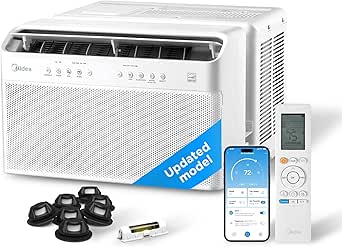
Midea 10,000 BTU U-Shaped Smart Inverter Window AC, Cools 450 Sq Ft, Ultra Quiet, Alexa/Google Compatible, 35% Energy Savings
This Midea is the stronger fit when a room needs more cooling than the 6,000 BTU U-shaped model can provide, but you still want the design benefits of an operable window. Its 10,000 BTU capacity is rated for up to 450 square feet, and the listed 32 dB noise level keeps it competitive for bedrooms and shared living areas. Wi-Fi and Alexa or Google Assistant support make remote adjustments easier; the 7,800 BTU Midea offers similar smart convenience but is rated for a smaller area and does not list a U-shaped design. The tradeoff is a more demanding installation: the unit weighs 56.9 pounds and requires a qualifying window opening. Its 890-watt draw is also worth checking against the electrical setup before buying.
Pros:- 10,000 BTU capacity is rated for rooms up to 450 square feet.
- 32 dB noise level combines substantial cooling with quiet operation.
- U-shaped layout preserves the ability to open the window while installed.
- Wi-Fi, Alexa, and Google Assistant controls offer flexible operation.
Cons:- At 56.9 pounds, installation may require help and a secure window setup.
- The unit requires a compatible window opening, with listed width and height limits.
- Its 890-watt rating may not suit every electrical setup.
Best for: Households cooling rooms up to 450 square feet that want a quiet inverter AC, voice control, and the ability to open the window around the U-shaped unit.
Not ideal for: Buyers with small rooms, incompatible windows, or limited capacity to install a 56.9-pound window unit.
- Cooling capacity:10,000 BTU
- Room coverage:Up to 450 sq ft
- Noise level:32 dB
- Refrigerant:R-32
- Voltage:115 volts
- Wattage:890 watts
- Dimensions:19.17 in D × 21.97 in W × 13.46 in H
- Weight:56.9 lb
- Window opening:22–36 in wide; 13.75–36 in high
Our verdict“Choose this over the smaller Midea U-shaped AC when you need up to 450-square-foot coverage and can accommodate its installation requirements.”
Midea 14,000 BTU Smart Inverter Window Air Conditioner, 115V, Wi-Fi Control
When room coverage is the deciding factor, this 14,000 BTU Midea is the clear step up in this batch: it is rated for spaces up to 700 square feet, compared with 450 square feet for the 10,000 BTU U-shaped Midea. App, remote, and voice controls give buyers several ways to adjust cooling, while inverter operation and a listed 41 dB noise level make it more than a capacity-only choice. That larger reach comes with a substantial electrical draw: the listed 1,508 watts is far above the 890 watts specified for the 10,000 BTU model. It also uses a conventional window installation rather than the U-shaped design, so it does not offer that model’s stated window-opening flexibility. I’d check room needs and electrical compatibility before choosing its extra capacity.
Pros:- 14,000 BTU capacity is rated for large rooms up to 700 square feet.
- App, remote, and voice controls allow several ways to manage cooling.
- Inverter technology is designed to reduce energy use while adjusting output.
- 41 dB listed noise level is relatively restrained for a high-capacity unit.
Cons:- Listed 1,508-watt draw is substantially higher than the 10,000 BTU Midea’s 890 watts.
- Conventional window installation does not offer the U-shaped model’s stated window-opening feature.
- Window installation and a compatible electrical setup are required.
Best for: People cooling a large living area or open-plan room up to 700 square feet who want Wi-Fi, remote, and voice control from a window-mounted inverter AC.
Not ideal for: Buyers with smaller rooms, limited electrical capacity, or a preference for a U-shaped design that leaves the window operable.
- Cooling capacity:14,000 BTU
- Room coverage:Up to 700 sq ft
- Noise level:41 dB
- Voltage:115 volts
- Wattage:1,508 watts
- Refrigerant:R-32
- SEER:17
- Controls:App, remote, voice
- Core material:Copper
Our verdict“Choose this for a large room that exceeds the Midea 10,000 BTU model’s stated coverage, provided your window and electrical setup can support it.”
ROVSUN 8000 BTU Window Air Conditioner with Heat, APP & Voice Control, 115V
The ROVSUN earns a distinct place here because it adds 8,400 BTU of heating alongside 8,000 BTU of cooling. That makes it more flexible across seasons than the cooling-focused Midea 7,800 BTU, which has smart controls and a slightly quieter listed noise level but no heating spec. For rooms up to 350 square feet, the ROVSUN pairs app, remote, and voice controls with a 4-way swing function to direct airflow. Its 40 dB noise level is close to the Midea’s 39 dBA listing, though the units’ measurements are not stated in the same format. The compromises are its one-year warranty and the added setup and app-integration steps that can come with a dual-function smart AC. I’d choose it for seasonal versatility, not for the largest rooms.
Pros:- Provides both 8,000 BTU cooling and 8,400 BTU heating.
- App, remote, and voice controls support flexible operation.
- 40 dB listed noise level is suitable for many bedrooms and offices.
- 4-way swing function helps direct air around the room.
Cons:- Coverage is limited to rooms up to 350 square feet.
- One-year warranty is shorter than the two-year warranty listed for the Midea 6,000 BTU U-shaped model.
- Setup or app integration may take more effort for buyers seeking straightforward controls.
Best for: Homeowners or office users who want one window unit for cooling and supplemental heating in a room up to 350 square feet, with app or voice operation.
Not ideal for: People needing cooling for rooms larger than 350 square feet, buyers seeking a longer stated warranty, or anyone who wants a simpler non-smart setup.
- Cooling capacity:8,000 BTU
- Heating capacity:8,400 BTU
- Room coverage:Up to 350 sq ft
- Voltage:115V
- Wattage:870W
- Noise level:40 dB
- Refrigerant:R-32
- Controls:App, remote, voice
- Warranty:1 year
Our verdict“Pick the ROVSUN over the cooling-only Midea 7,800 BTU if you want a single window AC that also provides heating for a medium-size room.”
Midea 8,000 BTU U-Shaped Smart Inverter Window AC
The Midea 8,000 BTU U-Shaped is my pick for buyers who want an inverter AC for a bedroom or smaller living space without giving up the ability to open the window. Its stated 32 dBA operation is the lowest noise figure in this group, while the U-shaped frame lets the window open above the unit. Compared with the 10,000 BTU Midea U-shaped model, this one is better matched to rooms capped at 350 square feet; choosing it for a larger area may leave cooling short. Wi-Fi, Alexa, and Google control add convenience, but those smart functions depend on a Wi-Fi connection. Installation also calls for careful window measurements, and its 55.6-pound weight may make setup a two-person job. I rank it ahead of larger models for quiet, modest-size rooms, not for broad coverage.
Pros:- Low stated operating noise of 32 dBA suits bedrooms and work areas.
- U-shaped design allows the window to open while the AC remains installed.
- Wi-Fi control works with Alexa and Google Assistant.
- Inverter operation and ENERGY STAR certification support energy-conscious cooling.
Cons:- Cooling capacity is limited to rooms up to 350 square feet.
- Window sizing needs careful checking before installation.
- Smart controls require Wi-Fi, and the 55.6-pound unit can be awkward to position.
Best for: Bedroom or home-office owners with a suitable window and a room up to 350 square feet who prioritize quiet operation and smart controls.
Not ideal for: Buyers cooling spaces larger than 350 square feet, or anyone whose window dimensions do not fit the listed range.
- Cooling power:8,000 BTU
- Noise:32 dBA
- Inverter:Yes
- Refrigerant:R-32
- Voltage:115 V
- Wattage:710 W
- Weight:55.6 lb
- Window width range:22–36 in
Our verdict“Choose this Midea for a quiet, smart inverter AC in a correctly sized room up to 350 square feet; pick the 10,000 BTU U-shaped model for more coverage.”
Midea 18,000 BTU Smart Inverter Window Air Conditioner
For a large open living area, the Midea 18,000 BTU stands apart from the smaller 115V options in this roundup: its stated coverage reaches 1,000 square feet, and Wi-Fi control is available through the app and voice assistants. The higher capacity is useful when an 8,000- or 12,000-BTU unit would be undersized, but it comes with a firm electrical requirement: this model needs a 230V outlet, not a standard 115V receptacle. Its stated 48 dB noise level is also less suited to quiet sleeping spaces than the 32 dBA Midea U-shaped models. At 91.5 pounds, installation may call for help, and the larger cabinet requires a compatible window opening. I place it here as the large-room choice rather than an all-purpose recommendation; check the electrical supply and window fit before selecting it.
Pros:- 18,000 BTU capacity is suited to spaces larger than those served by the 8,000- and 12,000-BTU models.
- Rated for rooms up to 1,000 square feet.
- Wi-Fi controls support app operation and voice-assistant use.
- Inverter technology adjusts cooling output rather than relying only on fixed-speed operation.
Cons:- Requires a 230V outlet and will not suit a standard 115V connection.
- The 91.5-pound unit can be difficult to install without assistance.
- At a stated 48 dB, it is not as quiet as the Midea U-shaped options.
Best for: Homeowners cooling a large room or connected living area up to 1,000 square feet who already have a suitable 230V outlet and window.
Not ideal for: Renters or buyers with only a standard 115V outlet, and anyone needing a lightweight installation or especially quiet bedroom AC.
- Cooling power:18,000 BTU
- Noise level:48 dB
- Inverter:Yes
- Refrigerant:R-32
- Voltage:230 V
- Wattage:2,760 W
- Weight:91.5 lb
- Minimum window width:28 in
Our verdict“Pick this Midea when you need inverter cooling for a large area and have a compatible 230V circuit, but choose a smaller 115V model for ordinary rooms.”
LG 23,500 BTU Dual Inverter Smart Window Air Conditioner
The LG Dual Inverter is the highest-capacity option in this batch, with a stated rating for rooms up to 1,440 square feet. That makes it a better fit for an expansive living area than the 18,000 BTU Midea, whose listed coverage is 1,000 square feet. LG also gives buyers ThinQ app control, Alexa and Google compatibility, a washable filter, and dehumidifier and silent modes. Its 44 dB noise figure is lower than the Midea 18,000 BTU’s stated 48 dB, though it cannot match the 32 dBA figures of the smaller U-shaped units. This scale comes with practical costs: it weighs 112 pounds, needs 230V power, and requires a large, carefully measured window opening. I would not choose it for a typical bedroom or a home without the right electrical circuit.
Pros:- 23,500 BTU capacity and listed coverage up to 1,440 square feet suit very large rooms.
- Dual inverter compressor and multiple operating modes offer flexible cooling.
- ThinQ app, Alexa, and Google compatibility provide remote and voice control.
- Washable filter simplifies routine maintenance.
Cons:- Requires 230V power, unlike the 115V Midea U-shaped models.
- At 112 pounds, installation likely requires assistance.
- Large window dimensions limit where it can be fitted, and 44 dB is not as quiet as the smaller 32 dBA models.
Best for: Owners of very large living rooms or open-plan spaces who need high-capacity inverter cooling, have 230V power, and can arrange assisted installation.
Not ideal for: Buyers cooling a small or medium room, homes with only 115V power, or anyone who needs a unit they can install alone.
- Cooling power:23,500 BTU
- Noise level:44 dB
- Inverter:Dual inverter compressor
- Refrigerant:R-32
- Voltage:230 V
- Weight:112 lb
- Minimum window width:26 in
- Maximum window width:41 in
Our verdict“Choose the LG for very large spaces that need more capacity than the 18,000 BTU Midea offers, provided your circuit and window can support it.”
Hisense 12,000 BTU Inverter Window Air Conditioner with Wi-Fi Smart App Control
The Hisense 12,000 BTU occupies a useful middle ground: its listed capacity is larger than the Midea 8,000 BTU U-shaped unit, while its 115V connection avoids the dedicated 230V requirement of the two largest models here. The supplied product details do not state a room-area rating, so I would not assume it covers the 550 square feet claimed in the description without checking the manufacturer’s guidance for your room. Its stated 35 dB noise level, inverter operation, and ConnectLife app control make it a plausible fit for a larger bedroom or living area, though Wi-Fi is needed for app features. Fan and dehumidifier modes add flexibility beyond cooling. Unlike the Midea U-shaped units, it does not list a design that allows the window to open around the installed AC, and the 63.9-pound weight still calls for a secure setup.
Pros:- 12,000 BTU capacity offers more cooling output than the 8,000 BTU Midea U-shaped model.
- Uses 115V power rather than requiring the 230V supply needed by the larger Midea and LG models.
- Listed noise level is 35 dB and it uses inverter technology.
- Cooling, fan, and dehumidifier modes plus a mesh filter support varied use and maintenance.
Cons:- The supplied specifications do not give a room-area rating, making room matching less certain.
- App control depends on Wi-Fi.
- At 63.9 pounds, installation may be difficult to manage alone.
Best for: Buyers seeking a 12,000 BTU inverter AC on a 115V circuit, with app control and cooling, fan, and dehumidifier modes.
Not ideal for: Anyone who needs a verified room-area rating, a U-shaped window-opening design, or smart app control without Wi-Fi.
- Cooling power:12,000 BTU
- Noise:35 dB
- Inverter:Yes
- Voltage:115 V
- Wattage:1,120 W
- Operating modes:Cooling, fan, dehumidifier
- Filter:Mesh
- Weight:63.9 lb
- Dimensions:20.5 × 20.3 × 14.6 in
Our verdict“Consider the Hisense for a mid-size 115V inverter AC with app and dehumidifier functions, but verify its room coverage before buying.”
Midea 10,000 BTU U-Shaped Window Air Conditioner
This 10,000 BTU Midea U-shaped model makes sense when the 8,000 BTU version’s 350-square-foot limit feels restrictive but a large 230V AC would be excessive. It is rated for rooms up to 450 square feet and runs on 115V, putting it in a different class from the 18,000 BTU Midea and 23,500 BTU LG. The U-shaped design preserves the option to open the window, while the listed 32 dB noise level and Wi-Fi voice-assistant support suit bedrooms and living rooms. The tradeoff is a more demanding fit: the minimum window height is 19.5 inches, and maximum width is 36 inches. Its 54-pound weight is manageable with help but not effortless to position. I’d favor it over the 8,000 BTU model when the room needs extra capacity, not as a substitute for a large-room unit.
Pros:- 10,000 BTU rating extends coverage beyond the 8,000 BTU Midea U-shaped model.
- Listed for rooms up to 450 square feet while using a standard 115V supply.
- 32 dB noise rating and U-shaped design suit quieter residential spaces.
- Wi-Fi, Alexa, and Google Assistant controls support remote operation.
Cons:- Window must meet the listed minimum height of 19.5 inches and maximum width of 36 inches.
- Coverage remains limited to rooms up to 450 square feet, well below the large Midea and LG models.
- Wi-Fi is needed for connected control, and installation may take help due to the 54-pound weight.
Best for: People cooling rooms up to 450 square feet who want a quiet, smart U-shaped inverter AC and have a compatible 115V window setup.
Not ideal for: Buyers with rooms larger than its stated coverage, windows below the minimum height, or no need for smart features.
- Cooling power:10,000 BTU
- Noise:32 dB
- Inverter:Yes
- Refrigerant:R-32
- Voltage:115 V
- Wattage:890 W
- Weight:54 lb
- Minimum window height:19.5 in
Our verdict“Choose this Midea over the 8,000 BTU U-shaped model when you need more cooling for a room up to 450 square feet on 115V power.”
LG 12,000 BTU Window Air Conditioner, Dual Inverter, WiFi & Voice Control, White
This LG unit stands out for its 12,000 BTU capacity, making it the most powerful option in this specific batch for rooms up to 550 square feet. While the Midea 8,000 BTU Smart Inverter is excellent for smaller spaces, the LG provides the raw cooling power needed for larger living areas or open-plan layouts. Its Dual Inverter technology ensures quieter operation at 44 dB compared to non-inverter models, though it lacks the U-shaped design found in some Midea competitors that allows for window opening. The inclusion of LG ThinQ app support and voice control adds significant convenience, allowing users to adjust settings before arriving home. However, the 1520-watt power draw is higher than smaller units, potentially impacting electricity bills if used continuously without energy-saving modes. It is a robust choice for buyers who prioritize cooling speed and smart integration over compact size.Pros:- High 12,000 BTU capacity handles rooms up to 550 sq ft
- Dual Inverter technology reduces noise to a quiet 44 dB
- Seamless integration with LG ThinQ app and major voice assistants
- Washable filter simplifies long-term maintenance
Cons:- Higher wattage (1520W) compared to smaller inverter units
- Traditional box design blocks the entire window view
- Limited to 115V power, restricting installation in some older buildings
Best for: Homeowners with living rooms or master bedrooms between 400 and 550 square feet who need strong, smart cooling.
Not ideal for: Renters or those with small bedrooms under 300 square feet, as the unit is oversized and power-hungry for the space.
- Cooling Power:12,000 BTU
- Room Size:Up to 550 sq ft
- Noise Level:44 dB
- Inverter Type:Dual Inverter
- Wattage:1520 watts
- Refrigerant:R-32
- Control Methods:App, Remote, Touch, Voice
Our verdict“Choose this LG if you need to cool a large room efficiently and want top-tier smart home connectivity.”
Midea 8,000 BTU Smart Inverter Window Air Conditioner with Heat and Dehumidifier
Unlike most competitors in this list that offer cooling only, this Midea unit includes a heat pump, making it a versatile option for transitional seasons. It effectively cools rooms up to 350 square feet while also providing supplemental heat, a feature absent in the LG 12,000 BTU and the Midea 6,000 BTU U-Shaped models. The 45 dBA noise level is competitive, though slightly louder than the ultra-quiet Midea U-shaped variants. Its smart controls work well with Alexa and Google Assistant, ensuring you can switch between cooling and heating modes remotely. The primary limitation is that the heat function only works above 41°F, so it serves as a booster rather than a primary furnace. This unit is ideal for buyers in mild climates who want to eliminate the need for separate heating and cooling appliances.Pros:- Provides both cooling and supplemental heating capabilities
- Energy-efficient inverter technology reduces power consumption
- Smart app and voice control compatibility for easy management
- Compact size fits standard windows without excessive protrusion
Cons:- Heat pump function is ineffective below 41°F outside temperature
- Limited cooling capacity for rooms larger than 350 sq ft
- Requires a window with at least 14.5 inches vertical opening
Best for: Residents in mild climates who want a single unit for both summer cooling and shoulder-season heating.
Not ideal for: Users in regions with harsh winters, as the heat pump fails below 41°F and cannot replace a furnace.
- Cooling Capacity:8,000 BTU
- Room Size:Up to 350 sq ft
- Heat Pump:Yes (works above 41°F)
- Noise Level:45 dBA
- CEER:13.3
- Voltage:115V
- Dimensions:19.41″ W x 22.17″ D x 13.9″ H
Our verdict“This is the only choice here for buyers who need heating and cooling in one compact, smart window unit.”
Midea 5,000 BTU Window Air Conditioner with Remote and Reusable Filter
This Midea unit is the most basic option in the lineup, offering 5,000 BTU cooling for spaces up to 150 square feet. It lacks the inverter technology found in the LG 12,000 BTU and other Midea models, meaning it uses a traditional compressor that cycles on and off rather than adjusting speed continuously. This results in a louder 52 dB noise level and less precise temperature control. However, its 580-watt power draw is significantly lower than the larger units, making it affordable to run in small bedrooms or home offices. The washable filter and simple remote control keep maintenance and operation straightforward. It is not a smart device, so those looking for app integration should look elsewhere. This is a practical, no-frills solution for cooling tight spaces without the premium price tag of inverter models.Pros:- Affordable entry price for basic window cooling
- Low power consumption at 580 watts
- Easy-to-clean reusable filter reduces ongoing costs
- Compact size fits narrow window openings
Cons:- No inverter technology leads to less efficient and noisier operation
- Limited to very small rooms up to 150 sq ft
- No smart app or voice control capabilities
Best for: Students or renters cooling small bedrooms or home offices under 150 square feet on a strict budget.
Not ideal for: Noise-sensitive sleepers or those in rooms larger than 150 sq ft, as it will struggle to keep up.
- Cooling Power:5,000 BTU
- Room Size:Up to 150 sq ft
- Noise Level:52 dB
- Wattage:580 watts
- Inverter Type:Non-Inverter
- Refrigerant:R-32
- Control Methods:Remote, Manual
Our verdict“Buy this if you need simple, low-cost cooling for a small room and don’t care about smart features.”
Midea 8,000 BTU Smart Inverter Window Air Conditioner, 115V, White
This Midea unit hits a sweet spot for 350 square foot rooms, offering 8,000 BTU cooling with modern inverter efficiency. Compared to the LG 12,000 BTU, it draws less power (900 watts vs. 1520 watts) while still delivering smart features like Wi-Fi control and voice assistant compatibility. It operates at a quiet 40 dB, which is quieter than the non-inverter Midea 5,000 BTU and comparable to the LG. The inclusion of Eco Mode and Fast Cooling adds flexibility for different usage scenarios. However, unlike the Midea 8,000 BTU with Heat, this model is cooling-only, so it cannot serve as a year-round comfort solution. It is an excellent choice for buyers who want the energy savings and quietness of an inverter compressor without paying for heating capabilities they don’t need.Pros:- Ultra-quiet 40 dB operation suitable for light sleepers
- Energy-efficient inverter technology saves on electricity bills
- Smart Wi-Fi and voice control integration
- Balanced cooling capacity for medium-sized rooms
Cons:- No heating function for winter use
- Requires Wi-Fi connection for full smart feature set
- Limited warranty details may vary by retailer
Best for: Apartment dwellers in 250-350 sq ft rooms who want quiet, energy-efficient cooling with smart app control.
Not ideal for: Those in climates with cold winters who need a heat pump, as this unit is cooling-only.
- Cooling Power:8,000 BTU
- Room Size:Up to 350 sq ft
- Noise Level:40 dB
- Inverter Type:Inverter
- Wattage:900 watts
- SEER:14
- Control Methods:App, Remote, Voice
Our verdict“This is the best balance of price, performance, and smart features for standard bedroom cooling.”
Midea 6,000 BTU U-Shaped Window Air Conditioner, Cools up to 250 Sq Ft
The standout feature of this Midea unit is its U-shaped design, which allows the window to slide down between the compressor and the indoor unit. This results in an exceptionally low 32 dBA noise level, significantly quieter than the Midea 8,000 BTU Smart Inverter (40 dB) and the LG 12,000 BTU (44 dB). It is ideal for bedrooms where silence is a priority. The design also lets you maintain a window view and access the window latch, a convenience traditional box units lack. However, the 6,000 BTU capacity limits it to rooms up to 250 square feet. While it includes Wi-Fi control and voice compatibility, it lacks the heating function of the multi-season Midea models. This unit is best for those who prioritize tranquility and aesthetics over maximum cooling power.Pros:- Ultra-quiet 32 dBA operation is among the quietest in class
- U-shaped design allows window to open and maintain view
- Smart Wi-Fi and voice assistant compatibility
- Energy-efficient inverter technology reduces power usage
Cons:- Limited cooling capacity for rooms larger than 250 sq ft
- U-shaped design requires specific window dimensions for installation
- No heating function for winter months
Best for: Light sleepers and apartment dwellers who want to keep their window view and minimize noise.
Not ideal for: Large rooms over 250 sq ft or users who need heating capabilities.
- Cooling Power:6,000 BTU
- Room Size:Up to 250 sq ft
- Noise Level:32 dBA
- Inverter Type:Inverter
- Wattage:625 watts
- Refrigerant:R-32
- Control Methods:Wi-Fi, Voice, App
Our verdict“Choose this U-shaped model if silence and window access are more important to you than raw BTU power.”

How We Picked
I evaluated these fifteen models based on their energy efficiency ratings (EER/SEER), cooling capacity relative to room size, and noise decibel levels. Since the primary benefit of an inverter AC is its ability to modulate compressor speed rather than cycling on and off, I prioritized units with variable-speed compressors that maintain steady temperatures without sudden spikes in power draw. I also assessed the integration of smart features, checking for compatibility with major ecosystems like Alexa and Google Home, as these add practical value for modern households.
Installation flexibility was another key criterion. I distinguished between traditional box-style units and U-shaped designs, noting that the latter offers superior versatility for users who want to keep their windows closed for security or open for fresh air. Finally, I considered voltage requirements, flagging models that require 230V connections to help buyers avoid purchasing units that are incompatible with their existing electrical infrastructure.
Factors to Consider When Choosing Inverter Window Air Conditioner
Selecting an inverter window AC involves more than just matching BTUs to square footage. You need to consider electrical constraints, installation geometry, and long-term operational costs. Here are the critical factors to weigh before making your purchase.Voltage Requirements and Electrical Compatibility
Most window ACs under 12,000 BTUs run on standard 115V outlets, which are common in most bedrooms and living areas. However, higher-capacity units like the 18,000 BTU Midea or the 23,500 BTU LG often require 208/230V dedicated circuits. Before buying, check your window’s proximity to a compatible outlet. If you live in an older home or a rental, installing a new 230V circuit can cost hundreds of dollars, potentially negating the savings of the unit. Always verify your electrical setup first to avoid buying a powerful AC you cannot actually plug in.
U-Shaped vs. Traditional Box Designs
Traditional window ACs block the entire window pane, sealing it shut for the season. U-shaped models like the Midea U series split the unit, allowing the window to close through the middle of the AC. This design lets you open the window for fresh air or natural light when cooling is not needed, without removing the heavy unit. It also places the compressor outside the window, which drastically reduces indoor noise. If you value flexibility and quiet operation, the U-shaped design is worth the slight premium over box styles.
Inverter Compressor Efficiency and Savings
Unlike standard ACs that run at full power then shut off, inverter compressors adjust their speed to maintain the set temperature. This results in smoother temperature control and less noise. The financial benefit depends on usage: if you run the AC for 8+ hours a day, the energy savings of 30-40% will offset the higher purchase price within a few seasons. For occasional use, a cheaper standard AC might make more financial sense. Assess your usage patterns before committing to the higher upfront cost of an inverter model.
Smart Connectivity and Ecosystem Integration
Modern inverter ACs often come with Wi-Fi capabilities, enabling control via apps and voice assistants. This is not just a gimmick; it allows you to pre-cool your room before you get home, ensuring comfort without running the unit all day. Check if the model supports your existing ecosystem (Alexa, Google Home, or Siri). Some brands use proprietary apps that are clunky or require separate hubs. A seamless integration with a well-supported smart home platform adds daily convenience and can improve energy management through scheduling features.
Noise Levels and Decibel Ratings
Noise is a major complaint with window units, especially in bedrooms. Inverter models are generally quieter because the compressor does not slam on and off. Look for units with dual inverter technology or specific noise ratings below 50 dB on high settings. U-shaped designs further mitigate noise by isolating the loudest components outside. If you are sensitive to sound or need a unit for a study or nursery, prioritize models explicitly marketed as ‘ultra-quiet’ and check user feedback on low-mode performance, as marketing specs often reflect high-mode noise only.
Frequently Asked Questions
Do I need a 230V outlet for all inverter window air conditioners?
No, most inverter window ACs under 12,000 BTUs operate on standard 115V outlets. However, larger capacity units, typically 14,000 BTUs and above, often require a 208/230V dedicated circuit to handle the higher electrical load. Always check the voltage requirement listed in the specifications before purchasing. If your window does not have a compatible 230V outlet, you will be limited to smaller capacity models unless you hire an electrician to install a new circuit.Is a U-shaped window AC better than a traditional box-style unit?
A U-shaped design offers distinct advantages over traditional box-style units, primarily regarding noise reduction and window flexibility. By splitting the unit, the compressor sits outside the window, which significantly lowers indoor noise levels. Additionally, it allows you to open the window for fresh air without removing the AC. However, traditional units are often cheaper and easier to install in standard window frames. If you prioritize quiet operation and the ability to use your window independently, the U-shaped design is the superior choice.How much energy can I actually save with an inverter AC?
Inverter air conditioners can save between 30% and 40% on energy costs compared to non-inverter models, but this depends heavily on usage duration. The savings come from the compressor running at partial capacity rather than cycling on and off at full power. If you run your AC for long hours during peak summer, the cumulative savings will justify the higher initial price tag. For occasional use, the payback period may be longer, so evaluate your typical runtime before deciding if the efficiency gains are worth the investment.Can I use a standard window AC in a sliding window?
Standard window ACs are designed for double-hung windows that open vertically. For sliding windows, you will need a specific sliding window kit or a U-shaped unit that can accommodate the horizontal frame. Some manufacturers offer adapters, but they can be tricky to install securely. If you have a sliding window, look for models explicitly labeled as compatible with sliding configurations or consider a portable AC unit if the structural modifications for a window unit are too complex or expensive for your setup.Do smart features really improve the efficiency of an inverter AC?
Smart features themselves do not change the mechanical efficiency of the compressor, but they enable behaviors that reduce energy waste. Wi-Fi control allows you to set schedules, so the unit is not running when no one is home. Voice control and app monitoring make it easier to adjust temperatures promptly, preventing the unit from overcooling a room unnecessarily. While the hardware efficiency comes from the inverter technology, the smart capabilities provide the control layer needed to maximize those savings in daily life.Conclusion
For most buyers, the Midea 10,000 BTU U-Shaped Smart Inverter offers the best blend of cooling power, quiet operation, and smart features, making it the best overall choice for medium-sized rooms. If you are looking for best value and have a smaller space, the Midea 6,000 BTU U-Shaped provides essential inverter benefits without the premium price. For those needing maximum cooling power in large areas, the LG 23,500 BTU Dual Inverter is the best premium option, provided you have the necessary 230V electrical infrastructure. Beginners or those in rentals with standard outlets should stick to the Midea 8,000 BTU Smart Inverter for its ease of installation and reliable performance on 115V power. Finally, if you need heating and cooling in one unit, the ROVSUN 8000 BTU offers versatile climate control, though it may lack the refined quietness of the top-tier Midea models.
Halloween Picks

Kalolary 12ft Halloween Witch Haunted House Inflatable Archway

Spirit Halloween Scary Sitting Scarecrow Animatronic, 4 ft 6 in

9 ft Halloween Inflatable Haunted Castle with Dragon and Ghost
As an affiliate, we earn on qualifying purchases.