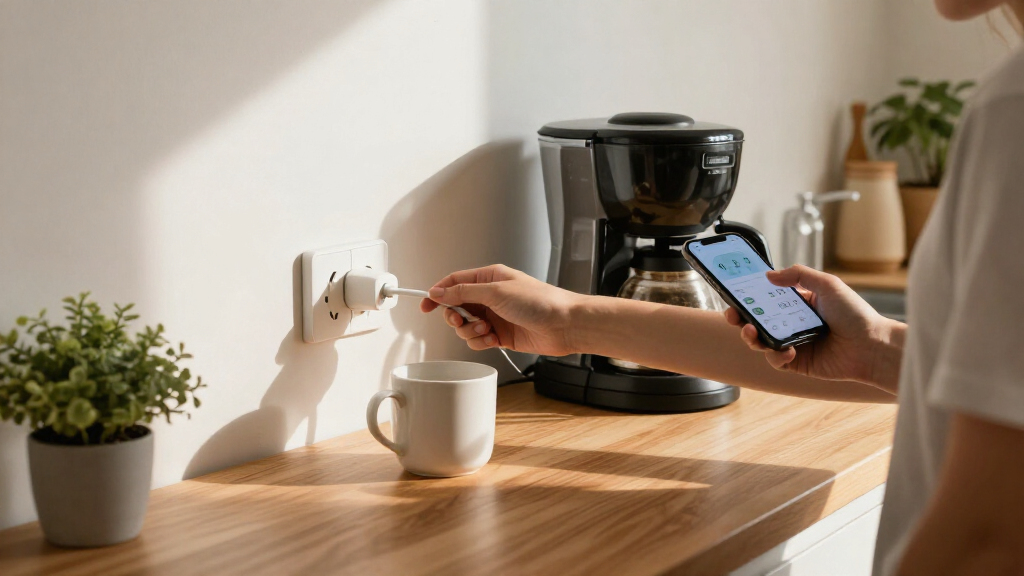

Smart plugs with energy monitoring show how much electricity a connected appliance uses, while adding app control and scheduling. My best overall pick is the Kasa Matter Smart Plug with Energy Monitoring for its mix of energy tracking and Matter compatibility; the Tapo P115 stands out for buyers who want a 15A plug in a multi-pack, while the Kasa HS300 suits desks or entertainment setups with several devices. The main tradeoffs are between a simple plug and a multi-outlet power strip, broad smart-home compatibility and app-specific features, and individual monitoring versus monitoring several devices together. Energy readings can guide habits, but they do not replace a whole-home monitor or a dedicated circuit measurement. Read on for the full comparison and help matching a plug to your appliances and setup.

Get home appliances delivered free with Prime
- Fast, free delivery on millions of items
- Prime Video, Amazon Music and more included
- Member-only deals all year
Complete the kit


Key Takeaways
- Kasa Matter plugs lead the lineup for buyers who want energy monitoring alongside Matter-based smart-home compatibility, with 2- and 4-pack options for different room counts.
- Tapo P115 and Tapo P110M give buyers distinct paths: the P115 is a Wi-Fi-focused 15A option, while the P110M adds Matter compatibility.
- Multi-packs from Govee, Emporia, THIRDREALITY, AiSeek, Kasa, and Tapo can make sense for monitoring several appliances, but app experience and smart-home support matter as much as the number of plugs.
- The Kasa HS300 is the lineup’s standout for a cluster of equipment: it offers six smart outlets and three USB ports, unlike the single-outlet plug designs.
- The Tapo P210M is an in-wall outlet rather than a plug-in adapter, so it suits buyers who want a built-in installation and should be skipped by anyone seeking a simple, portable setup.
| Govee Smart Plug with Energy Monitoring, Wi-Fi and Bluetooth, 4-Pack |  | Best for Detailed Usage History | Model: H5086 | Pack size: 4 plugs | Operating voltage: 120 V AC | VIEW LATEST PRICE | See Our Full Breakdown |
| Kasa Matter Smart Plug with Energy Monitoring, 2-Pack |  | Best for Matter Smart Homes | Model: KP125MP2 | Pack size: 2 plugs | Maximum current: 15 A | VIEW LATEST PRICE | See Our Full Breakdown |
| Tapo P115 Smart Wi-Fi Plug with Energy Monitoring, 4-Pack, 15A |  | Best for Cost-Conscious Whole-Home Monitoring | Model: P115 | Pack size: 4 plugs | Operating voltage: 110 V AC | VIEW LATEST PRICE | See Our Full Breakdown |
| Tapo P115 Smart Wi-Fi Plug with Energy Monitoring, 2-Pack, 15 A |  | Best for Starting Small | Model: P115 | Pack size: 2 plugs | Operating voltage: 125 V | VIEW LATEST PRICE | See Our Full Breakdown |
| Tapo P210M Matter-Compatible Smart In-Wall Outlet |  | Best Permanent, Dual-Outlet Upgrade | Model: P210M | Outlet control: Two devices independently or simultaneously | Connectivity: Matter and 2.4 GHz Wi-Fi | VIEW LATEST PRICE | See Our Full Breakdown |
| Emporia Energy Monitoring Smart Plugs, Wi-Fi, 4 Pack |  | Best for Simple Four-Plug Monitoring | Pack quantity: 4 plugs | Model: EMSO1-4 | Operating voltage: 120 V | VIEW LATEST PRICE | See Our Full Breakdown |
| THIRDREALITY Smart Plug Gen3, 4-Pack |  | Best for Zigbee Power-Use Precision | Pack quantity: 4 plugs | Connectivity protocol: Zigbee 3.0 | Operating voltage: 110 V | VIEW LATEST PRICE | See Our Full Breakdown |
| AiSeek Smart Plug with Energy Monitoring, 15A, 4-Pack |  | Best Feature-Rich Wi-Fi Value | Pack count: 4 | Model: KT-US-EM-15AP | Operating voltage: 120 V | VIEW LATEST PRICE | See Our Full Breakdown |
| Kasa Smart Plug Mini with Energy Monitoring, KP115 |  | Best for a Single Monitored Appliance | Model: KP115 | Connectivity: 2.4 GHz Wi-Fi | Operating voltage: 120 V AC | VIEW LATEST PRICE | See Our Full Breakdown |
| Kasa Matter Smart Plug with Energy Monitoring, 4-Pack |  | Best for Cross-Platform Matter Homes | Model: KP125MP4 | Pack size: 4 | Maximum wattage: 1800 W | VIEW LATEST PRICE | See Our Full Breakdown |
| Kasa Smart Plug Power Strip HS300 with 6 Smart Outlets and 3 USB Ports |  | Best for Multi-Device Monitoring | Outlets: 6 independently controlled | USB ports: 3; 5 V/2.4 A per port | Input: 100–125 V, 60 Hz, 15 A | VIEW LATEST PRICE | See Our Full Breakdown |
| Tapo P110M Matter Smart Plugs with Energy Monitoring, 4-Pack, 15 A |  | Best for Matter-Based Smart Homes | Pack size: 4 plugs | Wattage: 1800 W | Connectivity: Matter, Wi-Fi | VIEW LATEST PRICE | See Our Full Breakdown |
| smart plugs with energy monitoring | Operating voltage | Connectivity | Model | Pack size |
|---|---|---|---|---|
| Govee Smart Plug with Energy M | 120 V AC | Wi-Fi and Bluetooth | H5086 | 4 plugs |
| Kasa Matter Smart Plug with En | 120 V | Matter, Wi-Fi, and SmartThings | KP125MP2 | 2 plugs |
| Tapo P115 Smart Wi-Fi Plug wit | 110 V AC | 2.4 GHz Wi-Fi | P115 | 4 plugs |
| Tapo P115 Smart Wi-Fi Plug wit | 125 V | 2.4 GHz Wi-Fi | P115 | 2 plugs |
| Tapo P210M Matter-Compatible S | 125 V | Matter and 2.4 GHz Wi-Fi | P210M | — |
| Emporia Energy Monitoring Smar | 120 V | 2.4 GHz Wi-Fi | EMSO1-4 | — |
| THIRDREALITY Smart Plug Gen3 | 110 V | — | — | — |
| AiSeek Smart Plug with Energy | 120 V | 2.4 GHz Wi-Fi and Bluetooth | KT-US-EM-15AP | — |
| Kasa Smart Plug Mini with Ener | 120 V AC | 2.4 GHz Wi-Fi | KP115 | — |
| Kasa Matter Smart Plug with En | 120 V | Matter, SmartThings, and Wi-Fi | KP125MP4 | 4 |
| Kasa Smart Plug Power Strip HS | — | — | — | — |
| Tapo P110M Matter Smart Plugs | — | Matter, Wi-Fi | — | 4 plugs |
More Details on Our Top Picks
Govee Smart Plug with Energy Monitoring, Wi-Fi and Bluetooth, 4-Pack
I’d choose the Govee Smart Plug 4-Pack when reviewing device draw over time matters as much as switching appliances on and off. Its app tracks power, current, and voltage, with historical data available for up to a year—more detail than the Tapo P115 2-Pack describes. Four plugs also make it easier to monitor several devices around the home. Scheduling, group control, and Alexa or Google Assistant support cover everyday automation, while Bluetooth is listed alongside Wi-Fi connectivity. The tradeoff is that app-based monitoring and controls require Govee Home, and setup is limited to 2.4 GHz Wi-Fi. Compared with the Matter-compatible Kasa KP125M, Govee offers deeper stated electrical history, but less flexibility across smart-home platforms.
Pros:- Tracks power, current, and voltage with up to one year of historical data
- Four-plug pack supports monitoring multiple devices
- Offers scheduling, group control, remote app control, and voice control
- ETL- and FCC-certified, with fire-resistant materials listed in the product details
Cons:- Does not support 5 GHz Wi-Fi
- App-based features require the Govee Home app
- Does not list Matter support
Best for: Households that want year-long power, current, and voltage history across several appliances and already use the Govee Home app.
Not ideal for: Buyers with 5 GHz-only Wi-Fi or people who want one plug to work across several Matter-compatible smart-home platforms.
- Model:H5086
- Pack size:4 plugs
- Operating voltage:120 V AC
- Connectivity:Wi-Fi and Bluetooth
- Wi-Fi band:2.4 GHz; does not support 5 GHz
- Voice assistants:Amazon Alexa and Google Assistant
- Dimensions:2.68 × 2.4 × 1.5 in
- Certifications:ETL and FCC
Our verdict“Choose Govee if detailed, long-term electrical history across four devices matters more to you than Matter compatibility.”
Kasa Matter Smart Plug with Energy Monitoring, 2-Pack
The Kasa Matter Smart Plug KP125M is my pick for buyers who want energy monitoring without tying their setup to one smart-home ecosystem. It supports Apple Home, Alexa, Google Home, and SmartThings, and local network control can keep working when internet access is down. That makes it more adaptable than the Govee Smart Plug, whose listed platform support centers on Alexa and Google Assistant. The two-plug pack is a practical starting point for monitoring a couple of appliances, and its compact, flame-retardant design helps it fit into a crowded outlet area. The compromise is coverage: Tapo’s P115 4-Pack supplies four monitored plugs, while this Kasa bundle includes two. It also requires 2.4 GHz Wi-Fi and is rated up to 15 A and 1800 W.
Pros:- Matter compatibility supports several major smart-home platforms
- Local network control can continue when internet access is offline
- Includes energy monitoring and app or voice control
- Compact, flame-retardant construction with a 2-year limited warranty
Cons:- Pack includes only two plugs, fewer than the Govee and Tapo four-packs
- Requires 2.4 GHz Wi-Fi
- Maximum rating is 15 A and 1800 W
Best for: Smart-home owners using Apple Home, Alexa, Google Home, or SmartThings who want local control and energy tracking for a couple of devices.
Not ideal for: Buyers who need four or more monitored outlets in one bundle, use 5 GHz-only Wi-Fi, or need capacity above 15 A and 1800 W.
- Model:KP125MP2
- Pack size:2 plugs
- Maximum current:15 A
- Maximum power:1800 W
- Operating voltage:120 V
- Connectivity:Matter, Wi-Fi, and SmartThings
- Wi-Fi band:2.4 GHz
- Control:App and voice
- Warranty:2-year limited
Our verdict“Pick the Kasa KP125M if cross-platform Matter support and local control matter more than getting four plugs in one pack.”
Tapo P115 Smart Wi-Fi Plug with Energy Monitoring, 4-Pack, 15A
The Tapo P115 4-Pack suits buyers who want to track several appliances and use the readings to shape routines, rather than just check whether a plug is on. The Tapo app shows consumption statistics and lets users estimate energy costs; smart charging limits and automatic shutoff add practical controls that the Govee four-pack does not list. It also works with Alexa, Google Assistant, and SmartThings. Compared with the Tapo P115 2-Pack, this bundle is the more natural fit for monitoring several rooms, though buyers should confirm they need four plugs before choosing it. The key limitation is connectivity: it supports 2.4 GHz Wi-Fi only, with no Matter support listed. Its compact design can also help keep neighboring wall outlets accessible.
Pros:- Four plugs provide coverage for several appliances
- Tapo app provides usage statistics and estimated energy costs
- Smart charging limits and automatic shutoff add useful control options
- Compact design helps avoid blocking neighboring outlets
Cons:- Supports 2.4 GHz Wi-Fi only
- Matter compatibility is not listed
- Four plugs may be more than buyers monitoring only one or two devices need
Best for: Households tracking several devices who want app-based consumption statistics, cost estimates, and charging limits alongside voice control.
Not ideal for: Buyers who need Matter compatibility, 5 GHz Wi-Fi support, or only a couple of monitored outlets.
- Model:P115
- Pack size:4 plugs
- Operating voltage:110 V AC
- Maximum power:1800 W
- Connectivity:2.4 GHz Wi-Fi
- Control:Tapo app, Alexa, Google Assistant, and SmartThings
- Material:Polycarbonate
- Certifications:ETL, FCC, and RoHS
Our verdict“Choose this Tapo bundle for multi-device monitoring and charging controls, but pick the KP125M if Matter support is a priority.”
Tapo P115 Smart Wi-Fi Plug with Energy Monitoring, 2-Pack, 15 A
For buyers who want to monitor just a lamp, entertainment device, or other pair of appliances, the Tapo P115 2-Pack offers a smaller commitment than the four-plug Tapo P115 bundle. It provides energy monitoring and consumption statistics in the Tapo app, plus scheduling and remote control through Alexa or Google Assistant. A built-in overload shutoff adds a protection feature not stated in the Govee four-pack description, and the compact body is intended to leave neighboring outlets usable. The tradeoff is straightforward: this version has only two plugs and fewer listed control options than the Tapo P115 4-Pack, which also names SmartThings, smart charging limits, and automatic shutoff. It is limited to 2.4 GHz Wi-Fi and a 15 A, 1800 W maximum rating.
Pros:- Energy monitoring and consumption statistics are available in the Tapo app
- Scheduling and remote app control support everyday routines
- Works with Alexa and Google Assistant
- Compact design and built-in overload shutoff
Cons:- Two-plug pack covers fewer devices than the Tapo P115 4-Pack
- Supports 2.4 GHz Wi-Fi only
- Maximum rating is 15 A and 1800 W
Best for: Renters or first-time energy-monitoring buyers who want to track two household devices with simple app scheduling and Alexa or Google control.
Not ideal for: People monitoring several appliances, seeking Matter support, or needing Wi-Fi on the 5 GHz band.
- Model:P115
- Pack size:2 plugs
- Operating voltage:125 V
- Connectivity:2.4 GHz Wi-Fi
- Control:Tapo app, remote, and voice
- Voice assistants:Alexa and Google Assistant
- Material:Polycarbonate
- Certifications:ETL, FCC, and RoHS
Our verdict“Choose the Tapo P115 2-Pack when two monitored devices are enough and you want a compact, straightforward alternative to a four-plug bundle.”
Tapo P210M Matter-Compatible Smart In-Wall Outlet
The Tapo P210M takes a different approach from the Govee and plug-in Tapo P115 models: it replaces a wall outlet instead of occupying one. Its two receptacles can be controlled independently or together, and Matter support brings it to compatible platforms including Alexa, Siri, Google Assistant, and Samsung Bixby. Energy monitoring, scheduling, away mode, and local app control during internet outages make it more feature-rich than the plug-in P115 2-Pack, but installation is a real barrier. A neutral wire is required, and the work is not the same as simply plugging in a monitor. It also needs 2.4 GHz Wi-Fi for setup. Choose it for a permanent, tidier installation; skip it if you rent or want portable plugs you can move between rooms.
Pros:- Controls two connected devices independently or together
- Matter support works with several major smart-home platforms
- Includes energy monitoring, scheduling, and away mode
- Local app control can remain available during internet outages
Cons:- Requires neutral wiring and in-wall installation
- Requires 2.4 GHz Wi-Fi for setup
- Less portable than the Govee and Tapo P115 plug-in models
Best for: Homeowners with neutral wiring who want a permanent, Matter-compatible outlet that can monitor and control two devices separately.
Not ideal for: Renters, buyers without a neutral wire in the outlet box, or anyone who wants portable plugs without electrical installation.
- Model:P210M
- Outlet control:Two devices independently or simultaneously
- Connectivity:Matter and 2.4 GHz Wi-Fi
- Wiring requirement:Neutral wire required
- Operating voltage:125 V
- Maximum power:1875 W listed; product title states 1800 W maximum
- Voice assistants:Alexa, Siri, Google Assistant, and Samsung Bixby
- Certifications:FCC, ETL, and RoHS
- Operating conditions:32°F–104°F; 10%–90% humidity, non-condensing
Our verdict“Choose the P210M for a permanent dual-outlet upgrade with Matter and energy monitoring, provided your wiring includes a neutral wire.”
Emporia Energy Monitoring Smart Plugs, Wi-Fi, 4 Pack
The Emporia four-pack suits buyers who want energy tracking and straightforward remote control across several appliances without adding a hub. Its app supports scheduling, and Alexa and Google Assistant provide voice control; the four-plug bundle makes it easier to monitor multiple devices than buying a single plug at a time. Compared with the THIRDREALITY Smart Plug Gen3, Emporia uses familiar 2.4 GHz Wi-Fi rather than requiring a Zigbee hub, but it cannot extend a mesh network or offer THIRDREALITY’s stated ±1% monitoring accuracy. Its 10 A continuous-load limit is the key constraint: the listed 1200 W capacity is lower than the 1800 W rating of the Kasa KP115 and AiSeek plugs. I’d choose it for everyday, lower-draw devices, not higher-load appliances.
Pros:- Four plugs provide energy monitoring for multiple connected devices.
- App-based remote control and scheduling help automate everyday appliances.
- Works with Amazon Alexa and Google Assistant.
- No separate Zigbee hub is listed as required.
Cons:- The 10 A continuous-load limit and 1200 W rating are below the 1800 W capacity listed for the Kasa KP115 and AiSeek.
- Requires 2.4 GHz Wi-Fi and does not support 5 GHz networks.
- The one-year warranty is shorter than the two-year warranties listed for AiSeek and Kasa KP115.
Best for: Households that want to monitor and schedule several lower-power lamps, chargers, or small appliances through a Wi-Fi app and voice assistant.
Not ideal for: Buyers monitoring devices that may exceed 10 A continuous load, or anyone whose Wi-Fi network only provides 5 GHz.
- Pack quantity:4 plugs
- Model:EMSO1-4
- Operating voltage:120 V
- Maximum wattage:1200 W
- Connectivity:2.4 GHz Wi-Fi
- Control methods:App, remote, touch, and voice
- Compatible assistants:Amazon Alexa and Google Assistant
- Dimensions:1.97 × 3.31 × 1.5 in
- Warranty:1 year
Our verdict“Choose Emporia if you want a four-plug Wi-Fi bundle for monitoring and automating lower-draw devices, but skip it for loads near 1800 W.”
THIRDREALITY Smart Plug Gen3, 4-Pack
The THIRDREALITY Smart Plug Gen3 is the specialist choice here: its Zigbee 3.0 connection can feed a compatible smart-home system, while its listed ±1% power-monitoring accuracy may appeal to buyers who care about close readings. The plugs also act as Zigbee repeaters, so placing them around a home can help extend mesh coverage as well as monitor connected devices. That makes this a different proposition from the Wi-Fi-based Emporia four-pack, which is simpler to set up without a hub but has a lower listed wattage limit. The tradeoff is setup dependency: THIRDREALITY requires a compatible hub, and power-on status restoration works only on select platforms. I’d pick it for an established Zigbee setup, not as a casual plug-in option for someone starting from scratch.
Pros:- Four Zigbee plugs provide real-time power monitoring.
- Listed ±1% detection accuracy gives a specific precision target.
- Can extend Zigbee mesh coverage as a repeater.
- Supports platforms including Home Assistant, SmartThings, and Hubitat.
Cons:- A compatible Zigbee hub is required, unlike the Wi-Fi Emporia and Kasa KP115 options.
- Power-on status restoration is limited to select platforms.
- The supplied data does not state a maximum wattage or load rating.
Best for: Smart-home users with a compatible Zigbee hub who want stated monitoring accuracy and an added mesh-repeater function across several outlets.
Not ideal for: Beginners without a Zigbee hub, or buyers who need power-on status restoration to work consistently across platforms.
- Pack quantity:4 plugs
- Connectivity protocol:Zigbee 3.0
- Operating voltage:110 V
- Power monitoring accuracy:±1%
- Hub required:Yes
- Compatible platforms:Home Assistant, SmartThings, Hubitat, and compatible Echo devices
- Mounting type:Plug-in
- Warranty:1 year
Our verdict“Pick THIRDREALITY for a hub-based Zigbee home where accurate monitoring and mesh extension matter more than easy standalone setup.”
AiSeek Smart Plug with Energy Monitoring, 15A, 4-Pack
AiSeek combines a four-plug bundle with energy monitoring, schedules, timers, and group control in the SmartLife app, making it a good fit for buyers who want several devices to follow one routine. Its listed 1800 W capacity gives it more headroom than the 1200 W Emporia plugs, while short-circuit and overload protection add useful safeguards. Unlike the Kasa KP115, which offers IFTTT and Vera compatibility in its listed specs, AiSeek centers its app experience on SmartLife and Tuya; Alexa and Google Assistant need to be linked through the app. That extra setup is a modest hurdle, but it also means the voice-control experience depends on completing the account connection. I’d favor AiSeek when group automation and a four-plug set matter more than a simpler single-plug setup.
Pros:- Four plugs support monitoring across several appliances.
- Schedules, timers, and group control support coordinated routines.
- Listed 1800 W maximum is higher than Emporia’s 1200 W rating.
- Includes short-circuit and overload protection.
Cons:- Requires 2.4 GHz Wi-Fi.
- Alexa and Google Assistant require linking through the SmartLife app.
- Bluetooth is listed, but the product data does not explain what functions it enables.
Best for: Buyers who want four monitored plugs with SmartLife group control, timers, and voice-assistant integration for 120 V devices.
Not ideal for: People who want voice assistants to work without linking accounts through an app, or households without 2.4 GHz Wi-Fi.
- Pack count:4
- Model:KT-US-EM-15AP
- Operating voltage:120 V
- Maximum wattage:1800 W
- Connectivity:2.4 GHz Wi-Fi and Bluetooth
- App compatibility:SmartLife and Tuya
- Voice assistant compatibility:Amazon Alexa and Google Assistant
- Dimensions:1.4 × 2.8 × 2 in
- Warranty:2 years
Our verdict“Choose AiSeek for a feature-rich four-plug SmartLife setup with group routines and 1800 W capacity, provided app-linked voice control suits you.”
Kasa Smart Plug Mini with Energy Monitoring, KP115
The Kasa KP115 is a focused pick for monitoring one appliance without adding a hub: it reports energy consumption through the Kasa app and supports remote schedules plus Alexa and Google Assistant control. Its 1800 W rating matches the listed capacity of AiSeek and the Kasa Matter four-pack, while overheating protection and a child-resistant sliding cover give it a useful safety-focused profile. Compared with AiSeek, the KP115 is not presented as a four-pack with group control, so it makes more sense when you want a dedicated plug for one device than a coordinated set of outlets. It also lists IFTTT and Vera compatibility, extending its options beyond the assistants supported by Emporia. The tradeoff is 2.4 GHz Wi-Fi dependence and a 15 A ceiling; it is not a substitute for an outlet designed for a higher load.
Pros:- Tracks energy consumption without requiring a hub.
- Supports app, voice, and remote control with schedules.
- Lists Alexa, Google Assistant, IFTTT, and Vera compatibility.
- Includes overheating protection and a child-resistant sliding cover.
Cons:- Requires a 2.4 GHz Wi-Fi connection.
- Its 15 A, 1800 W limit rules out loads beyond that rating.
- A single plug is less suited to multi-device monitoring than the Emporia or AiSeek four-packs.
Best for: Buyers who want a hub-free, app-controlled plug to track and schedule one appliance, with Alexa, Google Assistant, or listed IFTTT and Vera compatibility.
Not ideal for: Shoppers who need several monitored outlets in one bundle, want Matter platform compatibility, or have devices exceeding 15 A or 1800 W.
- Model:KP115
- Connectivity:2.4 GHz Wi-Fi
- Operating voltage:120 V AC
- Maximum wattage:1800 W
- Compatibility:Amazon Alexa, Google Assistant, IFTTT, and Vera
- Control methods:App, voice, and remote
- Dimensions:2.62 × 1.57 × 1.5 in
- Safety certification:UL
- Warranty:2 years
Our verdict“Choose the KP115 for monitoring one 120 V appliance through Kasa without a hub, but look to a multi-pack if you need several outlets.”
Kasa Matter Smart Plug with Energy Monitoring, 4-Pack
This Kasa Matter four-pack stands out for buyers who want energy monitoring across multiple outlets without tying every plug to a single assistant ecosystem. It supports Apple Home, Amazon Alexa, Google Home, and Samsung SmartThings, with local network control listed for times when internet access is unavailable. That platform breadth gives it an advantage over the Kasa KP115, whose supplied compatibility list names Alexa, Google Assistant, IFTTT, and Vera but not Matter. Like the KP115 and AiSeek, this model is rated for 1800 W, so it suits ordinary 120 V loads rather than higher-capacity equipment. The limitation is its 2.4 GHz Wi-Fi requirement despite Matter support, so it is not a way around Wi-Fi band compatibility. I’d choose it for a mixed-platform home that values local control, not just a basic Alexa setup.
Pros:- Four plugs provide energy monitoring across multiple devices.
- Matter compatibility supports Apple Home, Alexa, Google Home, and SmartThings.
- Local network control can operate when internet access is offline.
- Compact design and UL-certified flame-retardant construction.
Cons:- Requires a 2.4 GHz Wi-Fi network.
- Maximum load is limited to 15 A or 1800 W.
- The four-pack may be more than needed for buyers monitoring only one appliance.
Best for: Households using multiple smart-home platforms who want energy monitoring on four outlets and local network control when internet service is unavailable.
Not ideal for: Buyers who need 5 GHz-only Wi-Fi, a load above 15 A or 1800 W, or only one monitored outlet.
- Model:KP125MP4
- Pack size:4
- Maximum wattage:1800 W
- Operating voltage:120 V
- Connectivity:Matter, SmartThings, and Wi-Fi
- Wi-Fi band:2.4 GHz
- Compatible platforms:Apple Home, Amazon Alexa, Google Home, and Samsung SmartThings
- Control methods:Kasa app, voice, and on/off
- Warranty:2-year limited warranty
Our verdict“Choose this Kasa pack for multi-platform Matter support and local control across four monitored outlets, as long as 2.4 GHz Wi-Fi is available.”
Kasa Smart Plug Power Strip HS300 with 6 Smart Outlets and 3 USB Ports
The HS300 is the lineup’s strongest fit for a desk, media center, or workbench with several devices to manage. Its six independently controlled outlets let you switch equipment separately, while the Kasa app’s energy monitoring helps you see which connected devices are drawing power. Compared with the individual Tapo P110M plugs, this power strip keeps multiple connections together and adds three USB charging ports, but it does not give you the same compact, outlet-by-outlet plug format. The aluminum enclosure and ETL-certified surge protection add practical protection for connected electronics. The tradeoff is its 14.17-inch body, which takes up more space than a mini plug, and setup requires 2.4 GHz Wi-Fi. The USB ports are useful for charging, though the supplied details do not describe them as independently controlled or monitored.
Pros:- Six outlets can be controlled independently
- Kasa app provides energy monitoring
- Three USB ports add charging without taking up outlet sockets
- ETL-certified surge protection and an aluminum enclosure
Cons:- The long power-strip body takes more space than individual compact plugs
- Requires a 2.4 GHz Wi-Fi network
- USB ports are not specified as independently controlled or energy-monitored
Best for: People outfitting a desk or entertainment center who want separate control and energy tracking for several plugged-in devices, plus USB charging.
Not ideal for: Buyers who need compact plugs for scattered outlets, want monitoring for USB-connected devices, or use a Wi-Fi network without 2.4 GHz support.
- Outlets:6 independently controlled
- USB ports:3; 5 V/2.4 A per port
- Input:100–125 V, 60 Hz, 15 A
- Maximum total load:1875 W
- Plug type:Type B, 3-prong
- Dimensions:14.17 × 2.49 in
- Enclosure material:Aluminum
- App requirements:iOS 10 or later; Android 4.4 or later
Our verdict“Choose the HS300 for a central cluster of devices that need separate control and energy tracking; choose compact Tapo P110M plugs for devices spread across multiple outlets.”
Tapo P110M Matter Smart Plugs with Energy Monitoring, 4-Pack, 15 A
This four-pack is the better match for buyers who want energy monitoring across several devices without tying control to one smart-home platform. Matter compatibility supports Amazon Alexa, Apple HomeKit, Google Home, and Samsung SmartThings, while usage statistics and scheduling make it easier to track consumption and automate routine shutoffs. Unlike the Kasa HS300, these are individual compact plugs, so they suit rooms where devices are spread across separate outlets rather than gathered around one strip. Their shape is designed to preserve access to neighboring sockets, a useful difference when fitting multiple plugs near one another. The tradeoff is that the HS300 offers six separately controlled outlets in a single unit, while this pack provides four plugs, each with a stated 1800-watt capacity. It also relies on 2.4 GHz Wi-Fi, so it is not a fit for networks that lack that band.
Pros:- Matter compatibility spans Alexa, Apple HomeKit, Google Home, and SmartThings
- Energy tracking provides usage statistics
- Supports app and voice control, scheduling, and remote operation
- Compact shape helps preserve access to neighboring outlets
Cons:- Supports 2.4 GHz Wi-Fi only
- Four plugs may be less convenient than the HS300 for a cluster of many devices
- The stated 1800-watt capacity may limit use with higher-load appliances
Best for: Households using Matter-compatible platforms that want energy statistics and scheduled control for devices in several rooms.
Not ideal for: Buyers who need a single strip for many adjacent devices, more than four monitored connections, or plugs that support a Wi-Fi band other than 2.4 GHz.
- Pack size:4 plugs
- Wattage:1800 W
- Connectivity:Matter, Wi-Fi
- Wi-Fi band:2.4 GHz
- Compatible platforms:Amazon Alexa, Apple HomeKit, Google Home, Samsung SmartThings
- Control methods:App, voice, scheduling
- Operation mode:Automatic
- Color:White
Our verdict“Pick the P110M four-pack for platform-flexible monitoring across separate outlets, but choose the HS300 when you need more individually controlled connections in one place.”

How We Picked
I ranked these smart plugs with energy monitoring by how well their monitoring, controls, and physical design fit common household jobs. I weighed stated electrical capacity, the clarity and usefulness of energy data, connectivity options such as Wi-Fi, Bluetooth, and Matter, outlet access, and whether a product’s format makes it practical for one appliance or several. Pack size mattered as a value and coverage factor, but a larger pack did not automatically outrank a plug with a better fit for mixed smart-home systems.
The higher-ranked choices offer a strong balance of energy tracking, usability, and versatility for a broad range of buyers. I placed more specialized designs lower when their benefits depend on a particular setup, such as an in-wall installation or a power strip location. Closely related pack-size versions are judged as separate options because the right quantity can affect a buyer’s setup, but I distinguish them by fit rather than treating the larger pack as inherently better. Product claims and compatibility should be checked against the manufacturer’s current specifications before purchase.
Factors to Consider When Choosing Smart Plugs With Energy Monitoring
Energy monitoring can help explain which appliances use power while idle, cycle often, or run for long stretches. Before choosing a plug, I would match its electrical rating and shape to the appliance, then check whether its app and smart-home connections fit the way I already control devices.
Match the plug’s rating to the appliance
Start with the appliance label or manual, not the plug’s headline rating alone. Compare the appliance’s current and power requirements with the plug’s stated limits, and pay attention to whether the device is a motor, heater, or other high-draw load. A plug marked for a particular amperage is not automatically suitable for every device that appears to fit the number. Avoid using smart plugs with appliances whose manuals prohibit them, or where switching power remotely could create a safety issue. When requirements are unclear, choose guidance from the appliance maker or a qualified electrician rather than guessing.
Decide what you need the energy data to tell you
Monitoring is most useful when you have a question in mind: whether standby draw is meaningful, how much a dehumidifier runs, or whether a schedule changes consumption. Check whether the app presents current power, accumulated energy, and useful time periods; a single total may be less helpful for comparing behavior over time. If you need to separate the use of several appliances, individual plugs make attribution easier than a shared outlet or strip. Conversely, a multi-outlet strip can reduce clutter, but readings may not answer questions about each connected device unless monitoring is provided per outlet. Treat app estimates as household guidance rather than utility-grade billing data.
Check Matter and hub requirements before buying
Smart-home compatibility can matter more than a long feature list if you already use a particular ecosystem. Matter support may make a plug easier to connect across compatible platforms, but it does not mean every app feature or energy statistic will appear in every controller. Some products rely on a manufacturer’s app, Wi-Fi, Bluetooth, or a separate hub for setup and control. Confirm which devices and versions are supported, and check whether remote access requires an account or cloud connection. A common mistake is buying by the word “compatible” without confirming that the exact function you want—especially energy history—works in your chosen app.
Measure outlet spacing and choose the right format
A compact plug may leave nearby receptacles usable, while a wider body or power strip can block adjacent sockets or complicate furniture placement. Measure crowded outlets behind desks, beds, and media units before buying a multi-pack. A power strip is better suited to a cluster of devices in one location; separate plugs are more flexible when appliances are spread across rooms. An in-wall outlet can give a built-in appearance, but installation and wiring compatibility make it a different kind of purchase from a plug-in adapter. Choose the format around where the devices sit, not just how many outlets are listed.
Buy for the number of locations you will actually monitor
Multi-packs can simplify outfitting several rooms, but extra plugs are only useful if you have appropriate appliances and outlets for them. Plan whether you want to monitor individual devices, create schedules, or simply add voice control; those goals may call for different quantities. A two-pack can be a sensible way to start and learn whether the app’s data changes your decisions. A four-pack makes more sense when several known devices are ready to connect and the plugs share the same household setup. Check whether pack variations are otherwise identical before assuming a larger bundle has different features.
Think about reliability, privacy, and long-term use
Energy monitoring depends on a connection and app that remain available, so review the maker’s setup requirements, update support, and data controls. If a plug will be used for a routine, such as switching a lamp at a set time, check what happens after a power or Wi-Fi outage and whether schedules run locally or rely on cloud services. Consider whether you are comfortable creating an account and sharing device data with the manufacturer. A simpler model may be preferable when you only need basic control, while a more connected option can suit a household that already uses its ecosystem. These details can affect everyday convenience more than a small difference in listed features.
Frequently Asked Questions
Will a smart plug with energy monitoring tell me exactly what an appliance costs to run?
It can show energy use that helps estimate running costs, but the plug may not calculate your exact bill. To estimate cost, you need an accurate electricity rate, and many households have time-based rates, fees, or taxes that a basic app does not include. Readings are best used to compare appliances or spot changes in usage rather than as a replacement for your utility statement. Measurement precision and the way an app reports totals can vary by model. For a billing-grade figure, consult your utility’s meter or tariff information.
Can I monitor a refrigerator, heater, or other high-draw appliance with one of these plugs?
Do not assume that every appliance is suitable just because a plug lists a 15A rating. Check both the appliance’s manual and the plug’s electrical limits, including any restrictions for motors, heating elements, or continuous loads. Some appliances should not be switched remotely, and a plug can be a poor fit if it interferes with a required safety control. If the appliance draws more power than the plug supports or its manufacturer advises against smart-plug use, do not connect it. Ask the appliance maker or an electrician when the specifications are unclear.
If a plug supports Matter, will its energy history appear in every smart-home app?
No. Matter compatibility can help a device work with compatible smart-home platforms, but support for particular features depends on the plug, platform, and software versions. Energy readings may be available in the manufacturer’s app but absent or limited in another controller. Before buying, verify that the exact energy-monitoring function you need is supported in your preferred app, not just that the plug can be paired. If detailed history matters, check whether it is stored in the manufacturer’s app and how long it remains accessible.
Should I choose a multi-pack or a power strip for monitoring several devices?
Choose separate plugs when appliances are in different locations or you want to track each one independently. A power strip is more convenient when several devices sit together, such as at a desk or media cabinet, and it can reduce the number of wall outlets in use. Check whether the strip reports consumption per outlet or only for the strip as a whole, since that changes how useful its data is for comparing devices. Also confirm that the connected load stays within the strip’s limits. The best format depends on where the appliances are and whether separate readings matter.
Is an in-wall smart outlet a better choice than a plug-in smart plug?
An in-wall outlet can suit a permanent setup where you want the hardware integrated into the wall, but it is not a direct substitute for a portable plug-in model. Installation may require compatible wiring, tools, and electrical work, so check the product instructions and local requirements before buying. A plug-in smart plug is easier to move between devices and generally simpler to set up, though it occupies an outlet and may affect neighboring sockets. Pick the in-wall design for a deliberate, fixed installation; choose a plug-in model for flexibility or a low-effort start. If you are unsure about wiring, consult a qualified electrician.
Conclusion
For most households, I would start with the Kasa Matter Smart Plug with Energy Monitoring as the best overall choice because it combines monitoring with Matter compatibility. The Tapo P115 is my best value direction for buyers who want multiple 15A Wi-Fi plugs, while the Kasa HS300 is the best premium-style fit for a desk or media setup that needs several smart outlets in one place. For beginners, a smaller pack such as the Kasa Matter 2-pack offers a manageable way to try energy tracking before outfitting more rooms. Choose the Tapo P210M for a fixed in-wall installation, or an individual plug when flexibility and device-by-device tracking matter most. Match the electrical rating, app support, and physical format to your appliances before deciding.