
Finding the best motion sensors for smart room control involves balancing compatibility, detection accuracy, and ease of use. The ThirdReality Zigbee Motion Sensor stands out for its broad device compatibility and pet-friendly design, making it ideal for versatile setups. The Eve Motion (Matter) offers advanced light sensor features and Thread support for seamless smart home integration, appealing to tech enthusiasts. Meanwhile, the Kasa Smart Motion Sensor Switch provides a straightforward Wi-Fi option requiring no hub, perfect for simple, budget-conscious installations. Most buyers face tradeoffs between detection range, connectivity protocols, and smart features—continue reading for a detailed breakdown of these options and what suits your needs best.
Key Takeaways
- Zigbee sensors like ThirdReality and Aqara excel in compatibility with multiple smart home ecosystems, appealing to users with existing Zigbee hubs.
- Radar-based sensors such as SwitchBot and GoveeLife offer highly precise detection and dynamic zone control, ideal for complex automation scenarios.
- Wi-Fi motion sensors, including GoveeLife and Kasa, provide easy setup without a hub but may have limitations in range and reliability compared to Zigbee or Thread devices.
- Pet-friendly and false alarm reduction features are increasingly common and valuable, especially in homes with pets or high-traffic areas.
- Compatibility with voice assistants and smart home platforms remains a key factor, influencing ease of integration and automation potential.





More Details on Our Top Picks
THIRDREALITY Zigbee Motion Sensor, Pet Friendly, Compatible with Home Assistant, SmartThings, Aeotec, Homey, Hubitat or Echo Devices with Built-in Zigbee Hub
This sensor stands out for its broad compatibility with Zigbee hubs, including popular options like SmartThings and Hubitat, making it ideal for users seeking seamless integration into existing Zigbee ecosystems. Its pet-friendly design reduces false triggers from small animals, and the long battery life of two AAA batteries lasting up to 2 years minimizes maintenance. Unlike the Bosch sensors, which have a longer recovery time, this model’s 35-second delay allows for more responsive automation, especially in busy households. The straightforward setup with Zigbee hubs and Echo devices makes it accessible for most users, though it requires a Zigbee hub for operation, limiting direct smart speaker compatibility. The main tradeoff is that it lacks tamper detection, which could be a concern for security-focused setups. This pick makes the most sense for homeowners wanting a reliable, adaptable motion sensor with extensive smart hub support.
Pros:- Compatible with a wide range of Zigbee hubs and Echo devices
- Pet friendly with minimal false triggers
- Long battery life of approximately 2 years
Cons:- Requires a Zigbee hub, adding setup complexity
- No tamper or alarm features
Best for: Homeowners with existing Zigbee hubs or smart home enthusiasts looking for flexible integration.
Not ideal for: Users without a Zigbee hub or those seeking a sensor with tamper detection for security purposes.
- Power Source:2 AAA batteries
- Maximum Range:20 feet
- Mounting Type:Wall Mount
- Battery Life:Up to 2 years
- Compatible Devices:Echo (4th Gen), SmartThings, Hubitat, Homey
- Size:0.79″D x 1.06″W x 3.54″H
Bottom line: Ideal for users who want a versatile, pet-friendly Zigbee sensor with extensive compatibility for smart home integration.
Aqara Zigbee Motion Sensor P1 3 Pack, Smart Motion Detector for Alarm System and Home Automations, 5-Year Battery Life, Pet Friendly, Compatible with HomeKit, Alexa, HomeKit, IFTTT, Requires Aqara Hub
This 3-pack of Aqara P1 sensors excels with an impressive 5-year battery life, reducing the need for frequent replacements and ideal for extensive setups. Its wide detection angle of 170° and adjustable range up to 7 meters make it suitable for various room sizes, and the flexible 360° stand allows precise placement. Unlike the ThirdReality sensor, which requires a Zigbee hub, the Aqara sensors are designed specifically for Aqara’s Zigbee 3.0 hub, ensuring reliable connectivity but limiting compatibility with other Zigbee systems. The sensor’s ability to customize detection timeout from 1 to 200 seconds offers energy savings and responsiveness, though the setup is limited to Aqara’s ecosystem and may require firmware updates for optimal performance. The absence of a tamper alarm is a minor drawback for security-focused users. This kit is best for users invested in Aqara or those seeking a cost-effective, long-lasting motion detection solution.
Pros:- Impressive 5-year battery life reduces maintenance
- Adjustable detection range and timeout for flexibility
- Wide 170° field of view with flexible placement
Cons:- Requires Aqara Zigbee hub; limited cross-platform support
- No tamper detection for security applications
Best for: Homeowners with Aqara hubs or users seeking a long-lasting, highly customizable motion sensor for automation.
Not ideal for: Users relying on non-Aqara Zigbee hubs or seeking broad ecosystem compatibility.
- Power Source:2 AAA batteries
- Maximum Range:7 meters
- Detection Angle:170°
- Battery Life:Up to 5 years
- Compatibility:Aqara Hub, HomeKit, Alexa, IFTTT
- Adjustable Timeout:1-200 seconds
Bottom line: Best suited for Aqara system users prioritizing long-term reliability and customizable detection settings.
GoveeLife Human Presence Sensor, 2.4 GHz Wi-Fi Required, Smart mmWave Radar & PIR Wired Motion Sensor, Zone Positioning, Multi-Person Detection, Support Alexa & Google Home, for Indoor Home Automation
This GoveeLife sensor leverages mmWave radar combined with PIR infrared detection to offer exceptionally accurate presence detection, ideal for complex environments with multiple people. Its zone positioning and support for multi-person detection make it superior to traditional PIR sensors like the Govee Life Motion Sensor, especially in busy households or offices. The dual detection method minimizes false triggers from electrical appliances or pets, unlike the simpler PIR sensors, and it supports integration with Alexa and Google Home, though it does not support Home Assistant directly. The requirement for 2.4 GHz Wi-Fi limits its compatibility with some networks, but it excels in indoor environments where precise detection matters. A tradeoff is that it needs a wired power source, restricting placement flexibility. This sensor is best for users who need detailed tracking of multiple people in a smart space.
Pros:- High-precision mmWave radar and PIR dual detection
- Supports zone positioning and multi-person detection
- Compatible with Alexa and Google Home
Cons:- Requires wired power connection, limiting placement options
- No direct support for Home Assistant
Best for: Home or office owners needing precise multi-person detection for advanced automation.
Not ideal for: Users without wired power or those seeking simple motion alerts without zone control.
- Power Source:Wired (power supply required)
- Detection Range:Up to 26 feet
- Detection Method: mmWave radar & PIR
- Support Ecosystem:Alexa, Google Home
- Multi-Person Detection:Yes
- Zone Positioning:Supported
Bottom line: Ideal for environments where detailed multi-person detection and zone control are key automation features.
GoveeLife Motion Sensor, Group Control Unlimited Devices, Wireless Mini Contact Sensor for Smart Home Automation, Battery Powered, Supports Most GoveeLife Smart Products
This compact GoveeLife motion sensor is designed for seamless integration within the Govee ecosystem, supporting group control of multiple devices and easy setup. Its 16-19 foot detection range and adjustable trigger interval from 60 to 180 seconds help reduce false alarms and energy waste. Compared with the Aqara sensors, it’s more straightforward to deploy in a Govee-only setup, especially with the accompanying smart plugs and devices, making it perfect for users who want a simple, wired-less solution. The sensor’s small size allows discreet placement, and it’s supported by the Govee Home app for straightforward automation. However, it’s limited to the Govee ecosystem and cannot connect directly with Alexa or Google Assistant, which might restrict broader smart home integration. This pick is best for Govee users who prioritize simplicity and ecosystem cohesion.
Pros:- Supports group control of multiple devices
- Easy to set up with Govee Home app
- Compact and discreet design
Cons:- Limited to Govee ecosystem, no direct Alexa/Google support
- No advanced security features like tamper detection
Best for: Govee ecosystem users seeking an easy-to-install, group-control capable motion sensor.
Not ideal for: Users wanting multi-platform support or advanced security features like tamper alerts.
- Power Source:Battery (included)
- Detection Range:16-19 feet
- Detection Angle:±60°
- Trigger Interval:60-180 seconds
- Ecosystem Support:Govee Home app
- Size:1.18″D x 1.18″W x 1.25″H
Bottom line: Best for Govee users wanting a straightforward, easy-to-manage motion sensor within a cohesive smart home setup.
Lutron Maestro Motion Sensor Light Switch Indoor for Bathroom, Garage, Laundry Room, Any Bulbs, Occupancy Vacancy Sensor, Single-Pole, MS-OPS2-WH, White
This Lutron Maestro switch combines simplicity with reliable motion sensing, automatically turning lights on and off based on occupancy or vacancy mode, making it ideal for utility rooms and spaces where manual control is less desired. Its ability to learn your preferred light levels over time and adjust for daylight presence ensures energy efficiency. The switch’s flexible mode settings allow for delayed off times of 1, 5, 15, or 30 minutes, unlike the shorter response times of most PIR sensors, providing customizable automation. Installation is straightforward for single-pole wiring, and its compatibility with most bulb types makes it versatile. A key tradeoff is that it does not support multi-location control or multi-zone detection, limiting its use to individual rooms. This switch is perfect for users who want a simple, reliable occupancy sensor for lighting control in specific rooms.
Pros:- Reliable motion detection with learned light levels
- Flexible delay settings from 1 to 30 minutes
- Easy to install in single-pole applications
Cons:- Limited to single-pole installations, no multi-zone support
- No integration with other smart home systems
Best for: Homeowners seeking a dependable, manual-install occupancy sensor switch for individual rooms or closets.
Not ideal for: Users needing multi-zone or multi-location sensor control, or complex automation setups.
- Type:Single-Pole Occupancy Sensor
- Detection Range:Not specified
- Delay Settings:1, 5, 15, 30 mins
- Supports:Incandescent, LED, CFL
- Installation:Single-Pole
- Compatibility:Manual switch
Bottom line: Best for users wanting a straightforward, reliable occupancy sensor switch for specific rooms without complex automation needs.
SwitchBot Smart mmWave Radar Motion Sensor, Bluetooth Presence Sensor with Dynamic Detection & Zone Positioning, Compatible with Alexa, HomeKit & Apple Home via SwitchBot Hub (Presence Sensor)
This SwitchBot mmWave radar sensor stands out for its ability to detect subtle, stationary presence, unlike typical PIR sensors which only respond to motion. Its use of mmWave technology provides a wider detection zone and better obstruction penetration, making it highly reliable in diverse environments. While setup is straightforward with the included magnetic mount, the current limited compatibility with some platforms like Home Assistant is a notable caveat. Its AI-driven sensitivity adjustment reduces false triggers, and the device’s ability to differentiate between stationary and moving humans enhances automation accuracy. Compared to the Onvis sensor, this pick excels in detecting stationary presence but requires a SwitchBot Hub for full functionality across platforms. Its long-lasting battery and flexible mounting options make it suitable for bathrooms, offices, or any space needing precise occupancy detection. The main tradeoff is that advanced automation features are still evolving, and full platform support isn’t yet available, which might limit immediate use for some users.
Pros:- Highly accurate detection of stationary humans, reducing false triggers
- Adjustable detection zones and sensitivity via AI, enhancing customization
- Long battery life up to 2 years with magnetic, flexible mounting
Cons:- Limited current support for some smart home platforms like Home Assistant
- Requires SwitchBot Hub for full platform compatibility
- Higher cost compared to basic PIR sensors
Best for: Homeowners seeking highly accurate presence detection in spaces where motion alone isn’t reliable, such as bathrooms or offices.
Not ideal for: Users who need seamless multi-platform integration now, since full support with platforms like Home Assistant is still in development.
- Detection Range:up to 8 meters
- Detection Angle:120 degrees
- Power Source:Battery (up to 2 years)
- Connectivity:Bluetooth, via SwitchBot Hub for automation
- Water Resistance:Indoor use only
- AI Sensitivity Adjustment:Yes
Bottom line: Ideal for those who prioritize precise occupancy detection and are willing to wait for broader platform support.
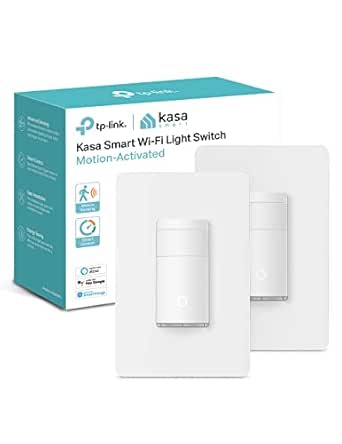
Kasa Smart Motion Sensor Switch, Single Pole, Needs Neutral Wire, 2.4GHz Wi-Fi Light Switch, Works with Alexa & Google Assistant, UL Certified, No Hub Required (KS200MP2), White, 2-Pack
This Kasa Smart motion sensor switch offers a simple, wire-integration approach for automatic lighting, making it ideal for replacing traditional switches. Unlike the Onvis or Eve Motion sensors, it functions as both a switch and motion detector, providing immediate control over connected lights without additional hubs. Its built-in daylight detection prevents unnecessary activation during daytime, conserving energy. While setup is straightforward with the included instructions, it requires a neutral wire, limiting installation options in some older homes. The switch’s integration with Alexa, Google, and other platforms enables voice commands and remote control via the Kasa app, making it perfect for users new to smart lighting. However, it only detects motion for lighting control and doesn’t offer broader sensor capabilities like temperature or humidity tracking. Compared to the Eve Motion, it’s more focused on lighting automation, but lacks outdoor water resistance. Its main limitation is the need for neutral wiring, which could exclude some installations.
Pros:- Easy wireless setup with no hub required
- Reliable motion detection with daylight sensing
- Works directly with Alexa and Google Assistant for voice control
Cons:- Requires neutral wire, limiting compatibility in some homes
- Focused on lighting control only, with no temperature or humidity sensors
- Potential compatibility issues with non-standard switches
Best for: Homeowners wanting seamless, hands-free control of lighting in hallways, bedrooms, or bathrooms with simple installation.
Not ideal for: Users in older homes without neutral wiring or those seeking multi-sensor environmental automation beyond lighting.
- Connectivity:Wi-Fi 2.4GHz
- Detection Range:up to 9 meters
- Power Source:Neutral wire required
- Compatibility:Alexa, Google Assistant
- Water Resistance:Indoor only
- Certification:UL
Bottom line: Best suited for users wanting straightforward, reliable smart lighting automation without extra hub dependencies.
YoLink LoRa 1/4 Mile Wireless Range Smart Motion Detector, Indoor Motion Sensor, Motion Detector, Alexa, IFTTT, YoLink Hub Required
This YoLink LoRa motion detector excels in large properties or areas where WiFi coverage is limited, thanks to its impressive 1/4 mile range and obstruction penetration. Its low-power LoRa technology makes it suitable for outdoor, multi-building setups, or expansive indoor spaces. Compared to the Onvis or Eve sensors, it offers unmatched range and minimal interference, easily covering multiple floors or distant buildings. The sensor is simple to install with magnetic mounting, and its long battery life of up to 3 years adds convenience. While setup with the YoLink hub is straightforward, the system’s reliance on LoRa and cloud services means it needs the hub for full operation and automation. The device supports notifications via SMS and app alerts, making it ideal for security and automation over vast areas. The primary tradeoff is the need for a dedicated hub and the limited platform integrations compared to more popular WiFi or Bluetooth sensors.
Pros:- Extremely long-range coverage up to 1/4 mile
- Obstruction-penetrating LoRa technology for outdoor use
- Low power consumption with 3-year battery life
Cons:- Requires YoLink Hub for full operation and automation
- Limited direct platform support outside the YoLink ecosystem
- Primarily designed for outdoor or large indoor spaces, less suited for small rooms
Best for: Large property owners or remote site managers seeking reliable, long-distance motion detection with minimal interference.
Not ideal for: Urban dwellers needing quick, short-range detection or those without space for a dedicated YoLink hub.
- Range:up to 1/4 mile
- Detection Angle:120 degrees
- Power Source:Battery (up to 3 years)
- Connectivity:LoRa, requires YoLink Hub
- Water Resistance:Indoor/Outdoor
- Supported Notifications:SMS, App Alerts
Bottom line: Perfect for large-scale or outdoor installations where long-range, interference-free detection is critical.
Eve Motion (Matter) – Smart Motion Sensor with Light Sensor, IPX3 Water Resistance, Automatic Activation of Lights and Devices, Thread
This Eve Motion sensor is tailored for Apple users seeking a privacy-focused, Matter-compatible device with outdoor use capability. Its IPX3 water resistance allows for installation outdoors, unlike many indoor-only sensors like GoveeLife. The 120° field of view and 9-meter range are comparable to other high-end sensors like the Onvis but with the added benefit of local processing and no cloud dependency, appealing to privacy-conscious buyers. The Thread protocol ensures robust, low-latency connectivity within a Thread network, making it a strong choice for Apple-centric smart homes. However, it requires an Apple TV 4K or HomePod as a hub, which may be a barrier for non-Apple households. While it automates lights and devices effectively, it doesn’t include environmental sensors like humidity or temperature. Its outdoor water resistance and privacy benefits make it a standout, but the higher price and specific ecosystem may limit its appeal.
Pros:- Water-resistant IPX3 for outdoor installation
- Matter and Thread support for robust connectivity
- Local processing ensures privacy and fast automations
Cons:- Requires Apple TV 4K or HomePod as a hub
- Higher price point relative to indoor-only sensors
- Limited environmental sensing beyond motion and light
Best for: Apple users wanting a secure, local, and outdoor-capable motion sensor that integrates seamlessly with their ecosystem.
Not ideal for: Non-Apple households or users seeking multi-platform compatibility beyond Apple’s ecosystem.
- Detection Range:up to 9 meters
- Detection Angle:120 degrees
- Water Resistance:IPX3
- Connectivity:Matter, Thread
- Power Source:Battery
- Compatibility:Apple HomeKit, Matter
Bottom line: Ideal for Apple users prioritizing privacy, outdoor use, and seamless ecosystem integration.
Onvis Smart Motion Sensor, Wireless Hygrometer, Thermometer, Works with Apple HomeKit, Smart Home Automation, PIR Motion Detector-Thread ((iOS 17.4 and Above is Required)
This Onvis motion sensor offers a compelling blend of environmental monitoring and motion detection, making it highly versatile. Its Thread support enhances responsiveness and efficiency compared to traditional WiFi or Zigbee sensors, providing near real-time notifications when paired with a Thread-compatible hub like HomePod mini. Unlike the Eve Motion, it adds humidity and temperature tracking, useful for automations beyond occupancy, and automatically updates its records every 15 minutes. However, its reliance on Apple HomeKit and the need for iOS 17.4+ limits its immediate compatibility for users on older systems. Its multi-purpose design suits those wanting comprehensive room data and automation control, but it might be overkill for purely lighting-focused automation. The privacy guarantees and local data storage are additional advantages, though the setup and customization may be complex for beginners. Overall, this sensor makes a strong case for multi-sensor setups in Apple-centric homes.
Pros:- Supports Thread for fast, reliable responsiveness
- Includes humidity and temperature sensors for environmental automation
- End-to-end encryption and local data storage enhance privacy
Cons:- Requires iOS 17.4 or newer, limiting compatibility
- Dependent on Thread-compatible hubs like HomePod mini
- Setup can be complex for non-technical users
Best for: Smart home enthusiasts seeking a multi-function sensor with environmental data and reliable motion detection within the Apple ecosystem.
Not ideal for: Users who prefer simple motion detection or do not have Thread-compatible hubs or iOS 17.4+ devices.
- Detection Range:up to 9 meters
- Detection Angle:120 degrees
- Water Resistance:Indoor
- Environmental Sensors:Temperature, Humidity
- Connectivity:Thread, Wi-Fi
- Privacy:End-to-end encryption
Bottom line: Best suited for Apple users wanting an all-in-one environmental and occupancy sensor with robust responsiveness.
How We Picked
The selection process focused on evaluating each motion sensor’s compatibility with popular smart home ecosystems, detection reliability, ease of installation, and build quality. We prioritized sensors that offer meaningful features like pet immunity, multi-zone detection, and long battery life. The ranking reflects a balance between versatility, performance, and value—products that excel in one area but maintain practical usability across different setups. We also considered user reviews and manufacturer reputation to identify models that deliver consistent performance over time. This approach ensures the list includes options suitable for a variety of smart home users, from beginners to tech-savvy enthusiasts.Factors to Consider When Choosing Best Motion Sensors For Smart Room Control
Choosing the best motion sensor for your smart room control depends on several key factors. Understanding your existing smart home ecosystem, detection needs, and budget will help narrow down the options. Additional considerations include connectivity protocols, detection range, false alarm mitigation, and integration features like light control or multi-person detection. Being aware of common pitfalls—such as pairing issues or limited compatibility—can prevent costly mistakes. Ultimately, selecting a sensor that aligns with your automation goals will lead to more reliable and satisfying smart home experiences.Compatibility with Smart Home Ecosystems
Ensure the motion sensor supports your existing smart home platforms like Zigbee, Z-Wave, Wi-Fi, or Thread. Some sensors require specific hubs, which can add complexity and cost, while others connect directly via Wi-Fi or Bluetooth. Compatibility impacts how easily the sensor integrates with your automations and voice assistants. Choosing a model aligned with your system prevents setup frustration and ensures seamless operation over time.
Detection Range and Zones
Assess the sensor’s detection distance and field of view to match your room size and layout. Sensors with adjustable zones or multi-zone detection provide more precise automation, such as turning on lights only when a person enters a specific area. Radar-based sensors often excel here, offering dynamic zone control, while PIR sensors may have more limited range. Consider your room’s size and activity zones to select a sensor that covers the necessary space without triggering false alarms.
False Alarm Prevention and Pet Immunity
False alarms are common with motion sensors, especially in homes with pets or fluctuating temperatures. Look for models that include pet immunity or adjustable sensitivity settings. Radar sensors generally handle pets better due to their ability to distinguish motion types, reducing unnecessary activations. Proper placement and settings are also crucial to minimize false triggers and maintain reliable automation.
Power Source and Maintenance
Battery life varies significantly among sensors, impacting ongoing maintenance. Long-lasting batteries reduce replacement frequency, especially for hard-to-reach placements. Wired options eliminate the need for batteries but require electrical wiring, which might not be feasible in all locations. Consider your willingness to perform regular checks versus the convenience of wireless, battery-powered models when making your choice.
Additional Features and Future-Proofing
Look for sensors that support advanced features like light sensing, multi-user detection, or integration with new standards like Matter. These features can enhance automation flexibility and ensure your system remains compatible with future smart home upgrades. While some models focus solely on motion detection, others expand capabilities to include environmental sensing or zone control, providing more comprehensive automation options.
Frequently Asked Questions
Can I use a Wi-Fi motion sensor without a hub?
Yes, Wi-Fi motion sensors like the Kasa or GoveeLife models connect directly to your home Wi-Fi network, eliminating the need for a dedicated hub. This setup simplifies installation and reduces upfront costs. However, Wi-Fi sensors may have limitations in range and reliability compared to Zigbee or Z-Wave devices, especially in larger homes. Proper placement and a stable Wi-Fi connection are essential to ensure consistent detection and automation performance.
Are radar-based motion sensors better than PIR for smart home automation?
Radar sensors generally offer higher detection accuracy and dynamic zone control, making them well-suited for complex automation scenarios. They can distinguish between different types of movement and often have better pet immunity. PIR sensors are simpler and more affordable but may produce more false alarms and have limited detection range. Choosing between them depends on your specific needs for precision and false alarm reduction.
Do I need a special hub for Zigbee motion sensors?
Most Zigbee motion sensors, like the Aqara or ThirdReality, require a compatible Zigbee hub or gateway to operate. These hubs act as a bridge between your sensors and smart home ecosystem, enabling automation and remote control. Without a hub, Zigbee sensors typically won’t function alone, so consider your existing setup and whether investing in a hub makes sense for your automation plans.
How important is detection range for a motion sensor in small rooms?
For small rooms, a wide detection range is less critical; instead, precise zone control or adjustable sensitivity is more important to avoid false triggers. Overly sensitive sensors in small spaces can lead to constant false alarms, especially if placed near windows or moving objects. Look for models offering adjustable detection zones or sensitivity settings to fine-tune performance in confined areas.
Should I prioritize a sensor with environmental sensing features?
If you want a more versatile sensor that can detect light levels or environmental changes, choosing models with built-in light sensors or environmental monitoring can add value. These sensors enable more complex automations, such as adjusting lighting based on ambient light or detecting environmental hazards. However, for purely motion-focused automation, simpler models may suffice and be more cost-effective.
Conclusion
For most users, the ThirdReality Zigbee Motion Sensor offers the best overall balance of compatibility, reliability, and ease of use. The Eve Motion (Matter) stands out as the premium choice for those seeking advanced features and future-proofing. Budget-conscious buyers should consider the Kasa Smart Motion Sensor Switch for straightforward, hub-free operation. Beginners or those with smaller spaces will find the GoveeLife Motion Sensor simple to set up, while tech enthusiasts can explore radar options like SwitchBot for precise detection. Ultimately, your decision should align with your existing system, automation goals, and budget.