To measure your ceiling height for the right fan, start by standing underneath and using a sturdy ladder or measuring tape to find the highest point of the ceiling, whether flat or vaulted. Then, measure from the floor to where the fan will hang, accounting for any slope in vaulted ceilings. Make certain your measurements are precise, marking key points for reference. With careful attention to detail, you’ll select a fan that balances style, safety, and efficient airflow—continue to learn more for perfect installation.
Key Takeaways
- Use a measuring tape or a sturdy ladder to measure from the floor to the ceiling’s highest point for accurate ceiling height.
- For vaulted ceilings, identify the lowest hanging point where the fan will be installed to ensure proper clearance.
- Measure from the floor to the fan mounting location, considering the desired blade clearance (8-9 feet) from the floor.
- Verify measurements with a level to ensure accurate alignment and safety during installation.
- Record all measurements precisely to select a fan with appropriate size, mounting style, and clearance for optimal performance.
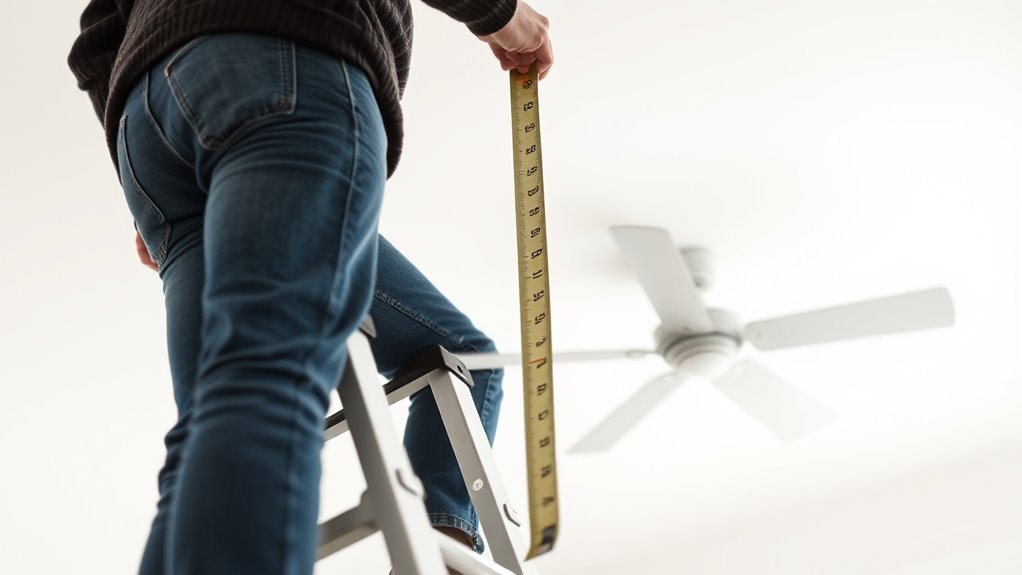
Determining the correct ceiling height for a fan begins with precise measurement, guaranteeing both safety and ideal airflow. The first step is to locate the highest point of your ceiling, whether it’s a flat surface or a vaulted ceiling with varying heights. Use a sturdy ladder or a tall measuring tape to reach the highest point comfortably. When measuring, keep your eye level aligned with the tape or measuring device to avoid parallax errors that could skew your results. It’s essential to record this measurement accurately because it serves as the foundation for selecting the right fan size and mounting style.
Start by accurately measuring the highest point of your ceiling for safe, effective fan installation.
Next, measure from the floor to the point where you plan to install the fan. Typically, a standard ceiling height is around 8 feet, but many homes feature higher ceilings, which require a different approach. For vaulted or cathedral ceilings, identify the lowest point where the fan will hang, ensuring you account for any slopes or angles. Use a measuring tape stretched taut and held steady to avoid sagging or inaccuracies. It’s helpful to mark this point with a piece of painter’s tape or chalk so you can consistently reference it during your calculations.
Once you’ve established these two key measurements—the height from the floor to the ceiling and from the floor to the fan mounting point—you can determine the appropriate fan size and style. For standard 8-foot ceilings, a flush mount fan, which sits directly against the ceiling, is usually suitable. If your ceiling height exceeds 8 feet, especially over 9 or 10 feet, you’ll want a downrod to extend the fan’s mounting point downward. Measure the desired clearance between the fan blades and the floor, generally aiming for about 8 to 9 feet for ideal airflow and safety. For vaulted ceilings, measure the slope to determine the best mounting angle and consider installing a slope adapter if necessary.
Throughout this process, pay close attention to details. Use a level to ensure your measurements are accurate and the fan will hang straight. Double-check all measurements before purchasing, as even a small discrepancy can impact the fan’s performance and safety. Remember, the goal is to achieve a balance: the fan should be high enough to avoid any head-bumping hazards but low enough to circulate air effectively. Precise measurement not only guarantees safety but also enhances the aesthetic appeal, as your fan will hang perfectly aligned, complementing your room’s architectural features. Interestingly, recent advancements in AI-driven tools can assist in precise measurements and installation planning, making the process even more efficient. The effort you put into careful measurement ultimately results in a comfortable, well-ventilated space that looks as good as it functions.

Sosation 6 Pcs Square Plastic Flat Blank Plate Wall Hole Cover Ceiling Cover Plate with 48 Pcs Double Faced Adhesive Tape for Ceilings or Wall (5 Inch)
Thoughtful Combination: package consists of 6 pieces of ceiling cover plates in white, also comes with 48 pieces…
As an affiliate, we earn on qualifying purchases.
As an affiliate, we earn on qualifying purchases.
Frequently Asked Questions
Can I Install a Fan on a Sloped Ceiling?
Yes, you can install a fan on a sloped ceiling. Use a sloped ceiling fan with an adjustable hanging angle to guarantee proper airflow. You’ll want a downrod that matches your ceiling’s pitch for ideal positioning. Carefully follow the installation instructions, making sure the fan remains balanced and secure. With the right fan and setup, you’ll enjoy efficient cooling and a sleek look that complements your space’s unique architectural angle.
How Does Ceiling Height Affect Fan Blade Length?
Ceiling height directly influences your fan blade length, as taller ceilings require longer blades for effective airflow, while lower ceilings need shorter blades to prevent obstruction. You should select blades that extend approximately 10-12 inches below the ceiling, ensuring ideal circulation without hitting the floor or walls. Consider the room’s proportions and your aesthetic preference, balancing form and function to create a harmonious, airy atmosphere.
What Safety Precautions Are Needed for High Ceilings?
When working with high ceilings, safety comes first. You should guarantee your ladder is sturdy and tall enough, and always have someone hold it steady. Use secure hooks or anchors for hanging fixtures, and double-check the weight limits of your tools. Wear protective gear like gloves and goggles, and turn off the power before working. Remember, safety isn’t a gamble; it’s the foundation of a job well done.
Is There a Difference in Mounting for Vaulted Ceilings?
Yes, mounting a fan on vaulted ceilings requires a specialized angled or sloped ceiling mount. You’ll need an adjustable or longer downrod to guarantee the fan hangs correctly and maintains ideal airflow. Position the fan at the appropriate height, typically 8-9 feet from the floor, and ensure it’s securely anchored to support the angle. This approach guarantees both safety and aesthetic harmony in your vaulted space.
How Do I Measure Ceiling Height Accurately in Irregular Spaces?
To tackle tricky, twisting spaces, take a tape measure, and start from a fixed point like the floor or a stable surface. Stretch the tape to the highest point, marking irregularities along the way, and note these nuances. For uneven ceilings, use a laser or a plumb line to pinpoint precise heights at multiple points. By carefully capturing each contour, you guarantee your fan fits perfectly and functions flawlessly.
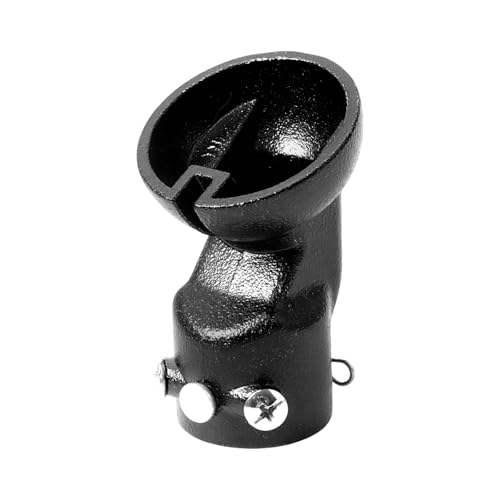
TEBTEOTEK Universal Sloped Ceiling Fan Adapter for Angled Ceiling Up to 45° (Black)
Slope Angeled (0°-45°): Install on various ceiling angles, from flat surfaces up to 45-degree slopes.
As an affiliate, we earn on qualifying purchases.
As an affiliate, we earn on qualifying purchases.
Conclusion
Remember, measuring accurately and matching fans meticulously makes your space both functional and fabulous. By balancing height and harmony, you guarantee every breeze feels beautiful and beneficial. Precision paves the path to perfect airflow, fostering comfort and creating a mesmerizing, cozy ambiance. So, take your time, trust your tools, and tune your technique—transforming your ceiling space into a seamless symphony of style and serenity. Small steps, significant serenity—your ideal fan awaits.

Laser Measure Device, MiLESEEY 229ft Digital Laser Tape Measure with Upgrade Electronic Angle Sensor, 2mm Accuracy, Area Measurement,Volume and Pythagoras, 2" LCD Backlit,Mute, Battery Included
[Reliable and Efficient] Upgraded electronic level with accuracy up to +/-0.3°and laser tape measure with accuracy up to…
As an affiliate, we earn on qualifying purchases.
As an affiliate, we earn on qualifying purchases.

Amico Ceiling Fans with Lights, 42 inch Low Profile Ceiling fan with Light and Remote Control, Flush Mount, Reversible, 3CCT, Dimmable, Noiseless, Black Ceiling Fan for Bedroom, Indoor/Outdoor Use
Ceiling Fan with Light: Decorate your home with Amico ceiling fan! While bringing you coolness and comfort, it…
As an affiliate, we earn on qualifying purchases.
As an affiliate, we earn on qualifying purchases.