
When comparing control protocols like Zigbee, Z-Wave, and Wi-Fi, you find that Zigbee uses IEEE 802.15.4 with mesh topology and CSMA/CA for efficient low-power communication. Z-Wave operates on a dedicated sub-GHz band with a simple, reliable mesh network and a time-slotted protocol for predictable latency. Wi-Fi relies on IEEE 802.11 standards with higher throughput but more power consumption. Understanding these differences helps optimize device network design—if you explore further, you’ll uncover deeper insights.
Key Takeaways
- Zigbee uses IEEE 802.15.4 with mesh topology and CSMA/CA, optimizing for low power and scalability.
- Z-Wave operates at 908.42 MHz with a mesh network, focusing on reliability, simplicity, and command-based control.
- Wi-Fi relies on IEEE 802.11 standards with star or mesh topologies, offering higher throughput but increased power consumption.
- Z-Wave’s time-slotted protocol provides predictable latency, while Zigbee’s contention-based method may cause delays under heavy load.
- Zigbee and Z-Wave excel in home automation with mesh networks for fault tolerance, whereas Wi-Fi prioritizes higher data rates.
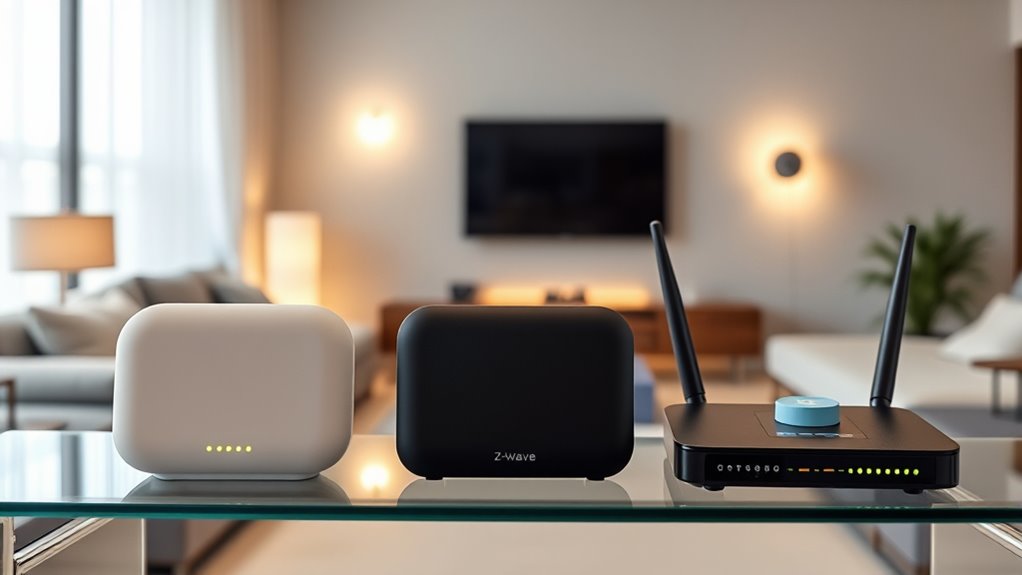
How do different control protocols impact system stability and efficiency? When evaluating protocols like Zigbee, Z-Wave, and Wi-Fi, it’s essential to understand their core communication mechanisms, network topologies, and how these factors influence overall system robustness and throughput. Zigbee employs a mesh network topology based on the IEEE 802.15.4 standard, which enhances fault tolerance and scalability. Its low-power operation minimizes energy consumption, making it ideal for battery-operated devices, but this comes with trade-offs in data throughput and latency. Zigbee’s reliance on a contention-based CSMA/CA (Carrier Sense Multiple Access with Collision Avoidance) protocol can introduce delays under high network load, impacting real-time responsiveness.
In contrast, Z-Wave operates on a dedicated sub-GHz frequency (908.42 MHz in the US), which provides better signal penetration and reduced interference in crowded RF environments. Its network architecture is mostly a mesh, similar to Zigbee, but with a focus on simplicity and reliability for home automation systems. Z-Wave’s protocol features a lower data rate compared to Zigbee—around 100 kbps—yet this suffices for typical command-and-control applications. Its time-slotted communication approach ensures predictable latency, contributing to system stability, especially when multiple devices communicate simultaneously. The protocol’s built-in security and straightforward implementation reduce potential points of failure, enhancing overall reliability. Additionally, understanding store hours can be crucial for planning maintenance or support visits to ensure systems operate smoothly.
Zigbee smart home hub
As an affiliate, we earn on qualifying purchases.
As an affiliate, we earn on qualifying purchases.
Frequently Asked Questions
Which Protocol Offers the Best Security Features for Smart Home Devices?
Zigbee generally offers the most effective security features for smart home devices, utilizing AES-128 encryption, secure key exchange, and robust network authentication. Z-Wave also provides strong security with S2 security framework, including encrypted communication. Wi-Fi‘s security depends on WPA3 encryption, but it’s more vulnerable due to broader exposure and higher attack surface. For ideal security, Zigbee‘s layered encryption and strict device authentication give it a slight edge over Z-Wave and Wi-Fi.
How Do These Protocols Impact Battery Life in Connected Devices?
You’ll notice that Zigbee and Z-Wave are designed for low power consumption, extending battery life considerably, especially in battery-operated sensors and remotes. Zigbee’s mesh network reduces transmission power with efficient routing, while Z-Wave’s optimized protocol minimizes energy use. Conversely, Wi-Fi demands more power due to higher data rates and constant connectivity, rapidly draining batteries. As a result, choosing Zigbee or Z-Wave benefits battery longevity in your smart devices.
Can These Protocols Be Integrated Easily With Existing Home Automation Systems?
You can integrate these protocols with existing home automation systems, but ease varies. Zigbee and Z-Wave typically require compatible hubs or gateways, which may involve configuration and network updates. Wi-Fi offers direct integration with standard routers and smart devices, simplifying setup. Industry-standard APIs and compatibility layers facilitate smoother integration, yet proprietary ecosystems or firmware limitations could pose challenges, especially with older or less common devices.
What Is the Typical Range of Each Control Protocol in Residential Settings?
Zigbee typically offers a range of about 10-20 meters indoors, Z-Wave extends slightly further at around 30 meters, while Wi-Fi generally covers 30-50 meters in residential environments. Visualize Zigbee’s compact footprint versus Z-Wave’s broader reach and Wi-Fi’s extensive coverage, reflecting their intended applications. These ranges influence network topology, device placement, and signal reliability, making your choice essential for seamless home automation integration and consistent device communication.
How Do These Protocols Handle Network Congestion and Interference?
You’ll find Zigbee and Z-Wave optimize mesh networking, rerouting data dynamically to avoid congestion and interference, while Wi-Fi relies on congestion management techniques like CSMA/CA. Zigbee’s lower data rates reduce channel contention, but both protocols may experience latency under high traffic. Wi-Fi’s bandwidth prioritization and channel selection help mitigate interference, yet it’s more susceptible to congestion in dense environments. Overall, Zigbee and Z-Wave excel in low-power, crowded scenarios.
Z-Wave home automation devices
As an affiliate, we earn on qualifying purchases.
As an affiliate, we earn on qualifying purchases.
Conclusion
Ultimately, selecting the right control protocol depends on your specific needs and network environment. Zigbee offers low power consumption and scalability, Z-Wave provides reliable mesh networking for smart homes, and Wi-Fi delivers high bandwidth for multimedia integration. Keep in mind, each protocol has its strengths and weaknesses—no one-size-fits-all solution. It’s essential to weigh these factors carefully; otherwise, you might find yourself chasing your tail. Choosing wisely guarantees your smart ecosystem operates seamlessly and efficiently.
Wi-Fi mesh network extender
As an affiliate, we earn on qualifying purchases.
As an affiliate, we earn on qualifying purchases.
smart home security Zigbee Z-Wave
As an affiliate, we earn on qualifying purchases.
As an affiliate, we earn on qualifying purchases.