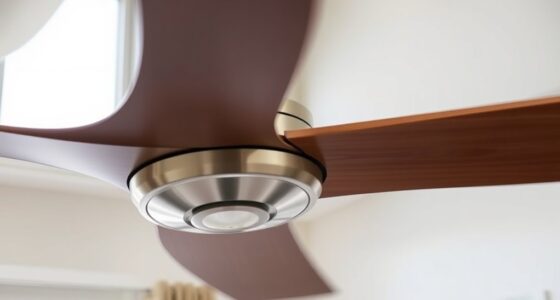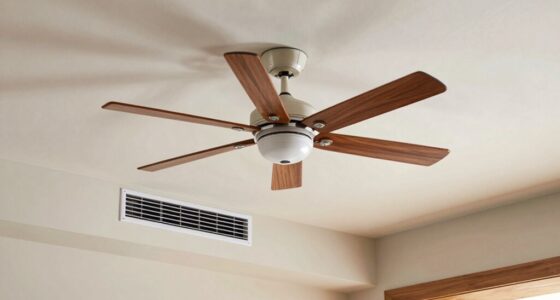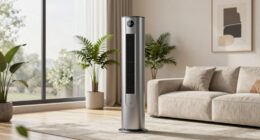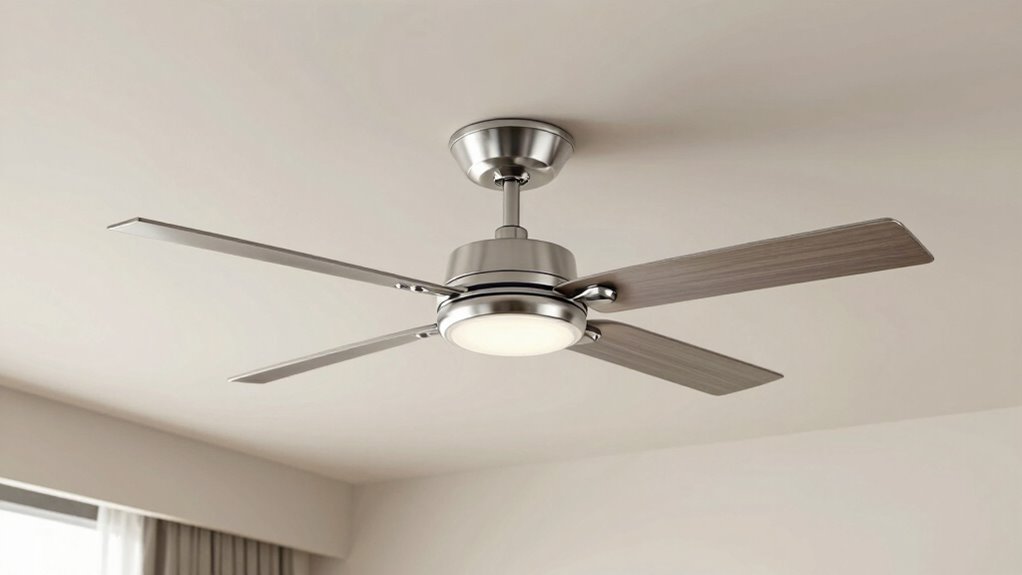

To improve efficiency, follow the centering rule by placing your ceiling fan in the room’s middle or near the midpoint of the ceiling. This position promotes even air circulation, helping prevent hot or cold spots and supporting your HVAC system. Proper placement reduces energy use and keeps your space comfortable. If you want to discover more tips on optimizing airflow and energy savings, keep exploring how the right fan positioning makes a difference.
Key Takeaways
- Place ceiling fans at the room’s center or near the midpoint of the ceiling for optimal airflow.
- Central positioning helps distribute cooled or heated air evenly, reducing hot or cold spots.
- Proper fan placement supports seasonal changes: clockwise in winter, counterclockwise in summer.
- Avoid placing fans near walls or furniture that obstruct airflow, ensuring efficiency.
- Well-centered fans prevent overworking HVAC systems, lowering energy bills and increasing comfort.

Proper fan placement can markedly boost your home’s energy efficiency and comfort. When you position your fans correctly, you ensure better airflow optimization, which helps distribute cooled or heated air more evenly throughout your space. This leads to a more balanced indoor climate and can prevent overworking your HVAC system. This means your HVAC system doesn’t have to work as hard, leading to lower energy bills and a more consistent indoor temperature. Additionally, strategic placement can significantly reduce noise, making your environment quieter and more relaxing.
To achieve ideal airflow, start by placing ceiling fans at the center of the room or slightly closer to the ceiling’s midpoint. This central positioning allows the fan to circulate air effectively across the entire space, preventing hot or cold spots. When airflow is optimized, you’ll notice a more uniform temperature distribution, which can help your HVAC system operate efficiently and reduce overall energy consumption. Keep in mind that blades should spin clockwise in winter to push warm air down and counterclockwise in summer to create a cooling breeze. Proper orientation ensures the fan complements your seasonal heating and cooling needs.
For floor and table fans, positioning them near windows or doorways can draw in fresh air or push stagnant air out, further enhancing airflow optimization. Place these fans at an angle that directs air across the room rather than directly at occupants, which helps minimize drafts and noise. When fans are correctly oriented, they work more quietly and efficiently, contributing to noise reduction. Avoid placing fans too close to walls or furniture, as obstructions hinder airflow and can increase operational noise, defeating the purpose of quiet comfort.
Another key to effective fan placement is avoiding interference with other appliances or fixtures that may cause vibrations or additional noise. Ensure fans are on stable surfaces and not obstructed by curtains or objects that could rattle or shake. This not only maintains noise reduction but also ensures steady performance. If you’re using multiple fans, coordinate their placement to prevent overlapping airflow that could create turbulent air currents, which are less efficient and noisier. Paying attention to proper placement can significantly boost energy savings and comfort in your home.

52 inch Ceiling Fans with Lights and Remote, Brushed Nickel Ceiling Fan, 6 Speed Reversible, 3CCT, Dimmable, Noiseless, 3 Blades, Quiet DC Motor, Silver Ceiling Fan for Bedroom, Indoor and Outdoor
Brushed Nickel Ceiling Fans with Lights and Remote Control: The silver ceiling fan comes equipped with a convenient…
As an affiliate, we earn on qualifying purchases.
As an affiliate, we earn on qualifying purchases.
Frequently Asked Questions
How Do I Determine the Perfect Fan Placement for My Room?
To determine the perfect fan placement for airflow optimization, position your fan at a height where it can circulate air evenly across the room. Usually, placing the fan at eye level or slightly higher works best. Make sure it’s centered in the space to prevent uneven airflow. Adjust the angle to direct air downward or upward, depending on the season, ensuring maximum comfort and efficiency.
Can Incorrect Fan Placement Cause Higher Energy Bills?
Incorrect fan placement can skyrocket your energy bills like a rocket to the moon! Poor airflow optimization causes your HVAC system to work harder, wasting energy and driving up costs. When fans aren’t properly centered or positioned, rooms don’t cool or heat evenly, forcing your system to overcompensate. To save money, make sure your fans are correctly placed to promote efficient airflow and maximize energy savings.
What Types of Fans Are Best Suited for Optimal Placement?
You should choose fans with adjustable fan blade types, like oscillating or multi-blade designs, for best placement. Portable fans are ideal because you can position them where airflow is most needed, ensuring your space stays comfortable and energy-efficient. Look for models with flexible mounting options and directional airflow to maximize their effectiveness. Properly placed portable fans with the right blade types help circulate air efficiently, reducing energy costs.
How Often Should I Adjust Fan Placement for Seasonal Changes?
You should check and adjust your fan placement seasonally, roughly every three to six months. Regular fan maintenance keeps air circulation ideal, ensuring your HVAC system runs efficiently year-round. As temperatures shift, reposition fans to promote even airflow, prevent hot or cold spots, and maintain comfort. Think of it as tuning a musical instrument—small adjustments make a big difference in air quality and energy savings, keeping your home cozy and efficient through every season.
Does Ceiling Height Affect the Fan Centering Rule Effectiveness?
Yes, ceiling height affects the fan centering rule’s effectiveness because it influences airflow dynamics. In taller ceilings, you should position fans higher and guarantee they move air more evenly across the space. This prevents stagnant air pockets and improves circulation. Adjust your fan placement accordingly, considering the height, to optimize airflow and energy efficiency, ensuring proper circulation in rooms with varying ceiling heights.
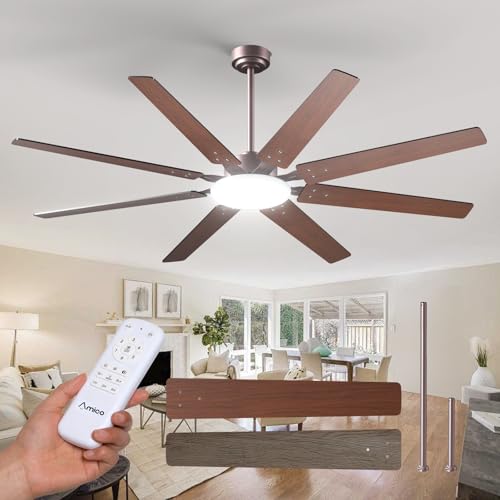
Amico 72 inch Farmhouse Bronze Ceiling Fan with Light, Large Energy Efficient Ceiling Fans with Remote, Reversible DC Motor, Dimmable 3CCT LED, Quiet Indoor/Outdoor for Living Room, Bedroom, Patio
Ceiling Fan with Light: Decorate your home with Amico ceiling fan! While bringing you coolness and comfort, it…
As an affiliate, we earn on qualifying purchases.
As an affiliate, we earn on qualifying purchases.
Conclusion
By following the centering rule for fan placement, you’re not just optimizing efficiency—you’re challenging the idea that more effort always equals better results. When you put the fan in the right spot, it’s like revealing hidden energy within your space. Believe in this simple truth: smart placement can transform your comfort and save you money. Don’t underestimate the power of a well-placed fan—sometimes, the smallest change makes the biggest difference.

LEVOIT Tower Fan for Bedroom, 90° Oscillating Standing Fan with 28dB Quiet for Sleep, 25ft/s Velocity, 12H Timer, 5 Speeds 4 Modes, Remoter, Bladeless Room Fan for Home, Office, Indoor, 36 inch, White
𝙎𝙖𝙮 𝙂𝙤𝙤𝙙𝙗𝙮𝙚 𝙩𝙤 𝙏𝙧𝙖𝙙𝙞𝙩𝙞𝙤𝙣𝙖𝙡 𝙁𝙖𝙣𝙨: Our innovative airflow design combines a curved air inlet and unique multi-blade design,…
As an affiliate, we earn on qualifying purchases.
As an affiliate, we earn on qualifying purchases.

Amazon Basics Air Circulator Desk Fan for Bedroom, Home and Office, 90-Degree Tilt Head, 3 Speed Settings, Cooling, 35 Watts, Black, 11.1"W x 6.3"D x 10.9"H
COMPACT DESIGN: Measuring just 6.3 x 11.1 x 10.9 inches (LxWxH) with three 7-inch blades, this fan occupies…
As an affiliate, we earn on qualifying purchases.
As an affiliate, we earn on qualifying purchases.