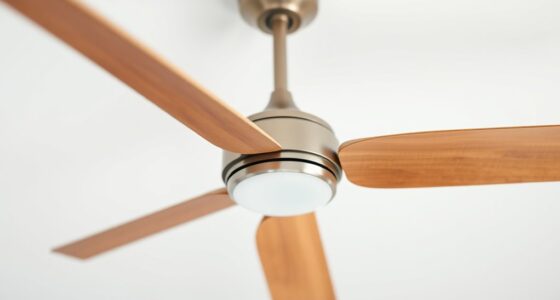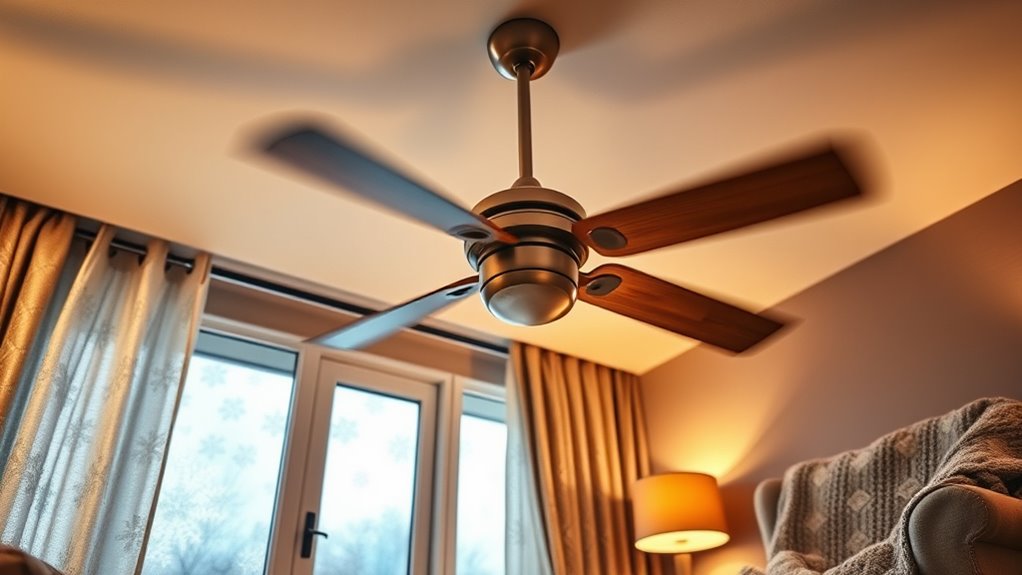

In winter, set your ceiling fan to rotate clockwise at low speed to promote heat circulation. This reverses airflow, pulling warm air upward and redistributing it along the ceiling and walls, reducing cold spots. Make certain your fan is installed at the correct height and blades are properly pitched for effective airflow. Regularly clean and balance the blades to prevent turbulence. Properly using your fan can improve comfort and energy efficiency—continue exploring to optimize your setup.

Get home appliances delivered free — and shop member deals
- Fast, free delivery on millions of items
- Access to Prime Big Deal Days deals on October 6–7
- Prime Video, Amazon Music and more included
Key Takeaways
- Set the ceiling fan to rotate clockwise at low speed to push warm air downward.
- Ensure the fan is installed at 8-9 feet height for optimal heat circulation.
- Use the fan near heat sources or vents to enhance room-wide heat distribution.
- Regularly clean and balance blades to maintain efficient, quiet operation.
- Combine fan use with your heating system to improve energy efficiency and maintain consistent warmth.
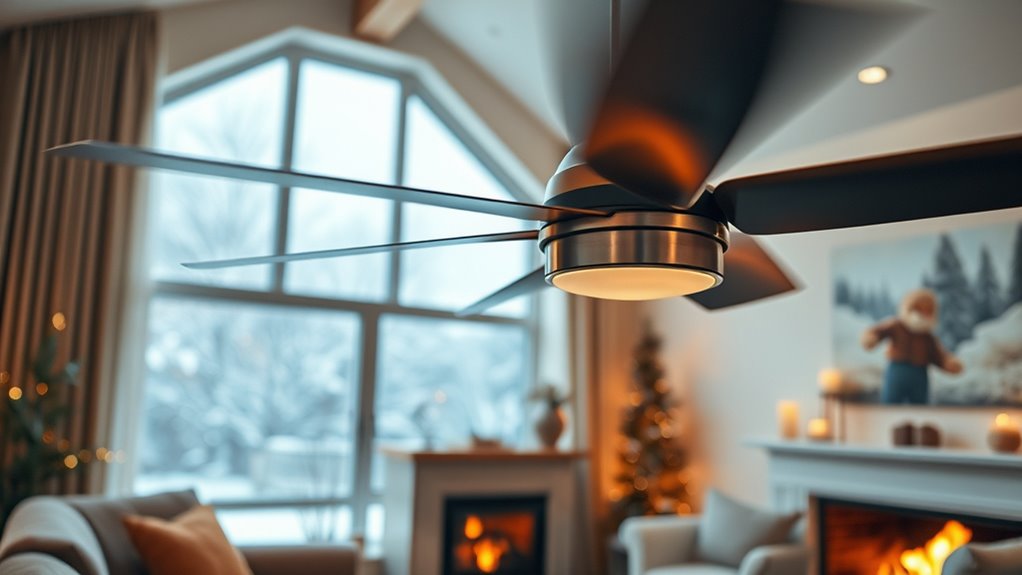
While ceiling fans are commonly associated with summer cooling, they can also be effective during winter months when used correctly. To maximize their performance in colder weather, you must understand the fundamental mechanics of airflow and how to adjust the fan’s operation accordingly. Most ceiling fans are designed with reversible motors, allowing you to switch the rotation direction between forward and reverse. In winter, you should set the fan to rotate clockwise at a low speed. This configuration, often referred to as the “winter mode,” pulls cool air upward while pushing warm air downward along the walls and ceiling, promoting better heat circulation within the room.
Set ceiling fan to clockwise at low speed to circulate warm air during winter.
The precise effect of this setting depends on the fan’s blade pitch and size, which influence airflow direction and volume. When you operate the fan in reverse, the blades should be angled so that the airflow is directed upward. This prevents the fan from creating a cooling breeze, which would be counterproductive in winter, and instead encourages the redistribution of warm air trapped near the ceiling. The goal is to create a gentle, continuous upward airflow that pushes warm air down along the walls and into living spaces. This process can reduce the workload on your heating system, leading to energy savings and consistent room temperatures. Additionally, airflow patterns can be optimized by adjusting the fan’s speed and direction to suit specific room layouts.
Proper installation height and blade angle are critical for achieving effective winter operation. The fan should be installed at a height that allows for ideal airflow—typically 8 to 9 feet from the floor—ensuring that the airflow pattern effectively circulates warm air without creating drafts or excessive noise. Additionally, the blade pitch should be sufficient to produce a significant airflow at low speeds without causing turbulence or vibrations. Regular maintenance, including cleaning dust and debris from the blades, is essential to maintain precise airflow patterns and prevent unbalanced operation.
Furthermore, you should evaluate the room’s layout and heat sources when using the fan in winter. Strategically placing the fan to enhance natural convection currents amplifies its effectiveness. For example, positioning the fan near a heat source or vent can help distribute warm air evenly across the space. When used correctly, a ceiling fan can complement your heating system by improving air circulation, reducing cold spots, and maintaining a more uniform temperature profile. This efficient use of airflow reduces the need for higher thermostat settings, ultimately conserving energy and lowering utility costs.
reversible ceiling fan for winter
As an affiliate, we earn on qualifying purchases.
As an affiliate, we earn on qualifying purchases.
Frequently Asked Questions
Can Ceiling Fans Help Reduce Heating Costs in Winter?
Ceiling fans can help reduce your heating costs in winter when used correctly. By reversing the fan’s rotation to clockwise at a low speed, you create an updraft that redistributes warm air trapped near the ceiling throughout the room. This process improves overall heat circulation, allowing you to lower your thermostat without sacrificing comfort. Properly utilizing ceiling fans in this manner optimizes energy efficiency and minimizes heating expenses.
How Should I Adjust My Fan’s Speed for Winter Use?
Think of your fan’s speed as the thermostat’s silent partner. In winter, you should set the fan to a low or medium speed, ideally running clockwise. This creates a gentle updraft, redistributing warm air trapped near the ceiling. Adjust the speed gradually; too fast, and you risk creating drafts that counteract heating efficiency. Precise control guarantees the best warmth without unnecessary energy consumption, maximizing your home’s comfort and savings.
Is It Necessary to Reverse Fan Direction in Winter?
Yes, reversing your fan direction in winter is necessary to optimize heating efficiency. Set your ceiling fan to rotate clockwise at a low speed to create an updraft, which pushes warm air near the ceiling down into the living space. This circulation helps maintain consistent temperatures, reduces heating costs, and improves comfort. Always verify your fan’s direction setting before winter use to guarantee proper airflow and energy savings.
Do Different Fan Models Operate Better in Cold Weather?
Different fan models do operate better in cold weather, primarily due to design differences like blade pitch, motor efficiency, and adjustable speeds. You’ll find that high-quality fans with reversible motors and aerodynamic blades provide better airflow and heat redistribution. Precise performance depends on selecting a fan tailored for winter use, ensuring ideal operation. Choosing the right model enhances energy efficiency, maximizes warmth, and maintains comfort through meticulous technical tuning.
Can Ceiling Fans Be Used Effectively in Poorly Insulated Rooms?
Yes, ceiling fans can be effective in poorly insulated rooms if used correctly. Set the fan to run clockwise at a low speed to create gentle upward airflow, which redistributes warm air trapped near the ceiling. This prevents stratification, improving overall comfort. Make certain the fan blades are clean and properly balanced for best performance. Using fans in this manner maximizes heat circulation, reducing heating costs and enhancing comfort in inadequately insulated spaces.
Conclusion
By harnessing your ceiling fan’s reverse function, you create a thermal chimney that pulls warm air down from the ceiling, like a skilled conductor guiding an orchestra. This efficient circulation ensures even heat distribution, reducing energy waste and keeping your space comfortable. Think of it as fine-tuning a complex machine—precise adjustments lead to peak performance. Mastering this simple switch transforms your fan into an invisible force, subtly but powerfully enhancing your winter comfort.
Halloween Picks
halloween
As an affiliate, we earn on qualifying purchases.